FoodTimeline library
The first pies were very simple and generally of the savory (meat and cheese) kind. Flaky pastry fruit-filled turnovers appeared in the early 19th century. Some pie-type foods are made for individual consumption. These portable pies... pasties, turnovers, empanadas, pierogi, calzones...were enjoyed by working classes and sold by street vendors. Pie variations (cobblers, slumps, grunts, etc.) are endless!
How old is "pie?"
The Oxford English Dictionary traces the first use of the word "pie" as it relates to
food to 1303, noting the word was well-known and popular by 1362.
Why call it "pie?"
"Pie...a word whose meaning has evolved in the course of many centuries and which varies to
some extent according to the country or even to region....The derivation of the word may be
from magpie, shortened to pie. The explanation offered in favour or this is that the magpie
collects a variety of things, and that it was an essential feature of early pies that they contained a
variety of ingredients."
---The Oxford Companion to Food, Alan Davidson, 2nd edition, Tom Jaine editor [Oxford University Press:Oxford] 2006 (p.
603)
First pies
Food historians confirm ancient people made pastry. Recipes, cooking techniques, meal presence and presentations varied according to culture and cuisine. In the
cradles of civilization (Mediterranean region including Ancient Rome, Greece, Mesopotamia, Egypt and Arabia) the primary fat was olive oil. When combined with
ground grains, it produced a rudimentary type of pastry. The challenging part of researching these early pies is most of us rely on translators of
original texts. These can vary according to scholarly proficiency and educated interpretation. Moreover, there are several editions of ancient texts and recipe numbers/titles
do not always match.
Food historians confirm the ancients crafted foods approximating pie. Modern pie, as we Americans know it today, descends from Medieval European ingredients (fat=suet, lard, butter) and technology (pie plates, freestanding pies, tiny tarts).
"The idea of enclosing meat inside a sort of pastry made from flour and oil originated in ancient Rome, but it was the northern
European use of lard and butter to make a pastry shell that could be rolled out and moulded that led to the advent of true pie."
---An A-Z of Food & Drink, John Ayto [Oxford University Press:Oxford] 2002 (p. 254)
"If the basic concept of 'a pie' is taken to mean a mixture of ingredients encased and cooked in pastry, then proto-pies were made
in the classical world and pies certainly figured in early Arab cookery. But those were flat affairs, since olive oil was used as
the fat in the pastry and will not produce upstanding pies; pastry made with olive oil is 'weak' and readily slumps."
---Oxford Companion to Food, Alan Davidson, 2nd edition, Tom Jaine editor [Oxford University Press:Oxford] 2006 (p. 603)
Ancient Roman recipes
"[287] [Baked picnic] Ham [Pork Shoulder, fresh or cured] Pernam
The hams should be braised with a good number of figs and some three laurel leaves; the skin is then pulled off and cut into square
pieces; these are macerated with honey. Thereupon make dough crumbs of flour and oil. [1] Lay the dough over or around the ham, stud the top with
the pieces of the skin so that they will be baked with the dough [bake slowly] and when done, retire from the oven and serve. [2]"
---Apicius, Book VII, IX, Apicius: Cookery and Dining in Imperial Rome, edited and translated by Joseph Dommers
Vehling, facsimile 1936 edition [Dover Publications:Mineola NY] 1977 (p. 169)
[NOTES (appended to this recipe: [1] Ordinary pie or pastry dough, or perhaps a preparation similar to streusel, unsweetened.
[2] Experimenting with this formula, we have adhered to the instructions as closely as possible, using regular pie dough to envelope
the parboiled meat. The figs were retired from the sauce pan long before the meat was done and they were served around the ham as a
garnish.]
Compare with this Latin text, English translation and modern instructions:
"Pernam, ubi eam cum caricis plurimis elixa veris et tribus lauri foliis, detracta cute tessellatim indicis et melle complebis. Deinde
farinam oleo subactam contexes et ei corium reddis et cum farina cocta fuerit, eximas furno ut est et inferes."
Boil the ham with a large number of dried figs and 3 bay leaves. Remove the skin and make diagonal incisions into the meat. Pour in
honey. Then make a dough of oil and flour and wrap the ham in it. Take it out of the oven when the dough is cooked and serve.
(Ap. 393)...
"Cover the base of a pan, large enough to take the ham, with figs and lay the ham, stuffed with figs, on top. Fill the pan with water,
and add 3 bay leaves. Cover, and boil the ham for 1 hour over a low heat. In the meantime make the pastry...When the ham is cooked, dry it well and
make incisions all over the flesh. Baste it with honey while it cooks. Then wrap it in the dough and decorate it. Preheat the oven to
200 C/400 F/Gas 6, and bake for 30 minutes until the crust is golden. leave to cool." (p. 268)
"Pastry dough: Roman pastry dough was made with lard or olive oil rather than butter. Use double the weight of fat in flour. Spelt flour needs rather less
fat than wheat flour. Rub the fat into the flour until it resembles breadcrumbs. Pour in a little salted water and press the
crumbs into a ball. Leave in a cool place for several hours. Then roll it into a sheet on a marble surface dusted with flour, and use as the recipe
requires." (p. 195)
---Around the Roman Table: Food and Feasting in Ancient Rome, Patrick Faas [Palgrave MacMillan:New York] 2003
?
Cato's Layered cheesecake has pastry bottom crust.
Mesopotamia
"Mersu (Date and Pistachio Pastry). Mersu was a widely known pastry. Different inventories list different ingredients for
mersu, so there were many recipes. mersu always seemed to contain first-quality dates and butter; beyond that, different records list
pistachios, garlic, onion seed, and other seemingly incongruous ingredients. Bakers who specialized in this treat were known as the
episat mersi, so mersu-making was probably an involved and respected process."
---Cooking in Ancient Civilizations, Cathy K. Kaufman [Greenwood Press:Westport CT] 2006 (p. 31)
[NOTE: Modernized recipe follows (p. 31-32). Finished product wraps dough around filling, free form, not in a pie dish.]
Medieval European pies
There is some controversy whether the pastry crust used in Medieval times was meant for eating or as a cooking receptacle.
The answer is both. A careful examination of these early recipes reveals crust purpose.
"Originally pies contained various assortments of meat and fish, and fruit pies do not appear until the late sixteenth century...pies
could be open as well as having a crust on top."
---An A-Z of Food and Drink, John Ayto [Oxford University Press:Oxford] 2002 (p. 254)
American pies
"As a favored dish of the English, pies were baked in America as soon as the early settlers set up
housekeeping on dry land. Beyond mere preference, howevers, there was a practical reason for
making pies, especially in the harsh and primitive conditions endured by the first colonists. A
piecrust used less flour than bread and did not require anything as complicated as a brick oven for
baking. More important, though, was how pies could stretch even the most meager provisions
into sustaining a few more hungry mouths...No one, least of all the early settlers, would probably
proclaim their early pies as masterpieces of culinary delight. The crusts were often heavy,
composed of some form of rough flour mixed with suet."
---Oxford Encyclopedia of Food and Drink in America, Andrew F. Smith editor [Oxford
University Press:New York] 2004 (p. 272)
"Small sweet cakes eaten by the ancient Egyptians may well have included types using pastry.
With their fine flour, oils, and honey they had the materials, and with their professional bakers
they had the skills. In the plays of Aristophenes (5th century BC) there are mentions of
sweetmeats including small pastries filled with fruit. Nothing is known of the actual pastry used,
but the Greeks certainly recognized the trade of pastry-cook as distinct from that of baker. The
Romans made a plain pastry of flour, oil, and water to cover meats and fowls which were baked,
thus keeping in the juices. (The covering was not meant to be eaten; it filled the role of what was
later called puff paste') A richer pastry, intended to be eaten, was used to make small pasties
containing eggs or little birds which were among the minor items served at banquets....In
Medieval Northern Europe the usual cooking fats were lard and butter, which--especially
lard--were conducive to making stiff pastry and permitted development of the solid, upright case
of the raised pie...No medieval cookery books give detailed instructions on how to make pastry;
they assume the necessary knowledge...Not all Medieval pastry was coarse. Small tarts would be
made with a rich pastry of fine white flour, butter, sugar, saffron, and other good things, certainly
meant to be eaten. From the middle of the 16th century on, actual recipes for pastry begin to
appear. ..The first recipe for something recognizable as puff pastry is in Dawson [The Good
Housewife's Jewell, London]...1596."
---Oxford Companion to Food, Alan Davidson [Oxford University Press:Oxford] 1999 (p.
586-7).
"Greek pistores had mastered the art of giving their bread the most extravagant forms, shaping it
like mushrooms, braids, crescents, and so on...thus illustrating in advance Careme's observation a
thousand years later: "The fine arts are five in number, namely: painting, sculpture, poetry, music
and architecture, the principal branch of the latter being pastry." And since it is not possible for us
to discuss flour without dealing with cakes, the moment has come to pose the question of what
pastry consisted of in antiquity, what it looked like and how it was made. The regrettable loss of
the great Treatise on Baking, by Chrysippus of Tyranus, which included detailed reicpes
for more than thirty cakes, each entirely different, leaves us somewhat short of information on this
important subject. But various cross-checks (not to mention the consulation of Apicius)
nonetheless give us a rather good idea of what the ancient Greeks and Romans confected in this
domain...the makers of Greco-Roman pastry had no knowledge of the subleties of dough, and
thus having nothing like our present-day babas, doughnuts, bioches, savarins, creampuffs,
millefeuille pastry, pastry made from raised dough or shortbreads...as a general rule, Greek pastry
closely resembled the sort that is still found today in North Africa, the Near East, and the Balkans:
the basic mixture was honey, oil, and flour, plus various aromatic substances, notably pepper. The
most frequent method of cooking was frying, but pastry was also cooked beneath coals. Other
ingredients included pine nuts, walnuts, dates, almonds, and poppy seeds. This mixture was
mainly baked in the form of thin round cakes and in the form doughnuts and fritters...Roman
pastry does not appear to have included many innovations over and above what the Greeks had
already invented."
---Culture and Cuisine: A Journey Through the History of Food, Jean-Francois Revel
[Doubleday:Garden City] 1979 (p. 68-9)
Professional pastry guilds & chefs
"The bakers of France made cakes too until one day in 1440 when a specialist corporation, the
corporation of pastrycooks, deprived them of the right to do so. The pastrycooks had begun by
making pies--meat pies, fish pies...Romans had known how to make a kind flaky pastry sheet by
sheet, like modern filo pastry, but the new method of adding butter, folding and rolling meant that
the pastry would rise and form sheets as it did so. Louis XI's favourite marzipan turnovers were
made with flaky pastry...From the sixteenth century onwards convents made biscuits and
fritters to be sold in the aid of good works...Missionary nuns took their talents as pastrycooks to
the French colonies..."
"Although the Paris pastry guild did not record its first constitution until 1440, there may well
have been pastry specialties before that date. Once their guild was recognized, they began to
expand the range of their production: in addition to meat pastries and tarts, they also created
pastries out of milk, eggs, and cream, usually sweetened, such as darioles, flans, and dauphins. In
order to become a master pastry maker in Le Mans in the early sixteenth century, one had to be
able to use sugar loaves to make hypocras, a sweet, spiced wine used as an aperitif and
after-dinner drink. It was not until 1566 that the king joined the Paris cookie makers guild to that
of the pastry makers, and the two would be wedded frequently thereafter."
See also: cakes.
Frozen pie crusts?
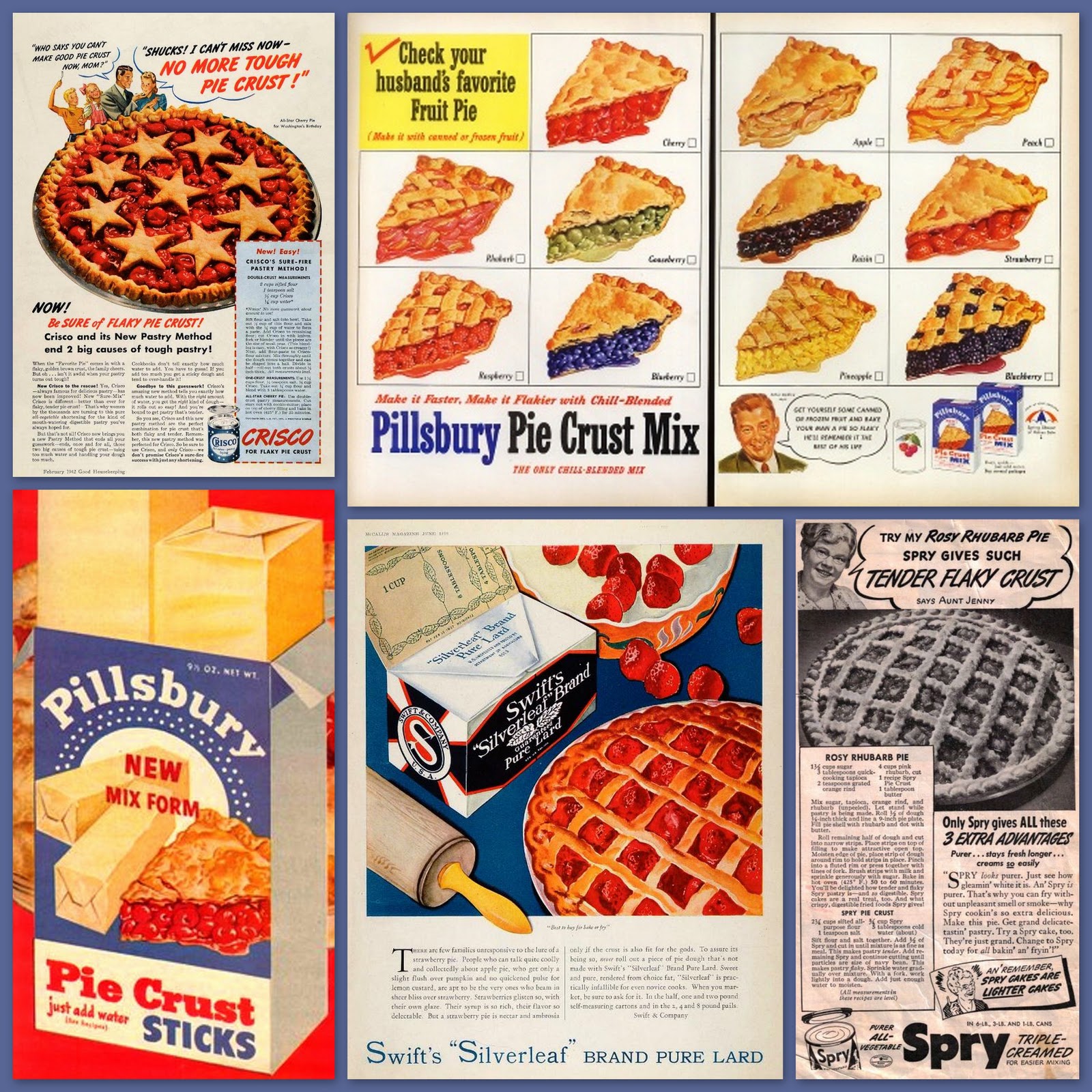
The earliest reference we find for frozen pie crust, as a stand-alone consumer retail product, appears in the mid-1950s.
In 1955, a process for making frozen pie crust (rolled) was patented. This item was packaged in roll from; not as ready-to-bake
tinned shells. This USA
patent. was filed by Billie Hamilton Armstrong [TN] on June 4, 1954 and published December 6,
1955.
Subsequent USA period ads do not describe frozen pie crusts. We have no way to know how the first frozen crusts were packaged: rolled
& destined for homemaker's own pie pans or pre-shelled "ready to fill" in disposable tins. In 1963 newspapers across America
heralded a "new" frozen pie crust sold in 9-inch tins; without referencing brand or company. The year before, two companies
rolled out new frozen pie crust products. Both were marketed to consumers in super markets. Pet-Ritz is generally credited for
introducing shelled frozen pie crust products to the American public. Oronoque Orchards [Stratford CT], a local farm stand
famous for its pies, may have actually eclipsed Pet-Ritz by a couple of months. Pet-Ritz took marketed their product nationally;
Oronoque Orchards remained local. By the mid-'60s, frozen pie shells were ubiquitous.
[1955]
"Puncture-Free Pie Crust. Frozen pie crust has to be compounded carefully so as to resist tearing and puncturing between
the time it is rolled and the time the housewife spreads it in the baking tin. Billie Hamilton Armstrong of Hohenwald, Tenn., has
found a good proportion to be about two parts "soft" flour from summer-ripening wheat and one part "hard" flour from the winter
vareity. She divides the batch into pats of about one pound each and then subdivides these into smaller bits, rolling them by
hand to sheet form. This preliminary sheet is returned to pat form and rolled in a machine into pre-formed pie crusts about
twelve to sixteen inches one-sixteenth of an inch thick. They got to the supermarket frozen, rolled in waxed paper and packed
in light cardboard. Pie crusts prepared from dough made by her method, which is protected by Patent 2,726,156, "have uniformly
superiour characteristics," Mrs. Hamilton says, "combining the essential factors for exceptional flakiness and delactable
taste."
[1956]
[1957]
[1958]
[1961]
[1962]
About Pet-Ritz:
"Betty Winton says: Now You Can Make Perfect Pies No Foolin---No Failin' with Oronoque Orchards Frozen Pie Crusts. They're perfct
when you buy them. They're perfect when you make them. At King Cole, Smirnoff's and other fine super markets."
[1963]
"Pet-Ritz...Frozen Pie Crust Shells, pkg of 2, 39 cents."
[1965]
Pie crust sticks
"Pie crust in a rectangular block--it is all ready to roll out or pat into a pan, fill and bake--is a time-saving innovation. Called Continental-style instant pie crust, it is
available for about 50 cents at the New York Exchange for Women's Work, 541 Madison Avenue. The term 'Continental' is appropriately used for this product
because the baked crust is much more crumbly and finer in consistency than the usual pastry made in this country. And that is not surprising, for the reicpe originated
in Poland. Like many another enterprising good cook, Mrs. Olgierd Langer has decided to merchandise this specialty, the recipe for which she obtained from
relatives in her native Poland. There is just enough pastry in the foil-wrapped package fora single eight-or-nine-inch pie crust. The package can be kept in the
refrigerator for several weeks."
About puff paste
"Puff paste is thought to have been perfected by the brilliant pastry chefs to the court of the dukes
of Tuscany, perhaps in the fifteenth century. From there it made its was to the royal court of
France, most likely brought by Marie de Medici."
In England, puff paste was a natural iteration of short paste. Compare these recipes:
[1596] "To make butter paste
[1615-1660] "Of puff paste.
Related foods? Choux & shortbread.
"Pies and tarts...In the Middle Ages, these sweet and savory preparations baked in a crust were
the specialty of patissiers--who had no other functions...We know that medieval cooks did not
always have ovens, and they worked with patissiers, to whom they sometimes brought fillings of
their own making for the patissier to place in a crust and bake. This explains why cookbooks
intended for professional chefs were nearly silent about the ingredients of these pastry wrappings,
but spoke only about consistency an thickness, and about the most suitable shapes...Still, medieval
cooks might take a chance and cook a simple pie or tart on their own by placing it in a shallow
pan, covered with a lid and surrounded by live embers, whose progress they had to monitor very
closely...In effect, the pastry because an oven, ensuring moderate heat thanks to its insulating
properties...So could it be that these pastry coverings were not necessarily eaten once they had
done their job of containing and protecting the fillings?"
Renaissance patissiers began experimenting with lighter, more malleable doughs. Recipes for short
paste ("short" in this case means butter) and puff paste enter
cookbooks at this time. 17th century English cook books and reveal several recipes for pie crust
and puff paste, all of varying thickness, taste and purpose. Robert May's The Accomplisht
Cook [1685] listed fourteen separate recipes for paste (pastry/pie crust/puff paste). American
cook books (The Virginia Housewife,
Mary Randoph [1828] & Directions for Cookery in its Various Branches, Miss Leslie
[1849]) contain instructions for making pies with puff paste, sometimes decorating them with cut
out pieces of this same paste. Mrs. Randolph's recipe for pumpkin pudding (pumpkin pie) states
"put a paste around the edges and in the bottom of a shallow dish or plate, pour in the mixture,
cut some thin bits of paste, twist them and lay them
across the top and bake it nicely." (University of South Carolina Press:Columbia] 1984 ( p. 154).
Mrs. Porter's New Southern Cookery Book [1879] reads: "Cranberry
tart...line your plates
with thin puff-paste, fill, lay strips of rich puff-paste across the top and bake in a moderate oven."
(p. 299). There is no illustration to show us exactly how these strips looked.
In addition to being efficient cooking receptacles, covered pies promoted preservation:
"The idea of the covered pie. The modern biscuit is a descendant of the barley bannock and the oatcake which have come down
to us from the beginning of civilization. It is a method of presering simply by reducing the water content of baked dough to such
a degree that the product is not likely to be affected by mould; this is done, with the biscuit, in such a manner as to make chewing
easy. The biscuit is thus the result of a successful fight against the dangers threatening normally fermented baked goods, mould, and
staleness. The basic idea of the covered pie is a similar one. The covered pie is of very old standing in the British Isles,
probably of longer standing than the modern biscuit. It has as a basis a similar dough to the biscuit, finely rolled out so
that it can be thoroughly baked like a crust, but not caramelized like a bread-crust. Such a crust, especially when some fat has
been added to the dough, is likely to withstand the influence of liquids and semi-liquids without becoming a sticky mess. If it is
given an open pie-dish form, it can be used for filling with semi-liquids like minced meat or fruit, the whole thing is protected
by the outer layer of the crust against certain contaminates and can be kept for quite a long time."
Apicius' recipe:
"Patissiere...Prehistoric man made sweet foods based on maple or birch syrup, wild honey, fruits,
and seeds. It is thought that the idea of cooking a cereal paste on a stone in the sun to make
pancakes began as far back in time as the Neolithic age...In the Middle Ages in France, the work
of bakers overlapped with that of the pastrycooks; bakers made gingerbread and meat, cheese,
and vegetable pies...However, it was the Crusaders who gave a decisive impetus to patisseries, by
discovering sugar cane and puff pastry in the East. This lead to pastrycooks, bakers, and
restauranteurs all claiming the same products as their own specialties, and various disputes arose
when one trade encroached upon the other...Another order, in 1440, gave the sole rights for meat,
fish, and cheese pies to patisseries, this being the first time that the word appeared. Their rights
and duties were also defined, and certain rules were established...In the 16th century, patissier
products were still quite different from the ones we know today. Choux pastry is said to have
been invented in 1540 by Popelini, Catherine de' Medici's chef, but the pastrycook's art only truly
began to develop in the 17th century and greatest innovator at the beginning of the 19th century
was indubitably [Antonin] Careme...There were about a hundred pastrycooks in Paris at the end
of the 18th century. In 1986 the count for the whole of France was over 40,000
baker-pastrycooks and 12,5000 pastrycooks."
---Larousse Gastronomique, Jenifer Harvey Lang, editor [Crown:New York] 1988 (p.
777-8)
---History of Food, Maguelonne Toussaint-Samat [Barnes & Noble Books:New York]
1992 (p.
242-244)
---Food: A Culinary History, Jean-Louis Flandrin & Massimo Montanari [Columbia
University:New York] 1999 (p.281-2)
Food historians laud Clarence Birdseye for launching the American frozen food industry. Fruits, veggies, fish
were first offerings. Other foods followed in swift progression. Swanson and Morton pioneered the frozen pie market;
concentrating savory selections [Chicken, Turkey, Beef].
"Pillsbury's Frozen Pie Crust, 2 pkgs., 35 cents."---Vidette-Messenger [Valparisio IN], February 15, 1955 (p. 16)
---"Patent on Lev Single-Cap Hatbox Brings Inquiry by Senate Group," Stacy V. Jones, New York Times, December 10, 1955 (p. 28)
"King's 2 in Pkg. Frozen Pie Crust, 35 cents."
---Blytheville Courier News [AR], December 13, 1956 (p. 20)
"Pet-Ritz Fruit Pies, frozen, ready to bake. Now you can bake your family a real fruit-country pie--a Pet-Ritz Pie with juicy,
sun-sweet fruit heaped high in a delicately tender crust, fir shiw golden butter! This very day, see why so many people say no pies
compare with Pet-Ritz Apple, cherry, peach...6 delicious fruit or berry favorites...made the traditional fruit-country way, baked
by you the new easy way!. Pet-Ritz brings the country's best to you."
---display ad, Los Angeles Times, August 22, 1957 (p. A6)
[NOTE: these pies were complete, no indication crust were also sold separately.]
"Frozen Pie Crust, pgk. 29 cents."
---Panola Watchman [Carthage TX], November 20, 1958 (p. 44)
"You! Enjoy the revolutionary new frozen product! Oronoque Frozen Pie crust 69 cents, 2-crust-3 pie pans. Victory [supermarket]
will supply free of charge...your choice of any two Jell-O pie fillings."
---Fitchburg Sentinel [MA], December 6, 1961 (p. 34)
"Pet-Ritz Frozen Pie Crusts and are introduced by Pet Milk, which has created an entirely new product category."
---The Food Chronology, James Trager [Henry Holt:New York] 1997 (p. 570)
"Pet-Ritz Pie Co. was started by the Petritz family. The family originally operated a roadside stand, selling cherry pies to Michigan
tourists. The success of the tourist business prompted the family to freeze pies and sell them. With the advent of modern mass production
and freezing capabilities, Pet-Ritz Fruit Pies became one of the midwest's leading brands of frozen fruit pies...Because of
consumer acceptance of frozen convenience products in the early 1960s, the Frozen Foods Division expanded into other product
areas. One frozen product that has been very successful is Pet-Ritz Pie Crust Shells. Pet's expertize in making pie crust for fruit
pies made pie crust shells a natural line extension."
---"Petritz family treats now shared by millions," Los Angeles Times, October 16, 1980 (p. S8)
---Bridgeport
Post [CT], March 5, 1962 (p. 20)
"New-Frozen Crusts. Easy as pie, the newest in pie crusts. There are frozen pie crust shells, each the 9-inch size, packed in
foil pans, all rolled and ready for a favorite filling. Tins serve as the baking pans."
---Redlands Daily Facts [CA], January 8,
1963 (p. 8)
---Daily News, Huntingdon and Mount Union [PA], January 23, 1963 (p. 12)
"Pillsbury Frozen Pie Crusts, pkg of two 9 inch shells, 29 cents."
---display ad, Los Angeles Times, December 20, 1965 (p. E18)
Both Pillsbury and Betty Crocker (General Mills) offered Pie Crust Sticks to the American public in the 1950s-1970s.
These were
natural iterations of pie crust baking mixes. The innovation factor was these sticks, packaged & wrapped like sticks of
butter, only
required rolling.
Pillsbury pie
sticks package.
---"Food: New Products," June Owen, New York Times, April 21, 1958 (p. 27)
Food historians generally agree puff paste was an invention of Renaissance cooks. It was a natural
iteration of shortcrust pastry. Early recipes were listed under various names. The term "puff
paste" became standard in early 17th century English cooking texts.
---Martha Washington's Book of Cookery, transcribed by Karen Hess [Columbia:New
York] 1981 (page156)
[1545] To make short paste
for tart
Take flour and seven or eight eggs, and cold butter and fair water, or rose water, and spices (if
you will) and make your paste. Beat it on a board, and when you have so done divide it into two
or three parts and drive out the piece with a rolling pin. And do['t] with butter one piece by
another, and fold up your paste upon the butter and drive it out again. And so do five or six times
together, and some not cut for bearings. Put them into the over, and when they be baked scrape
sugar on them and serve them."
---The Good Housewife's Jewel, Thomas Dawson, with an introduction by Maggie Black
[Southover Press:East Sussex] 1996 (p. 71)
Now for the making of puff paste of the best kind, you shall take the finest wheat flour after it
hath been a little baked in a pot in the oven, and blend it well with eggs, whites and yolks all
together, after the paste is well kneaded, roll out a part thereof as thin as you please, and then
spread cold sweet butter over the same, then upon the same butter roll another leaf of the paste as
before; and spread it with butter also; and thus roll leaf upon leaf with butter between till it be as
thick as you think good: and with it either cover any baked meat, or make paste for venison,
Florentine, tart of what dish else you please and so bake it. There be some that to this paste use
sugar, but it is certain it will hinder the rising thereof; and therefore when your puffed paste is
baked, you shall dissolved sugar into rose-water, and drop it into the paste as much as it will by
any means receive, and then set it a little while in the oven after and it will be sweet enough."
---The English Hous-wife, Gervase Markham, [W.Wilson:London] 1660 (p. 74)
[NOTE: facsimile 1615 edition of this book edited by Michael R. Best [McGill-Queen's
University Press:Montreal] 1998 contains this recipe (p. 98) and others. Your librarian can help
you obtain a copy.]
Pie crust
In its most basic definition, pie crust is a simple mix of flour and water. The addition of fat makes it pastry. In all times
and places, the grade of the ingredients depends upon the economic status of the cook. Apicius
[1st Century AD] makes reference to a simple recipe for crust (see below). Medieval cooking
texts typically instruct the cook to lay his fruit or meat in a "coffin," no recipe provided. Up
through Medieval times, pie crust was often used as a cooking receptacle. It was vented with
holes and sometimes marked to distinguish the baker/owner. Whether or not the crust was consumed or discarded is
debated by food historians. Some hypothesize the crust would have been rendered inedible due to extreme thickness and baking time.
Others observe flour, and by association flour-based products, was expensive and would not have been thrown away.
Possibly? Pies baked in grand Medieval houses served two classes: the wealthy at the contents and
the crust was given to the servants or poor. Modern iterations include Frozen pie crust
and Pie crust sticks.
---The Medieval Kitchen: Recipes from France and Italy, Odile Redon et al, [University of
Chicago Press:Chicago] 1998 (p. 133-4)
---(p. 184)
[287] [Baked Picnic] HAM [Pork Shoulder, fresh or cured] PERNAM
The ham should be raised with a good number of figs and some three laurel leaves; the skin is then
pulled off and cut into square pieces; these are macerated with hone. Thereupon make dough
crumbs of flour and oil. Lay the dough over or around the ham, stud the top with the pieces of the
skin so that they will be baked with the dough and when done, retire from the oven and
serve."
---Apicius: Cookery and Dining in Imperial Rome, Edited and translated by Joseph
Dommers Vehling [Dover:New York] 1977 (p. 169)
American apple pie
Recipes for apple pie (along with apples!) were brought to America by early European settlers.
These recipes date back to Medieval times. This 14th century English book offers For to Make Tartys in Applis.
[NOTE: cofyn is a medieval word meaning pie crust!]. About pie.
"The typical American pie made from uncooked apples, fat, sugar, and sweet spices mixed
together and baked inside a closed pie shell descends from fifteenth-century English apple pies,
which, while not quite the same, are similar enough that the relationship is unmistakable. By the
end of the sixteenth century in England, apple pies were being made that are virtually identical to
those made in America in the early twenty-first century. Apple pies came to America quite early.
There are recipes for apple pie in both manuscript receipts and eighteenth-century English
cookery books imported into the colonies."
---Oxford Encyclopedia of Food and Drink in America, Andrew F. Smith editor [Oxford
University Press:New York] 2004 (p. 43)
As American as Apple Pie
Who coined this phrase?
What does it mean?
"The expression "as American as apple pie" wasn't the product of an overzealous imagination.
Apple dishes of one kind or another could be found at practically every colonial meal, especially in
New England. The apple was made into pies and fritters and puddings and slumps, literally a host
of dishes. The colonists had inherited some of their taste for apples from the British along with
many of the British recipes, but many other dishes were the products of American invention."
---Apples: History, Folklore, Horticulture, and Gastronomy, Peter Wynne
[Hawthorn:New York] 1975 (p. 24)
"When you say that something is "as American as apple pie," what you're really saying is that the
item came to this country from elsewhere and was transformed into a distinctly American
experience."
---As American
as Apple Pie, John Lehndorff, American Pie Council.
Martha Washington's recipe:
Martha Washington's Booke of Cookery (which was hand transcribed in the middle/late
17th century and in Mrs. Washington's possession) contains a recipe for an codling [apple] tarte.
Note
the archaic language (and lack of directions we now think of as *standard,* such as measurements
and oven temps!):
Some American historic apple pie recipes:
Related food? Turnovers.
Why do some people serve cheddar cheese with apple pie?
"The dark ages...The main meal was taken around the middle of the day...In the evening a light
supper was
taken and this was always finished with a little hard cheese, for digestion's sake. Gradually the
large mid-day meal was later taken until that meal, wine-drinking and the cheese supper were
combined. Thus was
born the British habit of finishing an evening meal with cheese; almost every other society has
eaten cheese
before the sweet course to finish their main wine, or instead of a sweet."
"'After meat, [serve] pears, nuts, strawberries, wineberries and hard cheese, also blanderelles,
pippins
[apples].' All were considered hard or astringent, and therefore suitable to close up the stomache
again
after eating. Even so, apples and pears when taken at the end of the meal were usually roasted,
and eaten
with sugar, comfits, fennel seed or aniseed 'because of their ventosity.' Ordinary folk ate fruit as
and when
they could get it. The poor people in Piers Plowman sought to poison hunger with baked
apples..." Related food: Apple sauce
What about Mock Apple Pie?
Mock Apple Pie recipe survey
"Cracker Pie.--As apples are very scarce in many sections of the country, I think the housewife will find the following recipe for making an apple pie out of
crackers, very acceptable. For a common sized baking plate, take four of the square or size of the round crackers, a teacupfull of sugar, and a teaspoonfull of tartaric
aid; break the crackers into a pint of water, add the sugar and spice and finish as an apple pie.--Cor. Rural New Yorker."
[1869]
[1875]
[1879]
[1903]
About soda crackers & Ritz Crackers.
Related food? Apple cider
Why call it pandowdy?
"Pandowdy...n.. A dessert of apples prepared in various ways. Cf. apple dowdy, apple pandowdy. Pandowdy is usu. a deep-dish apple pie, freq. one sweetened with molasses. The crust may be of pastry, biscuit, dough, or cake dough. Sometimes it is steamed, sometimes baked. The name is also applied to brown betty...The origin of the term is obscure. EDD lists an obs. pandoulde, custard from Somerset. Also cf EDD's dowl, a verb meaning to knead or mix dough in a hurry, and dowler, a cake or a dumpling made in a hurry.' 1805 Pocumtuc HousewifeLife J. Downing 101 'You don't know how queer it looks to see...politics and pan-dowdy...jumbled up together. 1893 Leland Memoirs I. 74 Pan-Dowdy--'a kind of coarse and broken up apple-pie.'"
[1852]
[1857]
[1877]
[1916]
[1923]
[1924]
"Apple Crisp
[1933]
1. Add lemon juice and rind to applesauce ir sliced apples.
2. Fill a shallow baking dish with alternate layers of the apple and breadcrumbs, beginning with the apple and ending with the
breadcrumbs.<.br
3. Dot with butter and sprinkle lightly with sugar, cinnamon, and nutmeg.
[1956]
"Brown Betty.
Similar recipes, different names:
[1862]
[1908]
Related recipes? Apple crisp & Brown Betty & French Tarte Tatin.
"Filo is the Greek name for a dough of many paper-thin layers separated by films of
butter...Although known to Europeans and North Americans by a Greek name, the dough is
clearly of Turkish origin. The medieval nomad Turks had an obsessive interest in making layered
bread, possibly in emulation of the thick oven breads of city people. As early as the 11th century,
a dictionary of Turkish dialects (Diwan Lughat al-Turk) recorded pleated/folded bread as one
meaning of the word yuvgha, which is related to the word (yufka) which means a single sheet of
file in modern Turkish.
This love of layering continues among the Turks of Central Asia...The idea of making the
sheets paper thins is a later development.The Azerbaijanis make the usual sort of baklava with 50
or so layers of filo, but they also make a...pastry called Baki pakhlavasi (Baku-style baklava)
using ordinary noodle paste instead of filo...This may represent the earliest form of baklava,
resulting form the Turkish nomads adapting their concept of layered bread--developed in the
absence of ovens...If this is so, baklava actually pre-dated filo, and the paper-thin pastry we know
today was probably an innovation of the Ottoman sultan's kitchens at Topkapi palace in Istanbul.
There is an established connection between the Topkapi kitchens and baklava; on the 15th of
Ramadan every year, the Janissary troops stationed in Istanbul used to march to the palace, where
every regiment was presented with two trays of baklava. They would...march back to their
barracks in what was known as the Baklava Procession."
"[Syrian] baklava are renowned thoughout the Near East. Some (called kol wa shkor) are made
with extremely thin layers of filo pastry and have different shapes. Others are made with a type of
birds nest' pastry, shaped in cylinders, called borma...All are filled with a mixture of nuts (pine
nuts, hazelnuts, walnuts, pistachios can all be used), sugar, and rose or orange blossom water,
baked, and then coated with sugar syrup."
"Persians, renowned patissiers since antiquity, invented the diamond-shaped Baklava which
contained a nut stuffing perfumed with jasmine or pussy willow blossoms. In the sixth century the
sweetmeat was introduced to the Byzantine court of Justinian I at Constantinople, where they
Greeks discovered phyllo (thin pastry) and adopted the dessert which they serve today on New
Year's and other joyous occasions."
If you want to learn more about the history of food during the Ottoman Empire, check out
"Ottoman Culinary Culture: It's Effect Upon Contemporary Cuisine," Terrie Wright Chrones,
MA (Oregon State University)
http://www.orst.edu/food-resource/kelsey/chrones.html
Related foods? Mille feuille & Napoleons!
What is Mud pie?
When & where was Mud Pie invented?
Where did the idea come from?
[1974]
[1976]
Mud Pie
[1977]
[1981]
"Dorothy Ann Webb's Mississippi mud pie
"Pastry for a nine-inch pie
[1982]
[1985]
[1985]
[1988]
Dirt dessert
The earliest mention we find of a recipe specifically called "Dirt Cake" was printed in the
Arkansas Democrat-Gazette [newspaper], June 15, 1988 in a recipe exchange column. This article
references a local reader who sent in a recipe for "Kansas Dirt Cake." The St. Louis Dispatch
wrote an article on the topic July 24, 1989, Food section (p. 2): "Tickle Fancy With Dirt Cake."
This article states "This recipe is apparently making the rounds of the area..." attesting to its
popularity at that time.
"Napoleons...have nothing to do with Bonaparte, the daring Corsican...The name is the result of a
misunderstanding of the French word Napolitain which should have been translated as
Neopolitan pertaining to Naples. They are very much like the French mille-fueille or the
Italian mille foglie both of which mean a thousand leaves."
"Mille-Fueilles...The original cream-filled Mille-fueille or thousand leaf puff pastry was the
probably creation of Careme, who may have used it as a grosse piece d'entremets to adorn a
banquet table. It often goes by the name Napoleon, not out of respect for the corpulent corporal
but as a corruption of Napolitain, referring to the Neapolitan manner of making sweets and ices
in layers of alternating texture and color."
"Napolitains are large cakes which, like Breton and Savoie cakes, mille-feuilles and croquembouche, were once used to decorate
elaborate buffets. In former times it was customary to place at each end of a table set for a large dinner party either and
imposing decorated pastry or a heap of crayfish of other shellfish. This practice has now been abandoned; and although napolitains
are still made, they are now usually small. The name of this cake suggests that it was created in Naples, but was this, in
fact, the case? Or must we, as would seem more probable, ascribe its invention to Careme, who, as is generally known, at the
time when he was making great set pieces, invented a certain number of large and magnificent pastries to which he himself gave
the names which they bear today? It is a question to which no certain answer can be given."
"Mille Feuilles, French for thousand leaves and a term for any of several items made from
several layers of puff pastry...The invention of the form (but not of the pastry itself) is usually
attribued to the Hungarian town of Szeged, and a caramel-coated mille feuilles is called
Szegedinertorte. Careme, writing at the end of the 18th century, cautiously states only that it was
of ancient origin...The most usual kind of mille fueilles is made of three layers of pastry baked in a
rectangle shape, sandwiched with a cream filling containing nuts, or or some other cream or
apricot jam, the top sprinkled with icing sugar...One particular oval type consisting of two layers
joined around the edge, containing the same almond filling as gateau Pithiviers and iced with the
same mixture diluted with egg white, is known in France as a "Napoleon'--probably a corruption
of "Napolitain', from the Neapolitan habit of making layered confections. In the USA the name
Napoleon' may be applied to any mille feuilles, and it is usually to to all kinds with royal
icing."
According to the food historians, filo/phyllo is of Turkish origin. One of the
most popular foods made with this kind of dough is Baklava.
The Careme connection?
Compare these recipes
[1878]
[1961]
Method. Pound the almonds in a mortar with a little white of egg to bind them. When the almonds are pounded to a fine paste,
add the fine sugar, the flavoured sugar, the butter and flour. Pounding constantly, add as many whole eggs as are required to make
a very smooth and rather stiff paste. Take this paste out of the mortar and leave to stand for a while in a cool place. Roll out
the paste. Cut it into square, round or hexagonal pieces. With a pastry cutter 2 inches in diameter, cut out the middle of
each piece, except for two which will serve for the top and bottom layer of cake. Bake these layers of pastry in a hot oven.
When the layers are quite cold spread each one with a different fruit puree or jelly. Put the layers one on top of the other, using an
uncut layer to form the base, with alternate layers of jam or jelly. Cover with the other uncut layer. When the cake is built up,
coat with golden apricot jam and pipe with royal icing.
Note. In former times, napolitain ckase were decorated with motifs in almond paste or flaky pastry baked without
browning."
[1972]
Forming and cutting the Napoleons
Serving.
[To Make] A Codling Tarte Eyther to Looke Clear or Green
Similar recipes appear in American Cookery, Amelia Simmons [1796], The Virginia
Housewife, Mary Randolph [1824] and The Good Housekeeper, Sarah Josepha Hale
[1841].
"First coddle [poach] ye [the] apples in faire water; yn [then] take halfe the weight in sugar &
make as much syrrop as will cover ye bottom of yr [your] preserving pan, & ye rest of ye suger
keepe to throw on them as the boyle, which must be very softly; & you must turne them often
least they burne too. Then put them in a thin tart crust, & give them with theyr syrrup halfe an
hours bakeing; or If you pleas, you may serve them up in a handsome dish, onely garnished with
suger & cinnamon. If you would gave yr apples looke green, coddle them in fair water, then pill
them, & put them into ye water againe, & cover them very close. Then lay them in yr coffins [
crust] of paste with lofe [loaf] suger, & bake them not too hard. When you serve them up, put in
with a tunnell [funnel] to as many of them as you pleas, a little thick sweet cream."
---Martha Washington's Booke of Cookery, transcribed by Karen Hess [Columbia
University Press:New York] 1981 (p. 95-96)
[Ms. Hess adds these notes regarding codlings: "Some writers describe codlings as immature or
windfall apples, and this may have been tru ate times, but the term also designated a specific
apple, rather elongated and tapering toward the flower end...All sources agree that the codling
was good only for cooking."]
[1796] American
Cookery, Amelia Simmons
[1803] Frugal
Housewife, Susannah Carter
[1865] Mrs.
Goodfellow's cookery as it should be. A new manual of the dining room and kitchen
---pies (pps. 209-226); apple pie (pps. 215 & 220)
[1918] Boston Cooking-School Cook
Book, Fannie Merritt Farmer
The practice of combining cheese, fruit, and nuts dates back to ancient times. These were often
served at
the end of a meal because they were thought to aid in digestion. From the earliest days through
the
Renaissance, the partaking of these foods was generally considered a priviledge of the wealthy.
This
practice was continued by wealthy dinners composed of many courses up until the 19th century.
Apples
and cheesemaking were introduced to the New World by European settlers. These people also
brought
with them their recipes and love for certain combinations. This explains the popular tradition of
apple pie
and cheddar cheese in our country.
---Cheese: A Guide to the World of Cheese and Cheesemaking, Bruno Battistotti et al
[Facts on File
Publications:New York] 1983 (p. 14-5)
---Food and Drink in Britain From the Stone Age to the 19th Century, C. Anne Wilson
[Academy
Chicago:Chicago] 1991 (p. 334)
Imitation apple pies (Mock Apple Pie, Soda Cracker Pie, Cracker Pie) made with soda crackers were the pride of thrifty mid-19th century American cooks.
Recipes for Mock Apple Pie using Nabisco brand Ritz Crackers first surfaced in the mid-1950s. Early recipes published in newspapers are attributed to readers, not the
company. We do not know when Nabisco began printing Mock Apple Pie recipes on product boxes. Other crackers are also used, most notably saltines. Some mid-20th century
articles state Mock Apple Pie was invented during the Great Depression. This fact circulated enough so people accepted it as truth into the late 20th century.
[1857]
Mock Apple Pie
Over one and one half cups of bread crumbs, pour four cups of boiling water; add one cup of sugar, one grated nutmeg, small piece of butter, large teaspoonful of tartaric acid; when cool, add an egg well beaten. Bake with two crusts. This is an excellent substitute when apples are scarce.Quaker Girl, Minnie
---Quaker MinnieOut-of doors & In-doors, Brookville American [IN], February 27, 1857 (p. 4)
---"Useful Receipts," Saturday Evening Post, February 14, 1857, American Periodicals (p. 4)
"Imitation Apple Pie
Six soda-bicuit soaked in three cups of cold water, the grated rind and juice of three lemons, and
sugar to your taste. This will make three pies."
---Mrs. Putnam's Receipt Book and Young Housekeeper's Assistant, Mrs. Putnam, new
and enlarged edition [Sheldon and Company:New York] 1869 (p. 119)
Mock Apple Pie,--Two soda crackers, one egg, one cup of sugar and one of water, the juice and yellow rind of a lemon. Bake with upper and one under crust.
---Household Helps, Aurora Dearborn Independent [IN], August 19, 1875 (p. 4)
"Soda Cracker Pie.
Pour water on two large or four round soda crackers and let the remain till thoroughly wet. Then
press out the water and crush them up together. Stir in the juice and grated peel of a lemon, with
a cupful or more of powdered sugar. Put in pastry and bake.--Mrs. H.L"
---Housekeeping in Old Virginia, Marion Cabell Tyree [John P. Morton and
Company:Louisville KY] 1879 (p. 413)
"Mock Apple Pie
Two soda biscuits break in small pieces (do not roll): pour 1 cup boiling water on small pieces of butter, little salt, juice of
1 lemon and little of rind grated, a little nutmeg and you have a nice substitute for apple pie. Try it, please. Old Housekeeper."
---"Household Department," Boston Daily, September 24, 1903 (p. 9)
Apple Crisp, Brown Betty, Pandowdy & Slump
Tasty combinations of apples, spices, sweeteners and pastry were known to ancient cooks.
Medieval Europeans used apples frequently. They also perfected pie. When they settled in the
New World, they brought their apple pie recipes with them. Apple crisp, apple betty, brown betty,
apple slump, apple grunt, apple cobbler, apple pot pie, fried apple pies, apple bread pudding, & apple
pandowdy are delicious American cousins descending from a common Old World culinary tradition.
Essentially: one recipe done a dozen delicious ways.
"Pandowdy...U.S. [Of obscure origin;... a compound of Pan...Halliwell cites from Bp. Kennet's MS. pandoulde a custard (Somerset); but this is now unknown in Eng. dialects.] A kind of apple pudding, variously seasoned, bu usually with molasses and baked in a deep dish with or without a crust. 1846 Worcester, Pandowdy, food make of bread and apples baked together. 1852 Hawthorne Blithedale Rom xxiv, Hollingsworth [would] fill my plate from the great dish of pandowdy."
---Oxford English Dictionary, 2nd edition [Oxford University Press:Oxford] (p. 131)
[NOTE: EDD is the English Dialect Dictionary, Joseph Wright, London, 1898-1904, supplement, 1905).]
---Dictionary of Americanisms on Historic Principles, Mitford M. Mathew editor [University of Chicago Press:Chicago IL] 1951 (p. 1193)
[1849]
"Apple Bread Pudding.--Pare, core and slice thin a dozen or more fine juicy pippins, or bell-flowers, strewing among them some bits of
yellow rind of a large lemon that has been pared very thin, and squeezing over them the juice of the lemon. Or substitute a tea-spoonful of
essence of lemon. Cover the bottom of a large deep dish with a thick layer of sliced apples. Strew it thickly with brown sugar
theb scatter on a few very small bits of the best fresh butter. Next strew over it a thin layer of grated bread-crumbs. Afterwards another thick
layer of apple, followed by sugar, butter, and bread-crumbs as before. Continue this till you get the dish full, finishing with a thin
layer of crumbs. Put the dish into a moderate oven, and bake the pudding well, ascertaning that the apples are thorougly done and a soft as
marmalade. Send it to table either hot or cold, and eat it with cream-sauce, or with butter, sugar, and nutmeg, stirred to a cream. This
pudding is in some places called by the homely names of Brown Betty or Pan Dowdy. It will require far less baking, if the apples are previously stewed soft,
and afterwards mixed with the sugar and lemon. Then put it into the dish, in layers, interspersed (as above) with bits of butter,
and layers of grated crumbs. It will be much improved by the addition of a grated nutmeg, mixed with the apples."
---Directions for Cookery in Its Various Branches, Miss [Eliza] Leslie, 32nd edition with improvmeents, supplementary receipts, and
a new appendix [Carey & Hart::Philadelphia] 1849 (p. 463)
[NOTE: This recipe appears in the Appendix "Containing New Receipts."]
"An Apple Pandowdy.--Make a good plain paste. Pare, core, and slice a half dozen or more fine large juicy apples, and strew among thenm
sufficient brown sugar to make them very sweet; adding some cloves, cinnamon, or lemon-peel. Have ready a pint of sour milk. Butter
a deep tin baking-pan, and put in the apples with the sugar and spcie. Then, having dissolved, in a litte lukewarm water, a
small tea-spoonful of soda, stir it into the milk, and acid of which it will immediately remove. Pour the milk, foaming, upon
the appl;es, and immediately put a lid or cover of paste rolled out rather thick. Notch the edge all round, having made it fit closely.
Set it into a hot oven, and bake it an hour. Eat warm, wtih sugar."
---Miss Leslie's Complete Cookery. Directions for Cookery in its Various Branches, Miss [Eliza] Leslie, 47th edition, thoroulgy revised, with
additions [Henry Carey Baird:Philadelphia] 1852 (p. 498-499)
[NOTE: This book contains the same exact Apple Bread Pudding recipe above (1849 Leslie) on p. 462-463. It also lists this
stand-alone Pandowdy which is quite different.
Both recipes appear in "New Receipts" chapter, several pages apart. While they contain some similar ingredients, they are clearly not the same recipe.]
"A Brown Betty.--Pare, core, and slice thin some fine juicy apples. Cover with the apples the bottom of a large deep white-ware
dish. Sweeten them well with plenty of brown sugar; adding grated lemon or orange peel. Strew over them a thick layer of bread-crumbs,
and add to the crumbs a very few bits of fresh butter. The put in another layer of cut apples and sugar, followed by a
second layer of bread-crumbs and butter. Next more apples and sugar; then more bread-crumbs and butter; repeat this till the
dish is full, finishing it with bread-crumbs. Bake it till the apples are entirely done and quite soft. Send it to table hot. It will be
improved (if in the country at cider-making season) by adding to each layer of apples a very little sweet unfermented
cider, fresh from the press. This pudding is in some places called an Apple Pandowdy. We believe it is Brown Betty in the South;
Pandowdy in the North. It is a good plain bpudding if the butter is fresh and sweet, and not too much of it. The apples must be
juicy and not sweet. weet apples never cook well."
---Miss Leslie's New Cookery Book, Eliza Leslie [T.B. Peterson:Philadelphia] 1857 (p. 455)
[NOTE: This recipe
"Brown Betty
Put a layer of sweetened apple sauce in a buttered dish, add a few lumps of butter, then a layer of
cracker crumbs sprinkled with a little cinnamon, then layer of sauce, etc., making the last layer of
crumbs; bake in oven, and eat with cold, sweetened cream."
---Buckeye Cookery, Estelle Woods Wilcox, facsimile 1877 edition [Applewood
Books:Bedford MA] (p. 197)[NOTE: Compare with Swiss Pudding, 1853.]
"Apple Crisp
This recipe requires eight apples (or one quart), a teaspoon of cinnamon, a half cup of water, one cup of sugar, a half cup of flour and five tablespoons of butter.
Butter a fireproof dish and fill it with the apples, water and cinnamon, mixed. Work together the other ingredients, mixing them gently with the fingertips until
crumbly, then spread over the apple mixture. Bake 30 minutes, uncovered."
---Freeport Journal-Standard [IL], July 20, 1916 (p. 5)
"Brown Betty
(four portions)
(A delicious and economical dessert for the home meal.)
Two cups soft bread crumbs
Two and one-half cups peeled diced apples
One cup water
Two level tablespoons butter
One-half cup sugar
One level teaspoon ground cinnamon
One-fourth level teaspoon grated nutmeg
One tablespoon lemon juice.
Mix all the ingredients, and place in a buttered baking-dish. Bake in a moderate oven for forty
minutes or until the apples are soft. Serve warm with Hard Sauce or Cream."
---Bettina's Best Desserts, Louise Bennett Weaver and Helen Cowles LeCron [A.L. Burt
Company:New York] 1923 (p. 15)
"Apple Crisp
2 cups sliced apples
1 teaspoon cinnamon
1/2 cup water
3/4 cup flour
1/2 cup shortening
1 cup sugar
1 cup sauce
Put apples in greased baking dish. Sprinkle cinnamon over, pour water over. Work together with
a fork the four, shortening and sugar. It will be crumbly. Sprinkle over apples. Moderate oven, 30
to 40 min. Serve hot. Any creamy sauce, or Maple Syrup. Total time 45 to 55 min. (Prep. 15
min.) Serves 6 to 8."
---Everybody's Cook Book: A Comprehensive Manual of Home Cookery, Isabel Ely Lord
[Harcourt Brace and Company:New York] 1924 (p. 239)
8 apples (sliced) about one quart
1/2 cup water
1 teaspoon cinnamon
1 cup sugar
3/4 cup flour
7 tablespoon shortening
Butter a baking dish and fill with apples, water, and cinnamon mixed. Work together remaining ingredients with finger tips until crumbly, spread over the apple
mixture and bake uncovered in a hot oven. Serve with whipped cream, plain top milk, maple syrup or Lemon sauce. Time in oven, 30 minutes. Temperature,
400 degrees F. Servings, 6."
---Modern Priscilla Cook Book, special subscription edition [Priscilla Publishing:Boston] 1924 (p. 147)
"Apple Brown Betty (Apple Betty)
2 cups applesauce or sliced apples
rind and juice of one lemon
1/2 cup sugar
1/4 teaspoon cinnamon
1/8 teaspoon nutmeg
1 tablespoon butter
1 cup breadcrumbs
4. Bake in a moderate oven, about 350 degrees F., until breadcrumbs are well browned on top.
5. Serve with plain or whipped cream or with a hard sauce, or lemon sauce, or honey meringue."
---Girl Scout Handbook [Girl Scouts of America:New York] 1933 (p. 412)
"Apple Crisp (Apple Crumble)
Place in greased 8" square pan...
4 cups sliced, pared, cored baking apples (about 4 med.)
Blend until crumbly; then spread over apple..
2/3 to 3/4 brown sugar (packed)
1/2 cup sifted Gold Medal flour
1/2 cup rolled oats
3/4 tsp. cinnamon
3/4 tsp nutmeg
1/3 cup soft butter
Bake until apples are tender and topping is golden brown. Serve warm with cream, whipped ice
cream, or hard sauce.
Temperature: 375 degrees F. (Quick mod. Oven).
Time: Bake 30 to 35 min.
Amount: 6 to 8 servings."
Follow the recipe above --except place alternate layers of the sliced apples and crumb mixture in
pan. Pour 1/4 cup water over the top."
---Betty Crocker's Picture Cook Book, Revised and Enlarged, 2nd edition
[McGraw-Hill:New York] 1956 (p. 231)
Apple Slump
"Slump. A dish of cooked fruit and raised dough known since the middle of the eighteenth century and probably so called
because it is a somewhat misshapen dish that "slumps" one the plate. Louisa May Alcott, author of Little Women, named her
Concord, Massachusetts, home "Apple Slump" and recorded this recipe:
Slump
Pare, core and slice 6 apples and combine with one c(up). sugar, 1 t(easpoon) cinnamon, and 1/2 c. water in a saucepan. Cover and
beat to boiling point. Meanwhile sift together 1 1/2 c. flour, t t/4 t. salt and 1 1/2 t. baking powder and add 1/2 cup milk
to make a soft dough. Drop pieces of the dough from a tablespoon onto apple mixture, cover, and cook over low heat for 30 min.
Serve with cream."
---Encyclopedia of American Food and Drink, (p. 297)
[1853]
"Swiss Pudding.
Lay alternately in a baking dish slices of nice tart apples; on these sprinkle sugar and the grated
oily rind of a lemon, and then crumbs of stale rusks which have been soaked in milk; then more
slices of apples, sugar, and crumbs of rusks; cut very thin slices of butter and lay thickly on the
top; over this sift thickly pulverized sugar; bake one hour, and sent to table in the same dish."
---Cookery as it Should Be, by A Practical Housekeeper and pupil of Mrs. Goodfellow
[Willis P. Hazard:Philadelphia] 1853 (p. 222)
[NOTE: there is a handwritten entry in brown fountain pen ink adding this note to the title "or
Brown Betty."]
"Jenny Lind's Pudding
Grate the crumbs of a half a loaf, butter and dish well, and lay a thick layer of the crumbs; pare ten
or twelve apples, cut them down, and put a layer of them and sugar; then crumbs alternately, until
the dish is full; put a bit of butter on the top, and bake it in an oven or American reflector. An
excellent and economical pudding."
---Civil War Recipes: Receipts From the Pages of Godey's Lady's Book, compiled and
edited by Lily May Spaulding and John Spaulding [University Press of Kentucky:Lexington KY]
1999 (p. 226)
[NOTE: Godey's Lady's Book was a popular American women's magazine of the 19th
century. It published many recipes, such as the one above.]
"Apple Slump
Apple slump is another old fashioned dish, but none the less acceptable on account of its antiquity.
Pare, core and quarter a dozen tart, juicy apples, turn over them a cupful of boiling water and set
where they will begin to cook. Five minutes later add to the apples two cups of molasses and
cook five or more minutes while you prepare a very soft biscuit dough, using for a pint of flour a
teaspoonful of sugar, two teaspoonfuls of baking powder, a half tablespoonful of shortening, and
milk to stir this over the apples, which should be tender, but not broken, cover the kettle closely
and cook twenty-five minutes without lifting the cover. Serve with a hot sauce, made by heating
to a cream a half cup of butter and one cup of sugar, stirring in just before using a scant cupful of
boiling milk or water and seasoning to taste."
---New York Evening Telegram Cook Book, Emma Paddock Telford [Cupples &
Leon:New York] 1908 (p. 113) [NOTE: This "modern" version is closer to Apple crisp/Brown Betty.
Baklava & filo
The history and origin of baklava, a popular Middle Eastern pastry that is made of many sheets of
filo pastry laid flat in a pan and layered with sweet fillings, is commonly attributed to medieval
Turkey.
---Oxford Companion to Food, Alan Davidson [Oxford University Press:Oxford] 1999 (p.
299)
---Oxford Companion to Food (p. 446)
---The Horizon Cookbook and Illustrated History of Eating and Drinking though the
Ages, [American Heritage:New York] 1968 (p. 690)
Mud pie
There seems to be some controversy regarding the history of this particular dessert. Also
sometimes known as "Missisippi Mud Pie" and "Louisiana Mud Pie," food historians generally trace
Mud pie to the 1970s and when it hit mainstream restaurants. Most notably: The Chart House restaurant chain.
Print evidence confirms this recipe first surfaced in 1960s California. Noteriety grew in the 1970s and popularity exploded when
it became a "signature" dessert of the chocoholic 1980s.
Excellent question with no definative answer. This recipe invites experimentation. Early print descriptions suggest the
original dessert was a frozen fudge infused ice cream pie presented in chocolate cookie crumb pie crust. Ice cream flavors varied;
fudge ran from chocolate sauce to thick emulsion. Some recipes incorporate marshmallow or whipped cream.
Others have no ice cream at all and are served warm or room temperature. "Adult" versions are
laced with liqueur. Children's versions (think: Dirt dessert & Dirt cake) are a study in commercial
product assmeblage. They are classically garnished with gummy worms.
The earliest print reference we find for Mud Pie suggests it was concocted by the wife
of a rising star chef based in Long Beach California, circa 1965. Early 1970s newspapers offer key references to Mud Pie recipes in
readers' exhange columns and local fair contest winners. Clearly, the recipe was circulating locally among home bakers.
At some point in the early-mid 1970s, the Chart House restaurant chain added Mud Pie to its dessert menu. While we can't confirm this restaurant
"invented" mud pie, it certainly merits credit for elevating popularity to the national level. Upscale restaurants, foodservice operations,
corporate kitchens, and home cooks embraced the mud. With all sorts of interesting results. It is true that Mud Pie
recipes come from Mississippi. It is equally true they come from the West, North, East and Midwest. MacArthur Park Mud Pie celebrates the mud in
San Francisco Bay.
Likely culinary ancestors are Elizabethan-era Trifle (cream & cake), 19th century Viennese torten, 1900s double fudge brownies,
1920s Black Bottom Pie, and 1950s novelty ice cream cakes.
[1965]
"Well, 'behind every successful husband there is a wife, and Sandy, the former Sandra Lee Hicks of Long Beach, did win the $5 prize for her 'Mud Pie' recipe. it's composed of chocolate cookie-crumb pastry, filled with coffee ice cream and topped with chocolate frosting."
---"Chef of the Week: Gill, a gourmand, on the go," Mildred K. Flanary, Independent-Press Telegram [Long Beach, CA] August 1, 1965 (p. W12)
[NOTE: The article profiles Don G. Gill, husband of the woman referenced above. No recipe for Mud Pie included.]
Melba Hearrell...sent recipes for Scotch shortbread (from Fannie Farmer cookbook). Mississippi mud cake and creamy potato salad."
---Readers recipe Exchange: Short Bread Recipe Comes from Scotland," Abilene Reporter-News (TX), March 7, 1974 (p. 3B)
[NOTE: Recipe not included.]
"Dear SOS: Our family loves the Mud Pie served at the Chart House. We've had the pie in Coronado, Santa Barbara and Sun Valley, Idaho. We'd love the recipe...The pie does get around. A big football player-type waiter with a mustache at the Westwood Chart House tells us that the recipe has been tossed up and down the coast and landed in Los Angeles via the Chart House. No one we have asked so far seems to know its origin, but the formula can't be more simple: chocolate wafer crust, coffee or chocolate mint...ice cream, fudge sauce and whipped cream. The pie gets its name from the fudge layer, which supposedly resembles you know what.
2/3 (8 1/2-ounce package) dark chocolate wafers
1/4 cup butter or margarine
1/2 gallon coffee ice cream
3/4 cup fudge sauce
Whipped cream
Toasted sliced almonds
Crush wafers and mix with softened butter. Press into a 9-inch pie plate. Chill thoroughly or bake at 350 degrees 7 minutes, then chill. Pack ice cream into chilled crust, smoothing surface. Freeze until firm. (Freezing before adding the fudge sauce is essential to keep fudge from slipping off). Pour fudge sauce evenly over the pie and freeze until ready to serve. To serve, dollop with whipped cream and sprinkle with almond slices. Note: Commercial fudge sauce is used by restaurants, but you may use your own recipe or the one given here.
Chocolate Fudge Sauce
5 squares unsweetened Swiss chocolate
1/2 cup butter or margarine
1 small can evaporated milk
3 cups unsifted confectioners' sugar
1 1/4 teaspoons vanilla
Melt the chocolate and butter. Remove form heat and mix in milk alternately with sugar. Bring to a boil over medium heat, stirring constantly. Cook and stir 8 minutes or until thickened and creamy. Remove form heat and stir in vanilla. Store in refrigerator and use as needed. Makes 3 cups.
---"Culinary SOS: A Sweetheart of a Fudge Cake," Rose Dosti, Los Angeles Times, March 24, 1976 (p. G9)
"The two desserts ($1.25 each) leaves little room for choice, particularly when one is a cream cheesecake tasting strongly of condensed milk. However, a slice of mud pie can certainly be recommended. The Chart House makes it with a chocolate crumb crust filled with coffee ice cream, iced with fudge, topped with shipped cream of undetermined origin, and frozen. It arrives still frozen but begins to thaw very nicely thereafter."
---"Dining Out: California by the Hudson," Guy Henle, New York Times, September 25, 1977 (p. S26)
"We were asked recently if there was such thing as a mud pie, and we offered a vague definition from a book that spoke of a creation from Mississippi: a chocolate-cookie crust filled which chocolate or coffee-brandy ice cream. To our surprise, the printed question and answer elicited scores of recipes from all over the nation, not only from Mississippi mud pies but for mud cakes as well. Both of them, as our readers warned us, are sinfully rich. The Mississippi pie, with its emphatic chocolate flavor, may be served lukewarm with a scoop of vanilla ice cream. If allowed to cool, the filling becomes almost like fine chocolate candy. The following mud pie recipe is from Dorothy Ann Webb, a native Mississippian...
Six to eight servings
Preparation time: 20 minutes. Baking Time: 50 minutes
Pastry for a nine-inch pie...
8 tablespoons 91 stick) butter
3 ounces (squares) unsweetened chocolate
3 eggs
3 tablespoons white corn syrup
1 1/2 cups sugar
1 teaspoon pure vanilla extract
Vanilla ice cream, optional
1. Line a nine-inch pie tin with pastry. Mix butter and chocolate in a saucepan. Heat gently, stirring often, until melted and blended.
2. Beat the eggs until light an frothy. Stir in the syrup, sugar and vanilla. Pour the chocolate mixture, stirring. Pour the filling tin the prepared pie tin.
3. bake at 350 degrees 35 to 40 minutes or until the top is slightly crunchy and the filling is set. Do not overcook. The filling should remain soft inside. This is best served warm with a spoon of vanilla ice cream on top, but it is excellent served at room temperature or cold.
1 1/2 cups flour
1 teaspoon sugar
6 tablespoons cold butter
3 to 4 tablespoons ice water
1. Put flour and sugar into the container of a food processor. Cut the butter into small bits and add to the container>
2. Start processing and gradually add the water. Add only enough water until the dough comes away from the sides of the bowl."
---"What's chocolate, sinfully rich, and Southern? Mud pie, y'all," Craig Claiborne and Pierre Franey, New York Times News Service, Chicago Tribune, October 15, 1981 (p. W_A24A)
"Six months after The Tribune food department, conducted a survey of that allegedly deeply Southern dessert specialty, 'Mississippi Mud Pie.' Since then, my correspondents have been assuring me that there is plenty of good solid mud beyond the Mississippi-in bays, lakes and rivers in every state. One letter, however, led me to the MacArthur Park restaurant in San Francisco, that sparkling, almost Paris-style cafe filled with greenery and the sound of falling water, where the beautiful people maintain figures on gourmet natural foods. A waitress offered what she assured me as an authentic San Francisco Bay Mud Pie. it was so exceptionally good--with a quite unusual hot fudge topping--that I at once tried for the recipe. The MacArthur Park management are a charmingly secretive lot and I failed. Then I discovered that MacArthur's secret code had been broken by one of the best of San Francisco's food writers, Harvey Steinam, while working on his book, 'Great Recipes from San Francisco--Favorite Dishes from the City's Leading Restuarnats' (Tarcher, Los Angeles)."
---"Hot Fudge Poured Over a Rich Mud Pie for a Special Treat: Dessert Topped with Hot Fudge," Roy Andreis de Groot, Chicago Tribune, April 25, 1982 (p. S_A4)
[NOTE: Recipe included.]
"Mud pie is said to be the hottest dessert on restaurant menus in these trendy times. It's even more fun to make at home. Easy, too, considering that one popular version is simply mocha ice cream in a chocolate crumb crust served with lots of whipped cream and warm fudge sauce...With the adult version of mud pie, you get to crush things like Oreos, dabble in softened ice cream, sprinkle on Kahlua, stick your finger in slowly melting chocolate...There are fluffy, no-bake mud pies, and variations on the ice cream versions."
---"Trendy Mud Pie has Many Versions for All You Incurable Chocoholics," Joyce Rosencranz, Chicago Tribune, October 10, 1985 (p. F18)
Mississippi Mud Pie
1/2 (8 1/2-ounce) package chocolate wafers
1/2 cup butter, melted
1 quart coffee ice cream, softened
1 1/2 cups fudge sauce or chocolate fudge sauce ice cream toppings
Whipped cream, sliced almonds, or chocolate curls for garnish (optional)
Crush chocolate wafers and set aside. Melt butter in large frying pan over low heat. Add crushed
wafers and toss in butter to coat well. Press crumb mixture into a 9-inch pie plate and allow to
cool. Soften ice cream and spoon onto wafer crust. Freeze until firm. Top with cold fudge sauce.
Store in freezer about 8 to 10 hours. To serve, top with whipped cream and sliced almonds or
chocolate curls. Remove from freezer and allow to stand 5 to 10 minutes before service. Yield: 6
to 8 servings.--Mrs. Kenneth Kussmann, New Orleans, Louisiana."
---Vintage Vicksburg, Vicksburg [Mississippi] Jr. Auxiliary [Wimmer
Companies:Memphis] 1985.
"Where did all this mud stuff start? Not many people are willing as John (Chappy) Chapman...to
venture an explanation. Chapman, who grew up in New Orleans has spent all of his life in Gulf
Coast towns, said mud pie was invented years ago in the Vicksburg-Natchez area...It was [mud
pie]...a pre-baked pie crust filled with "a layer of [baked ] chocolate cake, a layer of chocolate
pudding, another of cake, another of pudding, another of cake, topped with chocolate icing."
Sometimes people added hot-fudge sauce and/or chocolate ice cream, he said."
---Mississippi Mud Pie (or Cake), Bernadette Wheeler, Newsday [New York], July 13,
1988 Food (p. 7)
Our survey of historicc USA magazines and newspapers suggest recipes called "dirt cake" & "Dirt dessert"
originated in the Midwest sometime in the 1980s. None of the articles we checked attribute this
recipe to a particular person or food company. Nor do they reveal the story behind the name. It is
plausable that "dirt cake" borrowed its moniker from another trendy rich chocolate dessert: Mud
pie. Whatever the case, it was an immediate hit. Dirt cake
was served at class parties, Brownie meetings, birthday parties and the like. It didn't take long for
food companies to cash in on the deal. Dirt cake mixes were first marketed as packaged items in
the early 1990's.
[1988]
Kansas Dirt Cake
1 small package of Oreo cookies
8 ounces cream cheese, softened
1/2 cup margarine, softened
1 cup confectioners' sugar
8-ounce carton Cool Whip
2 boxes (3 1/2 ounces each) instant vanilla pudding mix
1 teaspoon vanilla
3 cups milk
Crush cookies and spread half over bottom of a 9-by-13-inch pan.
Mix cream cheese and margarine with electric mixer until smooth. Beat in
confectioners' sugar. Then fold in Cool Whip.
In separate bowl, combine pudding mix, vanilla and milk until smooth and
mixture begins to thicken.
Fold pudding mixture into cream cheese mixture. Spread over cookie crumbs
and sprinkle remaining crumbs over top.
Freeze overnight. Let sit at room temperature 5 to 10 minutes before
servings.
---Arkansas Democrat-Gazette (Little Rock, AR), June 15, 1988
Napoleons
The general concensus among the food history books is that napoleons, a popular flaky pastry
dessert, were not named for the famous emperor. The name is thought to be a corruption of the
word "Napolitain," referring to a pastry made in the tradition of Naples, Italy. The pastry used for
making napoleons is mille feuilles, literally meaning thousand leaves. While food historians place
the creation of this mille feuilles in 19th century Europe, it might possibly be a descendant of filo,
which was known to ancient middle eastern and Greek cooks. Filo is also composed of many
layers or leaves. One of the most famous filo recipes is baklava.
---Rare Bits: Unusual Origins of Popular Recipes, Patricial Bunning Stevens [Ohio
University Press:Athens] 1998 (p.202).
---The Horizon CookBook and Illustrated History of Eating and Drinking though the
Ages, William Harlan Hale [American Heritage:New York] 1968 (p. 685).
---Larousse Gastronomique, Prosper Montagne, editor [Crown:New York] 1961 (p.653).
---Oxford Companion to Food, Alan Davidson [Oxford University Press:Oxford] 1999 (p.
505)
Careme is generally regarded as the father of all modern French pastries. Ian Kelly's Cooking for Kings: The Life of Antonin
Careme, the First Celebrity Chef includes a (modernized, translated) recipe for Gateau Pithvieir, attributed to Careme circa 1805 (p. 261). It is not so very
different from modern Napoleons. La Varenne's French Cook (we have the English version, circa 1653 published by Southover Press c. 2001) does not offer a
recipe for Napolitains. It does, however offer several general instructions for pastry making (p. 192). It also offers recipes for two layered tortes: Tourte of
Franchipanne (p. 200) and Tourte of Massepin [marzipan aka almond paste] (p. 201). It is interesting to note [but not necessarily connected] that Marie-Antoine Careme [1783-1833],
the famous french pastry chef who managed Tallyrand's kitchens, was a contemporary of
Napoleon I [1769-1821].
[1869]
"Neapolitan Cake
Blanch, peel, wash and dry 1 lb. of Jordan almonds; pound them in a mortar, moistening them
with white of egg, to prevent their turning oily; when well pounded add:
1 lb of pounded sugar
1/2 lb. of butter
1 1/4 lb. of flour
1 small pinch of salt
the grated peel of an orange;
Mix the whole to a stiffish paste, with 12 yolks of egg, and let it rest for an hour; Roll out the
paste to 3/16 inch thickness; cut it out with a plain round 5 1/2-inch cutter; put the rounds
obtained on baking sheets, in the oven; When of a light golden tinge, take the rounds out of the
oven, and trim them with the same cutter; When the rounds are cold, lay them one above the over
spreading them over alternately with apricot jam, and red currant jelly; All the pieces being stuck
together, trim the outside of the cake with a knife, and spread it over with apricot jam; Roll out
some twelve-turns puff paste, 1/8 inch thick; cut it into patterns with some fancy cutters; lay these
patterns on a baking-sheet; dredge some fine sugar over them, and bake them in the oven, without
colouring them; Decorate the top and round the cake with these puff paste patterns; and
serve.
---The Royal Cookery Book, Jules Gouffe, translated from the French and adapted for
English use by Alphonse Gouffe [Sampson Low, Son and Marston:London] New edition 1869 (p.
532-3)
"Neapolitainoes
Make enough puff-paste for a pie; roll out into a sheet half an inch thick, and cut into strips three
inches long and half as wide. Bake in a quick oven. When cold, spread half fo them with sweet
jam or jelly, and stick the others over them in pairs--the jelly being, of course, in the middle. Ice
with a frosting made of the whites of two eggs, whipped stiff with a half a pound of sugar. Make
these on Saturday. Pass with them strong, hot coffee, with a great spoonful of whipped cream on
the surface of each cupful."
---The Dinner Year-Book, Marion Harland [Charles Scribner's Sons:New York] 1878 (p.
597-8)
"Napolitain
Ingredients. For a large napolitain: 2 1/4 cups (365 grams) blanched sweet almonds; 1 tablepsoon (12 1/2 grams) blanched
bitter almonds; 1 14 cups (175 grams) fine sugar; 1/2 pound (250 grams) butter; 4 cups (500 grams) sieved cake flour; 1 3/4 cups
(30 grams) sugar flavoured with lemon (or any other flavouring); a pinch of salt.
---Larousse Gastronomique, Prosper Montagne, editor [Crown:New York] 1961 (p.653).
Napoleons-Millefueilles
For 16 pieces
Rolling out and baking the pastry
The preceding puff pastry
1 Tb softened butter
4 baking sheets, 12 by 18 inches
(Preheat oven to 450 degrees)
Roll the chilled pastry again into a rectangle; cut in half and chill one piece. Roll the remaining
piece rapidly into a 13-by-9 inch rectangle 1/8 inch thick. Run cold water over a baking sheet, roll
up pastry on your pin, and unroll over the baking sheet. With a knife or pastry wheel, cut off 1/2
inch of dough all around. To keep pastry from rising when baked, prick all over at 1/8-inch
intervals with two forks or a rotary pastry pricker. Chill for 30 minutes to relax dough. Repeat
with the second half of the pastry. Lightly butter undersides of the other baking sheets and lay one
over each sheet of dough. Set in upper-and lower-middle racks of oven and bake for 5 minutes.
Lift covering sheets, prick pastry again, and replace covering sheets, pressing them down on
pastry. Bake 5 minutes more, then remove covering sheets to let pastry brown; if pastry begins to
rise more than 1/4 inch, or starts to curl, replace coverings. Bake 18 to 20 minutes in all, or until
pastry is nicely browned. Cool 5 minutes, with covering sheets, then unmold and cool on racks.
(Cooled baked pastry may be frozen).
1 cup apricot jam forced thorugh a sieve and boiled to 128 degress with 2 Tb sugar
2 cups pastry cream (see the Eighty-third Show) or stiffly beaten whipped cream, sweetened and
flavored with kirsch
1 cup white fondant icing (see The Hundred and Nineteenth Show) or powdered sugar in a
sieve
1 cup melted chocolate
A paper decorating cone (see The Hundred and Nineteenth Show)
Cut the baked pastry into even strips 4 inchese wide. Paint the top of each with warm apricot, and
spread about 1/4 inch of pastry cream or whipped cream on two strips; mount one one top of
each other, and cover with the third. Repeat with the other three strips. Spread melted fondant
icing ir a 1/8-inch coating of powdered sugar on top of each. Make a cone of heavy freezer paper
or foil, cut the point to make a 1/8-inch opening, and fill cone with melted chocolate. Squeeze
crosswise lines of chocolate over the top of each strip, spacing lines about 3/8 inch apart. Draw
the dull edge of a knife down the middle of each strip, then draw another line in the opposite
direction on each side, to pull the chocolate into a decorative pattern. Let chocolate set for a few
minutes, then cut the strips into crosswise pieces 2 inches wide, using a very sharp knife held
upright; cut with an up-and-down sawing motion.
Arrange the Napoleons on a serving tray and chill and hour. Remove from refrigerator 20 minutes
before serving, so that chocolate (and fondant) will regain their bloom. Napoleons are at their best
when freshly made, though you may keep them several days under refrigeration or you may freeze
them."
---The French Chef Cookbook, Julia Child [Alfred A. Knopf:New York] 1972 (p. 330-2)
Banana cream pie
Pie is ancient. Cream, custard and pudding pies are Medieval. Bananas took the
American market by storm in the 1880s, due to impoved transpotration and savvy, aggresive
marketers. Late 19th/early 20th century cookbooks are full of banana recipes.
Bananas adapted well to most traditional fruit recipes. Hence: banana cream pie, banana pudding,
banana nut bread, banana ice cream, banana compote, banana fruit salads, banana splits, etc.
About pie,
custards & creams &
bananas.
The oldest recipes we find for banana pie in an American cookbook were published in the late 19th century. They employ sliced
bananas, not banana cream/custard.
[1880]
"Banana Pie
"Slice raw bananas, add butter, sugar, allspice and vinegar, or boiled cider, or diluted jelly; bake with two crusts. Cold boiled sweet potatoes may be used instead of bananas, and are very nice."
---Buckeye Cookery and Practical Housekeeping, revised and enlarged [Buckeye Publishing Company:Minneapolis MN] 1880 (p. 215)[1901]
"Banana Pie.
Fill a pie shell, already baked, with sliced bananas and powdered sugar. Put in the oven a few minutes until the fruit softens. Very nice so, but far better to cover the top with whipped cream and serve at once. Flavor with lemon juice."
---Woman's Exchange Cook Book, Mrs. Minnie Palmer [W.B. Conkey Company:Chicago] 1901 (p. 252)[1906]
Banana Cream Pie.
Line a pie pan with a crust and bake in a hot oven. When done, cover the bottom with slices of banana cut lengthwise, very thin, (Two small bananas are enough for one pie). The fill the pan with a custard made in the following manner: Two glasses of milk, two tablespoonfuls of corn-starch dissolved in a little milk, yolks of two eggs and one teaspoonful of vanilla extract. Boil in a double boiler until it thickens; then pour it into the pie crust. Cover the top with the whites of the eggs beaten stiff and slightly sweetened. Place in the oven just long enough to give it a rich brown color.---Ella N. Mitchell"
---The Blue Ribbon Cook Book, Annie R. Gregory [Monarch Book Company:Chicago] 1906 (p. 206)[1908]
"Banana Cream.
Whip half a pint of double cream until stiff and stir into it half an ounce of gelatine dissoved in half a gill of warm water, a little lemon juice and one pound of peeled bananas rubbed through a hair sieve with two ounces sugar. Put the mixture into a mould and leave it in a cool place to set."
---New York Evening Telegram Cook Book, Emma Paddock [Cupples & Leon:New York] 1908 (p. 112)
[NOTE: This recipes is found in the pastry chapter.][1950]
"Banana Whipped Cream Pie.
Dash of salt
1 cup heavy cream
2 tablespoons sugar
Few drops vanilla or almond flavoring
4 to 5 ripe bananas*
1 baked 9-inch pie shell
Toasted coconut.
*Use full ripe bananas...yellow peel flecked with brown
Add salt to cream and beat with rotary egg beater or electric mixer until stiff enough to hold its shape. Fold in sugar and vanilla or almond flavoring. Cover bottom of pie shell with small amount of whipped cream. Peel bananas and slice into pie shell. Cover immediately with remaining whipped cream. Garnish with toasted coconut. Makes one pie."
---Chiquita Banana's Recipe Book [United Fruit Company:1950] (p. 18)
[NOTE: This booklet also contains a recipe for Banana Chocolate Cream Pie.]
"Bstilla. Pronounced 'pastilla,' this is one of the Moroccan dishes said to have been brought back by the 'Moriscos'; from Andalusia after the Reconquista. 'Food of the
Gods,' as it is described by the Moroccans, this magnificent pigeon pie is baked on special occasions...The pie is unusually enormous and must be baked in a gigantic
tray."
---(p. 102-104)
[NOTE: Recipe is included.]
"Composed of a flaky pastry dough called warka surrounding a filling of chicken or pigeon meat, butter almonds, lemony eggs, spices and sugar, bastilla, when
properly made, is considered one of the great dishes of the world. It may come in as many versions as its name, which is printed variously as b'stilla, bastila, bastia,
pastila, bisteyya, bistylao and pastella (the latter name found most often on menus designated for Americans). Bastilla is believed to have begin with a Berber dish
called bestila that consisted of chicken cooked in butter and flavored with saffron. The first transformation occured with the initial wave of Arabs who, along with
their sweords, brought to Morocco an early form of pastry caled trid--made by stretching dough over a hot surface. When trid was combined with the Berber
dish of chicken and saffron the first bastilla was born. By the time the Arabs had launched their third wave they had perfected not only their invasion techniques but
their pastry. As a result, the standard bastila was transformed by adding lemony eggs, sweetened almond layers, a variety of spices, onions, cinnamon and in some
cases substituting piegeon for chicken meat...Bastila is said to have originated in the Medina in Fez."
---"The Search for Morocco's Best Bastilla," Edith Marks, New York Times, May 22, 1983 (p. XX20)
"Bastila is a pigeon pie, a sumptuous, utterly rich, and magnificent preparation made for special occasions in Morocco such as holidays, weddings, or when
esteemed guests arrive. The pie is surrounded by a very thin pastry leaf called warqa (which means 'leaf'), the top of which is sprinkled with powdered sugar and a
latticework of ground cinnamon. Warqa pastry begins as a spongy dough that is tapped or slapped against a hot convex sheet of pounded metal, a kind of pan
called tubsil set over a hot charcoal brazier, in a series of overlapping concentric circles to form a large film of pastry. This collection of leaves, now forming a
whole thin sheet, is carefully but quickly peeled off the metal and set aside. Warqa pastry is a bit thinner than phyllo pastry...The name of the pigeon pie, bastila or
bastal, comes from the Spanish word for pastry, pastilla, after the transformation of the phoneme 'p' into 'b' that is specific to the Arabic language...Contemporary
Moroccan cuisine is essentially an Arab and Hispano-Muslim cuisine set upon the foundation of an older and simpler Berber sustenance diet, with outside
influences from sub-Saharan West Africa and colonial-era France. The Arabs arrived in Morocco soon after the date of the Prophet Muhammad and continued
on into Spain by the early eighth century. The Arabs and Muslimized Berbers in Spain merged with Hispano-Roman population then ruled by the Visigoths, a
German military aristocracy, and they later came to be known by the historians as Hispano-Muslims and by popular writers as Moors. Between 1462 and 1615,
this population emigrated to Morocco and other areas of North Africa as a result of the Christian Reconquest of Spain and governmental policies that led to the
Great Expulsion of 1609-1614. ...[There is] some evidence of vestigial remain of the bastila or pastel around the Mediterranean. Perhaps the original Spanish dish
migrated to Turkey with the Jews, as suggested in Claudia Roden's description of the dish called pasteles of the Turkish Jews. Patricia Smouha, the author of a
Middle Eastern cookbook, also tells us of an 'old Syrian dish' called pastelis [sic], which is a pie stuffed with either fried beef, onions, and pine nuts or brains. In
any case, we know that as late as the sixteenth century, Spain's King Philip II was still eating pastel. That pastelis traveled is not in doubt. Besides the evidence
of the eastern Mediterranean, pastelis eventually appeared in Puerto Rican cookery stuffed with almonds, raisins, and cornmeal. There is another evidence of the
Andalusian origins of and inspiration behind bastila. Andalusia had a rich court life under the Spanish branch of the Umayyad dynasty (756-1031), and the
Almonhad (1130-1269) and Nasrid (1230-1492) caliphates and a concomitantly rich cuisine, whereas the Berbers did not. Pre-Islamic Berber cooking in
Morocco was subsistence cooking, not cuisine. The French were making a kind of pie or cake called pastillys, a word that was transformed into gastellus,
guastellus, wastellus, and gastiel--all names of different stuffed cakes that appear in texts from 1129 to 1200 in the areas of Champagne, Ile-de-France,
and Picardie. It was a luxury pasty made with very fine, good-quality flour, and stuffed with meat or fish and spices and fat, corresponding to Moroccan bastila.
The term crossed the English Channel, where the Scottish king William the Lion served wastelli dominici to Richard the Lion-Hearted. It also appears in yet a
different guise in Sicily as guastedde or vastieddi, a kind of spleen calzone. It still appears today in Corsica as bestella, a meat-and-vegetable-filled pie pastry...
Bastila is a huge pigeon pie traditional in Fez, and found throughout Morocco. One Moroccan cookbooks starts a recipe for bastila by saying that one must have
a dada come to the house to prepare it. A dada is a black professional woman cook from Saharan and sub-Saharan Africa employed in bourgeois and aristocratic
households in Morocco to this day."
---A Mediterranean Feast, Clifford A. Wright [William Morrow:New York] 1999 (p. 294-295)
[NOTE: Modern recipe follows.]
"B'stila is widely regarded as the crowning dish of Moroccan cuisine. In Fez, the country's culinary capital, this delightful pastry is traditionally served to newlyweds
the morning after their wedding night to symbolize their family's wish that their life together be as sweet as this sublime creation. The origin of b'stila remains a
subject of debate among food historians. Some believe it was created by the Persians and adopted by their Arab neighbors, who popularized it during the
conquest of North Africa. Other experts argue that credit fo the dish must go to the innovative cooks of Al Andus, the medieval Arabic name for Spain.
Whatever its origin, today b'stila is firmly established as a quintessentially Moroccan specialty. B'stila was traditionally made with pigeon, although nowadays
chicken is more commonly used. The meat is simmered in a sauce redolent of saffron, cinnamon, and ground ginger, then shredded and mixed with scrambled
eggs, ground almonds, and powdered sugar to form an exquisite filling that is layered between sheets of paper-thin phyllolike dough called ouarka. A golden b'stila,
just out of the oven, garnished with powdered sugar and decorated with cinnamon, never fails to elicit appreciative exclamations from around the table. A
solicitous Moroccan host will quickly poke several holes in the flaky outer crust to allow some of the trapped fragrant steam to escape. He invokes be blessing
'Bismillah!' before deftly breaking off a tasty morsel and offering it to one of his honored guests....B'stila calls for a paper-thin pastry dough called ouarka, whose
preparation is an art requiring considerable experience. In Morocco, it is mainly the domain of the dadas, women descended from Sudanese slaves. They are
reputed for their skill at creating the translucent round leaves. These ouarka specialists sit by the hour in front of a small charcoal fire, dexterously dabbing a ball
of moist, slippery dough on the hot tin-plated outside surface of a round copper pan (much like a modern upside-down crepe griddle) called a tabsil dial ouarka
that rests just above the glowing coals. The tabsil is evenly covered with overlapping circles of dough. Within a minute, a leaf of transluscent ouarka as thin as onion
skin is deftly peeled from the pan. Most modern Moroccan housewives purchase ready-made ouarka at their local market. Phyllo dough makes and excellent
subsistute for ouarka."
---Cooking at the Kasbah, Kitty Morse [Chronicle Books:San Francisco] 1998 (p. 69, 71)
[NOTE: recipe for B'stila B'djej (Chicken B'stila) follows.]
Compare with English Shepherd's Pie.
Recipes titled "Black Bottom" surface in early 20th century. They were hailed as 'novel' in the 1920s. Modern chilled versions coincide with the introduction of "icebox" (aka refrigerator) desserts. These new desserts typically incorporated commercially prepared items. In the case of pie, standard pastry shells were replaced by crushed cookie or graham cracker crusts. As time progressed, ratio of chocolate filling to white topping flipped. Some versions introduce a layer in between. About refrigerator pie.
Food historians generally associate "Black Bottom Pie" with Southern USA cuisine. Our research confirms this is true, but not in the place most folks expect. Latitude-wise. Our survey of historic USA newspapers suggest "Black Bottom Pie" originated in southern California (Los Angeles). Variations slowly rolled eastward (via Oklahoma, Texas, Kentucky, Florida) to the Atlantic shore where they were embraced without question. None of our Southern cookbooks published in 1930s contain "Black Bottom" recipes.
This is what the food historians say:
"'I think this is the most delicious pie I have ever eaten,' exclaimed Marjorie Kinnan Rawlings in her 1942 kitchen narrative, Cross
Creek Cookery...Duncan Hines, the wandering hotel and restaurant scout from Kentucky, published an almost identical black bottom pie in his
Adventures
in Good Cooking in the early 1940s, having found the dessert in a restaurant in Oklahoma City, but it isn't clear whether his discovery
receded Mrs. Rawlings' or drew its inspiration from hers. James Beard, in his American Cookery, said black bottom pie 'began appearing in
cookbooks around the turn of the century,' but he cited none; it wasn't in Fannie Farmer's magnum opus or Joy of Cooking until after Rawlings
and Hines published it. But the story of its origin has been lost, the basic formula for its unique combinations
of flavors is safe--and certain to remain with us. Let it suffice to say that black bottom is a Southern pie that has been
spreading joy in and out of the region for close to fifty years or more."
---Southern Food, John Egerton [University of North Carolina Press:Chapel Hill] 1993 (p. 328-329)
"Certain recipes are destined to catch the public fancy and become classics,
though not necessarily right away. One such recipe is Black Bottom Pie...appears not to have caught on, however, until
the late 1930s when Duncan Hines, author of America's trusted Adventures in
Good Eating, made note of it...Later Hines would recall Black Bottom Pie as "one of
those marvelous creations that has somehow managed to keep its light under a
bushel." In 1940 The Good Housekeeping Cook Book and Woman's Home
Companion Cook Book both printed recipes for Black Bottom Pie...One of Black
Bottom Pie's biggest fans was Floridian Marjorie Kinnan Rawlings, author of the
Yearling, who included her version of Black Bottom Pie in her Cross Creek
Cookery (1942)."
---The American Century Cookbook: The Most Popular Recipes of the 20th
Century, Jean Anderson [Clarkson Potter:New York] 1997 (p. 370)
Monroe Boston Strause "The Pie King" included an entire chapter on Black Bottom Pie in his classic
book Pie Marches On. He prefaced the recipe with these headnotes: "This is without doubt the most sensational pie
that has ever been introduced, and is one of the outstanding originals of the writer. Aside from being a sensation, I
believe it brought the highest price that any pie ever sold at commercially; $1.90 for a nine inch pie retail, and the
volume in which it sold made pie history. This pie was written up by newspapers and magazines all over the country, and
on these pages the recipe is published for the first time. Those who were among the fortunate few to obtain this recipe
guarded it very closely, and it is my prediction that it will be the outstanding pie in this book. The sensation was not
in the pie alone, but in its design and make-up, as well as the crust beneath it. On this pie was first introduced the
Graham Cracker Crust and, of course, we will start with the crust."
---Pie Marches On, Monroe Boston Strause
[Ahrens Publishing:New York], 2nd edition 1951 (p. 231) [NOTES: (1) Recipe included; happy to scan or fax. (2) Mr. Strause is credited for inventing
Chiffon Pie
(3) We cannot absolutely confirm this recipe appeared in the original 1939 edition]
Monroe Strause appears to be claiming to be the inventor of Black Bottom Pie. He was from Los Angeles. The earliest
recipes we find titled "Black Bottom Pie" were published in California Newspapers. Coincidence? Maybe not.
Additional notes & citings, courtesy of Barry Popik.
A survey of recipes through time
[1928]
"Seeking inspiration for a menu to present to her cooking class, meeting this afternoon at 2 o'clock in the Times demonstration room...Mrs. Mabelle (Chef) Wyman consulted her request bulletin with the result that the entire cuisine is made up of suggested favorites. Includes are such novelties as black-bottom pie and baking-powder Parker House rolls...Recipes will be distributed at the conclusion of the lecture."
---"Class Will Get Request Menu," Los Angeles Times, July 13, 1928 (p. A5)[1929]
"Black Bottom Pie. Ask for it at Old Chelsea. Where Wonderful luncheons and dinners are served...at 4571 Melrose, near Normandie."
---"Peg O' Los Angeles," Los Angeles Times, March 3, 1929 (p. C23) [no recipe included.]"Black Bottom Pie,
Mrs. J. R., Alhambra Cal. mix three-quarters of a cupful of sugar with two tablespoonfuls of sifted flour, and two squares of grated unsweetened chocolate, add slowly to the mixture, stirring constantly, one and a third cupfuls of scalded milk, and when it is well mixed, add the beaten yolks of two eggs, and one whole egg. Add to the mixture, one teaspoonful of vanilla, place in a double-boiler and stir over a slow fire, until the mixture is thick and smooth, pour into a baked pie shell, cover with whipped cream, cover all over with a thick meringue, run into the oven and brown quickly."
---"Practical Recipes," Los Angeles Times, November 22, 1929 (p. A9)[1931]
"Mammy's Black Bottom Pie
With Graham Cracker Crust
...Dark Filling
3 egg yolks
3/4 cup sugar
4 tablespoons cocoa
1 3/4 Valley Sanitary milk
4 tablespoons Pillsbury' s flour
1 teaspoon vanilla
Scald milk, mix sugar, cocoa and flour together. Add to milk and cook in double boiler until thick. Then add egg yolks and cook 5 minutes longer. Cool and pour into Graham cracker crust."
---Brownsville Herald [TX], November 22, 1931 (p.3)[1932]
"A dessert that makes or 'breaks' a menu, someone said, and maybe they're right. With the right kind of 'finis' you luncheon or dinner guests are bound to be satisfied. If you don't want your guests to come back then DON'T give them one of these desserts!
"Black Bottom Pie
(Part 1)
1 c. milk
4 tbsp. cocoa or ground chocolate
1 1/4 tbsp. cornstarch
3/4 c. sugar
1 tsp. vanilla
1 tsp. gelatine dissolved in 1 tsp. cold water.
Method for part 1: Scald milk, mix dry ingredients, add to milk, cook in top of double boiler 15 minutes, or until smooth. Remove, add gelatine and vanilla. When cold, fold in beaten whites of 2 eggs.
(Part 2)
1 tbsp. gelatine
1/4 c. cold water
2 eggs
1/2 c. sugar
1/2 pint cream, whipped
Vanilla or rum flavoring
Method for part 2: Soak gelatine, beat sugar with egg yolk, add milk, cook until cream. Remove from the fire and add soaked gelatine and stir until cool. When cold, fold in egg whites, beaten stiff. Cover top with whipped cream sprinkled with grated chocolate or chocolate shot."
---"Katherine Parsons' Cooking Column," Van Nuys News [CA], October 27, 1932 (p. 11)[1934]
"Oasis Black Bottom Pie
(Makes two pies)
For the chocolate custard, scald two cupfuls of milk and mix three-fourths cupful of sugar, four tablespoonfuls of Sieffa chocolate, two and one-half tablespoonfuls cornstarch; then add to the milk and cook fifteen minutes in a double boiler, until smooth. Let cool and add one teaspoonful of vanilla. For the second part, beat one cupful of sugar and four egg yolks together until thick, add two cupfuls of milk and cook until the spoon is coated, as for custard. Dissolve two tablespoonfuls of plain Jell Well in one-half cupful boiling water and add to the custard mixture and stir thoroughly. When cool, add the stiffly beaten egg whites and one teaspoonful of rum extract. One hour before serving, fill the pie shells one-half full of the chocolate mixture, then completely fill with the second custard and top with whipped cream."
---"Requested Recipes," Marian Manners, Los Angeles Times, January 22, 1934 (p. 11)[1939]
"497. Black Bottom Pie. (Makes a 9-inch pie)
Crust:
Ingredients: 14 crisp ginger snaps
5 tablespoons melted butter
Roll snaps out fine. Add butter to cookie crumbs and pat evenly into a 9-inch pan. Bake 10 minutes in 300 F. oven. Allow to cool.
Filling:
2 cups milk--scalded
4 egg yolks--beaten
Add eggs slowly to hot milk.
1/2 cup sugar
1 1/4 tablespoons cornstarch
Combine and stir into above. Cook in double boiler for 20 minutes, stirring occasionally until it generously coats a spoon. Remove and take out 1 cup.
1 1/2 squares chocolate
Add to the cup of custard and beat well.
1 teaspoon vanilla
As custard cools, add vanilla, pour into pie crust and chill.
1 tablespoons gelatin
4 tablespoons cold water
Blend thoroughly and add to the remaining hot custard. Let cool, but not thick.
4 egg whites
1/2 cup sugar
1/4 teaspoon cream tartar
2 tablespoons rum
Beat into a meringue and fold into custard. Add rum. As soon as chocolate custard has set, add this. Chill again until it sets.
1 cup whipped cream
Spread on top of pie.
1/2 square chocolate
Shave and sprinkle over pie and serve."
(Dolores Restaurant, Oklahoma City, Oklahoma)
---Adventures in Good Cooking and the Art of Carving in the Home, Duncan Hines [Adventures in Good Eating:Bowling Green KY] 1939, 1952 (no page number, recipes are numbered)[1942]
"Black Bottom Pie.
I think this is the most delicious pie I have ever eaten. The recipe form which I first made it was sent me by a generous correspondent, and originated at an old hotel in Louisiana. It seemed to me it could be no better. Then another correspondent sent me a recipe for Black Bottom Pie that varied in some details from the first one. Having tried both, I now combine the two to make a pie so delicate, so luscious, that I hope to be propped up on my dying bed and fed a generous portion. The I think that I should refuse outright to die, for life would be too good to relinquish. The pie seems fussy to make, but once a cook gets the hang of it, it goes easily.
Crust
14 crisp ginger cookies
5 tablespoons melted butter
Roll the cookies fine. Mix with the melted butter. Line a nine-inch pie tin, sides and bottom, with the buttered crumbs, pressing flat and firm. Bake ten minutes in a slow oven to set.
Basic Filling
1 3/4 cups milk
1 tablespoon cornstarch
4 tablespoon gelatine
1/2 cup sugar
4 egg yolks
Pinch of salt
For Chocolate Layer
2 squares melted chocolate
1 teaspoon vanilla
For Rum-Flavored Layer
4 egg whites
1/8 teaspoon cream of tartar
1/2 cup sugar
1 tablespoon rum
Topping
2 tablespoons confectioners' sugar
1 cup whipping cream
Grated chocolate
Soak the gelatine in the cold water. Scald the nilk, add one-half cup sugar mixed with the cornstarch, pinch of salt, then beaten egg yolks. Cook in double boiler, stirring constantly, until custard thickens and will coat the back of the spoon. Stir in the dissolved gelatine. Divide custard in half. To one-half add the melted chocolate and the vanilla. Turn while hot into the cooled crust, dipping out carefully so as not to disturb the crust. Let the remaining half of the custard cool. Beat the egg whites and cream of tartar, adding one-half cup of sugar slowly. Blend with the cooled custard. Add one tablespoon rum. Spread carefully over the chocolate layer. Place in ice box to chill thoroughly. It may even stand over-night. When ready to serve, whip the heavy cream stiff, adding two tablespoons confectioners' sugar slowly. Pile over the top of the pie. Sprinkle with grated bitter or semi-sweet chocolate."
---Cross Creek Cookery, Marjorie Kinnan Rawlings [Charles Scribner's Sons:New York] 1942 (p. 174-175)
It it interesting to note the the first Boston Cooking School Cook Book, Mrs. D.A. Lincoln [1884] DOES NOT contain a recipe for Boston pie or Boston cream cakes. This book DOES contain several recipes using custard and cream [most notably Bavarian cream] fillings for cakes [plain, sponge], pies and pastry [cream puffs, lady fingers, trifles]. These were very popular both in America and abroad. If you want to inspect these recipes ask your librarian can help you find a copy of this book. It was reprinted in 1996 [Dover Publications/paperback] and is available full-text online. Take a look at "Sponge cake for cream pies, or Berwick sponge cake," (p. 375).[1864]
"Boston Cream Cakes.--Take qurt of new milk, and set it on the fire to boil. Moisten four tablespoonfuls of sifted flour with three tablespoonfuls of cold milk. Separate four eggs and beat them up well; add to the yelks five heaping tablespoonfuls of sifted loaf-sugar; when the milk is hot--on the point of boiling--stir in the moistened flour; let it thicken, but not boil. Now stir up the whites and yelks of the eggs together; beat them up and stir to them a little of the hot milk, and then stir the into the whole quart of milk. Let it boil for three minutes, add the grated rind and the juuice of one lemon to it, and set it away to cool. You must now proceed to make the paste. Take a pint of sifted flour and a quarter of a pound off butter (fresh, of course); place it over hot water till the butter melts, add a quart of milk, and stir in three-fourths of a pound of flour. Let is scald through and become cold before you beat all the lumps out into a paste; separate twelve eggs, beat them, and stir in (first the yelks, and then the whites) to the paste. Butter twenty-four round tin pans, line and cover with this paste, bake thoroughly; when cold, lift the lid, and fill up with your cream; put the edges together, and wet them with a little egg. They should be eaten the day they are made."
---"Cakes, Puddings, Etc.," Godey's Lady's Book and Magazie, September 1864, 69, American Peridicals, (p. 259)[1875]
Boston Cream Pie
Cream part.One pint of new milk, two eggs, three tablespoonfuls of sifted flour, five tablespoonfuls of sugar. Put two-thirds of the milk on to boil, and stir the sugar and flour in what is left. When the rest boils, put in the whole, and stir until it cooks thoroughly. When cool, flavor with vanilla or lemon.
Crust part.--Three eggs, beaten separately, one cup of granulated sugar, one and a half cups of sifted flour, one teaspoonful of baking powder. Divide in half, put in two pie tins, and bake in a quick oven to a straw color. When taken out, split in halves and spread the cream between.
---Household Recipes, New York Times, December 26, 1875 (p. 9)[1882]
"Boston Cream Cakes.
1/2 lb butter
3/4 lb flour
8 eggs
1 pint waterStir the butter into the water, which should be warm, set it on the fire in a saucepan, and slowly bring to a boil, stirring it often. When it boils, put in the flour, boil one minute, stirring all the while; take from the fire, turn into a deep dish, and let it cool. Beat the eggs very light, and whip into this cooled paste, first the yolks, then the whites. Drop, in great spoonfulls, upon buttered paper, taking care not to let then touch or run into each other, and bake ten minutes.
Cream for filling
1 quart milk
4 tablespoons corn-starch
2 eggs
2 cups sugarWet the corn-starch with enough milk to work it into a smooth paste. Boil the rest of the milk. Beat the eggs, add the sugar and corn-starch to these, and so soon as the milk boils pour in the mixture gradually, stirring all the time until smooth and thick. Drop in a teaspoonful of butter, and when this is mixed in, set the custard aside to cool. Then add vanilla or lemon seasoning; pass a sharp knife lightly around the puffs, split them, and fill with the mixture. The best cream cakes I have ever tasted were made by this somewhat odd receipt. Try it."
---Common Sense in the Household: A Manual of Practical Housewifery, Marion Harland [New York: 1882] (p. 335-6)
Other recipes similar to Boston cream pie
[1997]
"Boston cream pie was invented by Monsieur Sanzian, a French pastry chef hired in 1855 by the
former Parker House (now the Omni Parker House). Executive chef Joseph Ribas, who has been
with the hotel for 27 years, says Sanzian invented it "because he was topping an English cream
cake with chocolate. He started to play around with the recipe, put almonds around the outside,
and the guests loved it...
According to research conducted by Stephanie Seacord, former director of public relations for the
Omni Parker House, the original Boston cream pie had only two layers. Ribas's version, however,
consists of three layers of spongecake, which are soaked with rum syrup, spread with
whipped-cream-lightened custard, topped with chocolate and vanilla icing, and garnished with
toasted sliced almonds. This recipe makes 4 cups of custard filling, a fine amount if you're going
to cut the cake into three layers. If you plan to cut the cake into two layers, however, I
recommend making a half portion of the pastry cream.
For the pastry cream:
1 tablespoon butter
2 cups milk
2 cups light cream
1/2 cup sugar
3 1/2 tablespoons cornstarch
6 eggs
1 teaspoon dark rum
For the chocolate fondant icing:
2 cups sugar
1/8 teaspoon cream of tartar
1 cup water
3 ounces semisweet chocolate
1/2 cup sliced almonds
For the cake:
7 eggs
1 cup sugar
1 cup flour
2 tablespoons butter, melted
To make the pastry cream, combine the butter, milk, and light cream in a medium saucepan over
medium-high heat. Bring just to a boil. In a medium bowl, whisk together the sugar and
cornstarch. Add the eggs and beat until ribbons form, about 5 minutes. Whisk into the hot-milk
mixture and bring to a boil, whisking constantly (to prevent the eggs from scrambling) until the
mixture has thickened, about 1 minute. Transfer to a bowl and cover the surface with plastic wrap
(to keep a skin from forming). Refrigerate for several hours. Whisk in the rum.
To make the chocolate fondant icing, wipe a large cookie sheet (or marble slab) with a damp cloth. Combine the sugar, cream of tartar, and water in a heavy-bottomed pot over medium heat. Bring the mixture to a boil, stirring to dissolve the sugar. Cover and let boil for 3 minutes. Uncover and dip a pastry brush in cold water to wash down the sides of the pot; boil until the syrup reaches the soft-ball stage (238 degrees), about 5 minutes. Remove from the heat and pour onto the damp cookie sheet. Let it cool for 10 minutes, or until lukewarm.
Using a metal spatula, spread the sugar mixture out and turn it over on itself until it starts to thicken and whiten. (It may be easier to knead the mixture with your hands.) Continue kneading the sugar mixture until it is very stiff. Scrape it off the sheet, place in an airtight container, and refrigerate for several hours. To make the cake, preheat the oven to 350 degrees. Lightly grease a 10-inch springform pan. Separate the eggs, putting the whites in one medium bowl and the yolks in another. Add 1/2 cup of sugar to each bowl. Beat the egg whites until they form stiff peaks; beat the egg yolks until they are thick and pale yellow in color, about 5 minutes. Gently fold the stiff egg white mixture into the yolk mixture.
Gradually fold in the flour and then fold in the melted butter. Pour the batter into the prepared
cake pan and bake for 18 to 20 minutes, or until a cake tester comes out
clean when inserted into the center of the cake. Let cool. To assemble, heat 3/4 cup of the fondant
and the chocolate in a double boiler until warm. Stir to a spreading consistency, adding a little
water as necessary. Using a long serrated knife, slice the cake into 2 layers. Spread the pastry
cream over the bottom layer, reserving approximately 1 cup of pastry cream to spread around the
sides of the cake (to help the almonds adhere). Place the second layer of cake over the pastry
cream and spread the reserved pastry cream around the sides of the cake. Top with the chocolate
icing (work rapidly, since the icing sets very quickly) and press the almonds around the sides.
Serve immediately at room temperature, or refrigerate for up to 2 days and bring to room
temperature before serving. (When refrigerated, the fudgelike icing becomes quite heavy and
stiff.) Serves 10.
---"Saluting the Boston Cream Pie," The Boston Globe, July 2, 1997 (p. E1)
Boston cream pie is the official dessert of the State of
Massachusetts.
Related food? Chocolate pie.
"Cannolo (or cannoli, the plural form more familiar in N. America), a Sicilian sweetmeat made from flour, mixed with Marsala,
cinnamon, cocoa, egg, and a mixture of water and vinegar (which is said to keep it crisp). The thinly rolled dough, cut in circles,
is wrapped around metal tubes and deep fried. When cool, the connolo is filled with sweetened ricotta, chocolate chips,
and candied orange peel, or liqueur-flavoured ricotta in which case the ends are dipped in chocolate nuts. These cakes are
made for carnival, in February."
---Oxford Companion to Food, Alan Davidson [Oxford University Press:Oxford] 1999 (p. 131-2)
"Cannoli..."Pipes." Crisp fried pastry tubes...filled with sweetened ricotta...In Naples, cannoli are usually flavored with rosewater or orange flower
water and cinnamon, with candied fruit, pistachios, and chocolate added to the filling...In Sicily, the crust is
flavored with wine or Marsala."
---The Dictionary of Italian Food and Drink, John Mariani [Broadway Books:New York] 1998 (p. 57)
"Cannoli...The convents of Sicily are the great repositories of Arab-influenced desserts, the so-called dolci de badia, or
abbey sweets...sweets from the Convento di Santa Caterina on Piazza Bellini in Palermo, where they make cannoli...
The great Sicilian gastronome...Alberto Denti di Pirajno proposed a theory as to how the convents became home for so many
Arab-influenced sweets. During Arab rule in Sicily (827-1091), the inland town of Caltanissetta was called
Qal'at al-nissa, the castle of women, because of the fame of the harem of the emir of that city. In the hours when they
awaited their masters, the women prepared sweets and cakes. After the Normans conquered Caltanissettta, the harems
disappeared by the Muslims did not. They were driven into the mountains, and some converted--perhaps the women found
refuge as crypto-Muslim nuns in the convents, bringing their secret recipes...to be handed down through the confines
of the convents."
---A Mediterranean Feast, Clifford A. Wright [William Morrow:New York] 1999 (p. 177)
"...the king of Carnival is the cannolo, which in its plural form, cannoli, is now part of the American language...To be
good, cannoli have to be very fresh (the best coffee houses and bars in Palermo offer cannoli espress--filled while you
wait), so if you are a cannoli fan and you can get good ricotta, it is worth the effort to make them at home."
---Pomp and Sustentance: Twenty-Five Centuries of Sicilian Food, Mary Taylor Simeti [ECCO Press:Hopewell NJ] 1989 (p. 164)
[NOTE: This book contains a recipe for cannoli and much more information about local sweets & pastries. Your local public
librarian will be happy to help you find a copy.]
About ricotta
"Ricotta is known as an albumin or serum cheese, a cheese made as a by-product of provolone cheese
from the recooked whey, hence the name, ricotta, "recooked." Ricotta cheese, which is generally
recognized as having been invented in Sicily, is known in the language of the island by another name:
zammataru, a word in Sicilian meaning "dairy farmer." This word is derived form the Arabic za'ama,
meaning "cow," leading to the supposition that ricotta might have had its origins in the Arab-Sicilian era.
The Greek antiquarian who wrote volumes on food, Atheneus (c. A.D. 170-230), talks about "tender
cheese" at a banquet. We don't know if this is ricotta, but he also mentions a cheese from Sicily that was
well known. Two of the earliest mentions or depictions of ricotta are related to Sicily. Professor Santi
Correnti, chairman of the history department of the University of Catania and a preeminent historian of
Sicily, told me that during the reign of the Sicilian king Frederick II, in the early thirteenth century, the king,
and his hunting party came across the hut of a dairy farmer making ricotta and, being ravenous, asked for
some. Frederic pulled out his bread loaf, poured the hot ricotta and when you top, and advised his retinue
that "Cu; non manica ccu' so' cucchiaru lassa tutto o zammatary" (Those who don't eat with a spoon will
leave all their ricotta behind). The first depiction of the making of ricotta is an illustration in the medical
treatise known as the Tacuinum sanitas (medieval health handbook), the Latin translation of Ibn Butlan's
eleventh-century Taqwim al-sihha."
"Salted ricotta belongs to all the summer; from October to May ricotta is eaten fresh, both as a cheese and
as the basis of Sicilian confectionery. We have already met sweetened ricotta mixed with cuccia, and
while the renowned cannoli and the cassate siciliane with their ricotta cream fillings belong not to the
classical but to a later period in Sicilan history, this is the place for a recipe that uses sugar and ricotta in a
different fashion."
About
cheesecake and custard.
"The Southern chess pie carries and old--even ancient--tradition of puddings and pastries with the
rich
texture of cheese. "Chess" is probably derived from the word "cheese," although various other
theories
have arisen about the origin of the name. Elizabeth Hedgecock Sparks, author of North
Carolina and
Old Salem Cookery, says it is "an old, old tart which may have obtained its name from the
town of
Chester, England." Others believe that "chess" is a corruption of the world "chest" (as in a pie
chest) where
pies are often kept. Then there is the story about the cook who was asked what she put in the pie,
and she
replied, "Anything in our chest." Or the one who was asked about the kind of pie. The answer
was "Oh, jes'
pie."
The cheese etymology seems the most likely one, because in old cookbooks, cheesecakes and
pies
that were sometimes made with cheese sometimes without (referring to cheese in the textural
sense--lemon card, for example, is often referred to as lemon cheese), are often included in a
single category. A
selection of cheeseless "cheese" pastries in Housekeeping in Old Virginia (1879) are made
with egg
yolks, sugar, butter, milk, and lemon juice--very much like chess pie filling. Sometimes called
"Cheesecake
Pudding" (the filling is made of yolks, brown sugar, butter, nutmeg, and brandy or rum) is baked
in a crust in
small tins..."
"Chess pie is the classic Southern pastry, rich, sweet, and intense. The name is a corruption of
cheese, for
in the British culinary tradition eggs and cheese share the same terminology...The Oxford English
Dictionary
says a cheesecake is "a cake or tart of light pastry, orginally containing cheese; now filled with a
yellow
butterlike compound of milk-curds, sugar, and butter, or a preparation of whipped egg and
sugar." The
Southern version is the latter...The classic chess pie is pointed up with vanilla and/or nutmeg.
Lemon chess,
perhaps the favorite, receive just enough citrus flavor to name, but not dominate, the
custard...Variations on
the chess theme are Brown Sugar Pie, and with nuts, Pecan Pie."
Cheeseless cheescake & chess pie recipes through time
[1653]
[1747]
[1803]
[1871]
[1877]
[1879]
[1884]
[1928]
Related food? Shoofly pie (based on brown sugar & molasses).
"Ricotta is an Italian cottage cheese made originally from the whey left after making other cheeses--from
cow's, ewe's, or even goat's milk--but nowadays often with full or skimmed milk added. It is widely used in
Italian cookery: applications include fillings for ravioli and cannelloni, cheesecakes, and ice cream. Its
name means literally 'recooked', from the method of manufacture; it goes back to Latin recocta, feminine
past participle of recoquere, cook again.'"
---An A to Z of Food and Drink, John Ayto [Oxford University Press:Oxford] 2002 (p. 282)
---A Mediterranean Feast, Clifford A. Wright [William Morrow:New York] 1999 (p. 467)
---Pomp and Sustenance: Twenty-Five Centuries of Sicilian Food, Mary Taylor Simeti [Ecco Press:Hopewell NJ] 1989 (p. 40)
Chess pie
Chess pie (also known as chess cake, chess tart, & sugar pie) belongs to a long Southern
American
tradition of
sweet egg-rich custard pies. Popular culinary folklore offers several interesting explanations for
the name of
this recipe. The most plausible is the connection between it and 17th century English cheeseless
cheesecakes. Foodways expert Karen Hess confirms:
"Since the archaic spellings of cheese often had but one "e" we have the answer to
the riddle
of the name of that southern favorite "Chess Pie," recipes for which vary no more from that for
"Transparent
Pudding" than those do among themselves; "Chess Cake: is also akin, if less directly. (The
tradition of
making cheesecake without the cheese goes back to early seventeenth century and
beyond...)"
---The Virginia House-wife, Mary Randolph, with Historical Notes and Commentaries by
Karen Hess
[University of South Carolina Press:Columbia SC] 1984 (p. 289)
---Around the Southern Table, Sarah Belk [Simon and Schuster:New York] 1991 (p.
367-8)
[NOTE: this author observes "sugar pies" were chess pies made with white sugar, "brown sugar
pies" were the same recipe made with brown sugar and "Osgood" pies included raisins.]
---Biscuits, Spoonbread, and Sweet Potato Pie, Bill Neal [Knopf:New York] 1996 (p.
262)
[17th century]
"To make very good chee[secakes without] cheese curd
Take a quart of cream, & when it boyles take 14 eggs; If they be very yallow take out 2 or 3 of
the youlks;
put them into [the] cream when it boyles & keep it with continuall stirring till it be thick like curd.
[Then] put
into it sugar & currans, of each halfe a pound; ye currans must first be plumpt in faire water; then
take a
pound of butter & put into the curd a quarter of [that] butter; [then] take a quart of fine flowre, &
put [the]
resto of [the] butter to it in little bits, with 4 or 5 spoonsfulls of faire water, make [the] paste of it
& when it is
well mingled beat it on a table & soe roule it out.. Then put [the] curd into [the] paste, first
putting therein 2
nutmeggs slyced, a little salt, & a little rosewater; [the] eggs must be well beaten before you put
them in; &
for [your] paste you may make them up into what fashion you please..."
---Martha Washington's Booke of Cookery, transcribed by Karen Hess [Columbia
University
Press:New York] 1995 (p. 130-1)
To Make Cheese-Cakes
---A True Gentlewoman's Delight [England]
"To make Lemon Cheesecakes
Take the Peel of two large Leons, boil it very tender, then pound it well in a Mortar, with a
quarter of a Pound or more of Laf-sugar, the Yolks of six Eggs, and a half a Pound of fresh
Butter; pound a mix all well together, lay a Puff-paste in your Patty-pans, and fil them half full,
and bake them. Orange Cheesecakes are don the same Way, only you boil the Peel in tow or three
Waters, to take out the Bitterness."
---The Art of Cookery Made Plain & Easy, Hannah Glasse, Facsimile edition [Prospect
Books:Devon England] 1995 (p. 142)
Cheesecakes
without
rennet
---The Frugal Housewife, Susannah Carter [G.R. Waite:New York] (p. 157)
[NOTE: see next page for "Potato and Lemon Cheesesake."]
"Lemon cheesecake
Three ounces of butter, half a pound of loaf sugar, three eggs, leaving out the whites of two, the
grated rind
and juice of one large lemon; boil it till the sugar is dissolved and it becomes the consistence of
honey; line
the pan with egg-paste, in the above mixture, and bake in a quick oven."
---Mrs. Porter's New Southern Cookery Book, Mrs. M. E. Porter, Introduction and
Suggested Recipes
by Louis Szathmary [Promontory Press:New York] 1974 (p. 189)
Chess
pie
---Buckeye Cookery, Estelle Woods Wilcox [Buckeye Publishers:Minneapolis] (p. 187)
"Lemon Cheese Cake
Yolks of sixteen eggs, one pound sugar, three-quarters pound butter, four lemons, boiling rinds
twice before
using, two tablespoonfuls powdered cracker. Bake in paste. --Mrs. Dr. E.
---Housekeeping in Old Virginia, Marion Cabell Tyree [John P. Morton:Louisville KY]
1879 (p. 414)
Chess
pie
---Boston Cooking School Cook Book, Mrs. D. A. Lincoln [Roberts Brothers:Boston] (p.
324-5)
"Janet's Chess Pie
1 cup sugar
1 cup butter
3 egg yolks and 1 white
3 tablespoons water
1 teaspoon vanilla
Cream butter and sugar as if for one cake. Add egg yolks and 1 white and beat until foamy; add water and flavoring, again beating
until well mixed. Pour this into pan lined with raw pastry and cook..."
Chiffon pie
Our survey of historic recipes suggests chiffon pie first surfaced in the United
States during the 1920s. Precursors can be found under different names. The ultimate underlying inspiration is probably
meringue. The person credited for "inventing" chiffon pie is Monroe Boston
Strause.
What is chiffon?
"A chiffon pie is a light fluffy confection in which flavoring, usually in an egg-yolk base, is supported by stiffly beaten egg
whites and/or whipped heavy cream. Often gelatin is added as well, as a stabilizer. Without gelatin, the chiffon is essentially a
bousse, a French term meaning, literally, 'froth,' or 'foam.'...When gelatin is added to the egg yolk base along with whipped
cream, it becomes, strictly speaking, a Bavarian cream."
---The Perfect Pie, Susan G. Purdy [Broadway Books:New York] 2000 (p. 290)
"Chiffon. A very light, sweet fluffy filling for a pie, cake, or pudding. The word is from the French, meaning "rag," and ultimately the Middle English word for "chip,"
as chiffon also refers to pieces of sheer, delicate ribbon or fabric for women's clothing. Chiffon pie is first mentioned in American print in 1929 as a "chiffon pumpkin
pie," in the Beverly Hills Women's Club's Fashions in Food. The 1931 edition of Irma S. Rombauer's Joy of Cooking gave a recipe for lemon chiffon."
---Encylopedia of American Food and Drink, John F. Mariani [Lebhar-Friedman:New York] 1999 (p. 74)
"Chiffon Pie. My research tells me that these fluffy unbaked pies debuted in the early 1920s as "souffle" or "gelatin" pies. A headnote to the Eggnog Chiffon Pie
recipe in Woman's Day Old Fashioned Desserts (1978) says that "Chiffon pies were invented in 1921 by a professional baker who lived in Iowa. By
beating egg whites with a fruit-flavored syrup until the mixture was light and fluffy, he achieved a filling that his mother said looked like a pie of "chiffon." It's a story
I've been unable to substantiate. Besides, Knox Gelatine's 1915 booklet, Dainty Desserts for Dainty People, features gelatin "sponges," "marshmallow
puddings," and "marshmallow creams"--the airy mixes that would one day emerge as chiffon fillings...Searches of several dozen early-twentieth-century cookbooks
turn up a few "souffle" and "sponge" pies, but these contained no gelatin and/or whipped cream. They were baked pies with stiffly beaten egg whites folded in just
before they went into the oven...The earliest fluffy gelatin pies that I was able to locate both appeared in Good Housekeeping's Book of Menus, Recipes and
Household Discoveries. The date: 1922. The first, Coffee Souffle Pie, qualifies on all counts as a chiffon pie...The second Good Housekeeping recipe,
Pineapple Gelatin Pie, contains gelatin and heavy cream...but no egg whites. Still, it is very chiffonlike. Leafing through 1930s cookbooks, I find four chiffon pies in
My Better Homes & Gardens Cook Book (1939); lemon, chocolate, pineapple, and pumpkin. All begin with a gelatin "custard," are fluffed with stiffly
peaking egg whites, and, in the case of the pineapple, with whipped cream as well. Here too, the crusts are the standard pastry, baked and cooled (crumb-crusted
chiffon pies come later--with pies such as grasshopper...and Black Bottom..). Two 1940 cookbooks featured a great variety of chiffon pies: Women's Home
Companion Cook Book (with nineteen) and the Good Housekeeping Cook Book (with thirteen). Despite World War II sugar shortages, chiffon pies
surged into popularity during '40s, driven perhaps by The Joy of Cooking, which devoted a special section to them. Chiffon pies remained popular right
through the '70s. Then in the 1980s when salmonella began compromising the wholesomeness of our eggs, they fell from favor. But only briefly. Savvy food
manufacturers discovered that powdered egg whites, cream cheese, whipped toppings, and marshmallow cream could double nicely for raw egg whites. Thus,
'90s chiffon pies are likely to contain no eggs at all. And sometimes no gelatin. There's usually no stinting, however, on whipped cream."
---American Century Cookbook: The Most Popular Recipes of the 20th Century, Jean Anderson [Clarkson Potter:New York] 1997 (p. 364)
[1922]
"Coffee Souffle Pie
2 tablespoons granulated gelatin
1/2 cup cold water
2 cupsfuls hot coffee infusion
1/2 cupful sugar
2 eggs
1/8 teaspoonful vanilla
1 cupful cream
1 tablespoonful sugar
Pastry
Soak the gelatin in the cold water and add the hot coffee infusion and one-half cupful of sugar. Stir until dissolved and our into the egg-yolks beaten slightly with one tablespoonful of sugar. Cook in the top of a double-boiler until thickened. Remove from the fire and add the salt and vanilla. Let cool, stirring often. When beginning to set, beat hard, fold in the egg-whites and cream, both stiffly beaten. Cook until the mixture is stiff enough to pile up well on the spoon, then turn into a baked pastry shell. Chill thoroughly before serving. Good Housekeeping Institute."
---Good Housekeeping Book of Menus, Recipes, and Household Discoveries [Good Housekeeping:New York] 1922 (p. 183)[1931]
"Chiffon Pumpkin Pie
1 1/2 cups mashed pumpkin
1/2 cup milk
3/4 cup sugar
1/4 teaspoon nutmeg
1/4 teaspoon cinnamon
1/4 teaspoon ginger
1/4 teaspoon salt
2 teaspoons corntarch
Yolk of two eggs
Mix pumpkin, sugar, egg yolks and spices together and place in double boiler and boil for five minutes after adding corstarch to milk. When cool beat whites of eggs and fold into pumpkin. Put into pie shell previously baked and served with whipped cream.--- Mrs. Katharine Parmelee."
---Fashions in Foods in Beverly Hills, Beverly Hills Woman's Club [Beverly Hills CA] 3rd edition, August 1931 (p. 189)[1931]
"Fairy Lemon Tart
1 Large or 2 Small Pies
I. Soak 2 teaspoons of gelatine and 1/3 cup of cold water.
II. Place 4 egg yolks, slightly beaten, in a double boiler, add the rind and juice of 1 large lemon and 1 1/8 cups sugar. Cook these ingredients over hot water, stirring them constantly until they are smooth and thick. Add the dissolved gelatine and cool the mixture.
III. Beat the whites of 4 eggs until they are stiff, and fold them into I. and II. Have a baked pie shell in readiness and fill it with the lemon mixture. Chill the tart for several hours. Before serving it cover it with 1 cup of cream whipped, to which 1 teaspoon of vanilla and (if desired) 3 tablespoonsful of sugar have been added. This tart may be made a day in advance."
---The Joy of Cooking, Irma S. Rombaurer, facsimile 1931 edition [Scribner:New York] 1998 (p. 217)[1932]
"Lemon Chiffon Pie
Mix 2 tablespoon of butteer with 1 cup of sugar. Stir into this the yolks of 2 eggs, well beaten. Add three tablespoons flour. Beat. Add 1 cup of milk. Beat. Add the juice and grated rind of 1 lemon. Fold in 2 stiffly beaten egg whites. Pour into a pie plate lined with uncooked pastry. Bake 10 minutes in a hot oven (450 degrees F.). Finish baking for 20 minutes in a moderate oven (325 degrees F.)."
---Bamburger's Cook Book, Mabel Claire [Greenberg:New York] 1932 (p. 340)[1937]
"Lemon Chiffon Pie
1 tablespoon gelatin
1/4 cup water
4 eggs, separated
1 cup sugar
1/2 teaspoon salt
1 1/2 teaspoons grated lemon rind
6 tablespoons lemon juice
1 baked (9-inch) pastry or Cream Cheese Pastry shell
1 cup heavy cream, whipped
Soften gelatin in 2 tablespoons water. Combine slightly beaten egg yolks, 1/2 cup sugar, salt, lemon rind and juice, add remaining 2 tablespoons water; cook over boiling water until mixture thickens, stirring constantly. Add softened gelatin, stirring until gelatin is dissolved; cool until mixture begins to thicken. Then gradually beat remaining 1/2 cup sugar into stiffly beaten egg whites and fold into lemon-gelatin miture. Turn into baked pastry shell and chill until firm. When ready to serve, top with whipped cream. Yield: 1 one-crust pie."
---America's Cook Book, Compiled by the Home Institute of the New York Herald Tribune [Charles Scribner's Sons:New York] 1937 (p. 653)
Who was Monroe Boston Strause, "The Pie King?"
"Monroe Boston Strause, pie engineer. Here is the man who invented chiffon pie--and his recipe...Fruit-fragrant chiffon will be the
pie star on the menus of tomorrow, is the prediction of Monroe Boston Strause, number-one pie engineer of the nation. And pie man
Strause ought to know: Commercial bakers in 48 states look to him as style leader in the building of America's favorite
dessert. Monroe Boston Strause has a weakness for that pie called chiffon; it's an invention all his own. But chiffon pies postwar
will have a different kind of thickening from those of today. Cornstarch is being outmoded by new gelatinizing agents, tasteless,
clear as glass, that can be combined with the filling without beating. Fresh fruit chiffons will taste like fresh fruit. It was in
1921 that ambitious, redheaded Monroe Strause, 16, went into the business with an uncle who fancied himself a pie baker. Cream
pies were Uncle Mike's specialty--stiff with cornstarch. Monroe couldn't bear the sight of them, let alone promote their
sale...Determined to make his first business venture succeed, the youngster began fooling around with pie fillings. He started with
a recipe for the French cream used in eclairs in which boiled sugar syrup is added to beaten egg whites, then the cornstarch
filling folded into this. Anything for lightness, so Monroe began piling in the egg whites. First thing he knew he had a filling
ethereal. This creation he carried home to show off to his mother. 'Why, it looks just like a pile of chiffon,' she said.
So the pie was christened. Mere piecrust seemed unworthy support for such a delicate dainty. Monroe's mother suggested graham crackers
for a shell. Then crumb crusts were unknown. More experimentation. Eventually a shell light, crisp, tender--the ideal mate for chiffon.
Monroe's first chiffon pies sold as a restaurant novelty, 35 cents a thin wedge. Within three years he boasted the largest pie
business in the West. Bakers from everywhere were asking, 'How did you do it?' Monroe sold his pie company to be a pie
engineer. Anyone, he claims, can turn out a chiffon nothing short of perfection by following his blueprint directions."
---"Food for Conversation," Clementine Paddleford, Los Angeles Times, May 6, 1945 (p. F21)
[NOTE: Orange chiffon pie recipe from this article here.]
[1935]
"It isn't the pie, but overeating, that brings on that 'Great American tummy ache,' Monroe Strause, Los Angeles, told the National
Restaurant Association today. 'The properly made pie is highly digestible,' Strause, who was introduced as the nation's champion
pie-maker, asserted. 'But it gets the blame for the pains and overstuffed feeling when the real trouble is overeating before the dessert
course is reached.' The best advice on dining was mother's injunction" 'Save room for that pie, sonny.' he said."
---"Pie-Maker Contends Stuffing, not Pie, Causes Tummy Ache," Associated Press, San Antonio Express [TX], October 11, 1935
(p. 3)
[1937]
"Monroe 'Boston' Strause, hailed as the Nation's No. 1 pie expert, rolled out a neat pie crust and proclaimed that inn his 20 year's
experience, he has found apple pie is the No. 1 pie in the nation. Peach pie is second he enumerated...Fruit pies reank high in the
the United States, but recently the cream pie has taken on popularity by leaps and bounds...Strause, whose home is in Hollywood, gave a pie-baking
demonstration last night before the International Stewards' and Caterer's Association convention."
---"Mere Man is No. 1 Pie Expert," Indiana Evening Gazette, [PA] August 17, 1937 (p. 2)
"Monroe Boston Strause of New York was proclaimed pie king after he baked 300 apple pies for the [National Restaurant] association
breakfast yesterday."
---"Girl called 'perfect waitress,'" New York Times, October 8, 1937 (p. 25)
[1947]
"San Diego, Calif.---Frozen pie in the sky is another preoucct of the modern progress. The sky angle, shipment by air was used for initial 'rush'
orders, explained Monroe Boston Strause, who developed the freezing process for pies during the war. Strause's bakery and freezing
plant truning out 15,0000 pies daily, is also shipping by railroad refrigerator car."
---"Frozen Pie in the Sky May be Bakery Salvation," Amarillo Daily News [TX], April 4, 1947 (p. 12)
[1968]
"'The secret is to slice the apples, add the sugar and cinnamon, then place them in a collander to drain into a pan for an hour
or two.' So states Boston Strause--and if anyone ought to know pie secrets, it's Boston Strause, currently chief pie maker for Jane
Dobbins Pie shop in Pasadena. Boston, who is the creator of the graham crust and the chiffon pie, and who has been master baker for several
hotel chains an has judged hundreds of contests for both professional and amateur pie pie-makers all over the United States,
began baking when he was sixteen years old, in his father's bakery. He later added color and excitement to his career by becoming the exclusive
supplier of pies to comedian Buster Keaton. Keaton and Mary Pickford, we understand, threw (and ate) pies made only by Boston Strause.
More recently the American Medical Association called on Boston for advice on how to create a low calorie pie."
---"Recipes of the Week: Apple, Pumpkin Pies are Favorite Treat All Year," Patricia McCune, Pasadena Independent [CA]
December 19, 1968 (p. 18)
Additional bio notes courtesy of Charles Perry: I & II.
What about Chiffon cake?
Why call it cobbler?
Our dictionaries, word history books and food history reference sources
generally agree the term cobbler, as it applies to a fruit dessert covered
with rough biscuit dough, originated in the American west in the middle of
the 19th century. Where did the name come from? Most of our books simply
state "source unknown." The Barnhart Dictionary of Etymology/Barnhart adds:
"A kind of pie baked in a deep dish,. 1859, American English, but
perhaps ultimately related to, or even developed from unrecorded use of
cobeler, n. 1385, a kind of wooden bowl or dish." (p. 184)
In the absence of documented evidence, educated guesses may be constructed. It is possible the name derived from the look of the final product. Cob/cobble/cobber convey many meanings in the English language. Elizabeth David (English Bread and Yeast Cookery)tells us traditional English "cob" bread was small, brown and round. Similar, perhaps to cobbletones. Perhaps this is what the the first cobbler resembled?
While American dictionaries date the first print instance of the term "cobbler" in 1859, Nancy Baggett (fellow IACP member and cookbook author) recently located this older reference. Proving? Culinary history sleuthing is often the result of careful reading and research.
[1839]
"A Peach Pot-Pie.
A Peach pot pie, or cobler, as it is often termed, should be made of clingstone peaches, that are very ripe, and then pared and sliced from the stones. Prepare a pot or oven with paste, as directed for the apple pot-pie, put in the prepared peaches, sprinkle on a large handful of brown sugar, pour in plenty of water to cook the peaches without burning them, though there should be but very little liquor or syrup when the pie is done. Put a paste over the top, and bake it with moderate heat, raising the lid occasionally, to see how it is baking. When the crust is brown, and the peaches very soft, invert the crust on a large dish, put the peaches evenly on, and grate loaf sugar thickly over it. Eat it warm or cold. Although it is not a fashionable pie for company, it is very excellent for family use, with cold sweet milk." ---The Kentucky Housewife, Lettice Bryan, facsimile reprint of 1839 edition stereotyped by Shepard & Stearns:Cincinnati [Image Graphics:Paducah KY] (p. 268)
The Dictionary of Americanisms traces the first instance of the word cobbler (as it applies to a pie dish) in print to 1859: "Cobbler...a sort of pie, baked in a pot lined with dough of great thickness, upon which fruit is placed."
"Another kind of cobbler is a western- deep-dish pie with a thick crust and a fruit filling. This dish
is called bird's nest pudding or crow's nest pudding in New England; it is served with a custard by
no topping in Connecticut, with maple sugar in Massachusetts, and with a sour sauce in
Vermont."
---Encyclopedia of American Food and Drink, John F. Mariani [Lebhar-Friedman:New
York] 1999 (p. 87)
"Cobbler, also cobbler pie: A deep-dish fruit pie with crust, often biscuit dough, on the top and
sometimes lining the pan. Chiefly South, South Middle (parts of the United States.)."
---Dictionary of American Regional English, Frederic G. Cassidy, editor, [Belknap
Press:Cambridge MA: 1985] Volume 1 (p. 704)
[NOTE: This book has a map of where cobbler is popular.]
[1877]
Plum cobbler
[NOTE: the end of this recipe references peaches, both canned and fresh.]
?
What is a Fanchonette?
"Varieties of small, puff pastries, usually filled with custard, cream or jam, and covered with meringue."
---Master Dictionary of Food & Cookery, Henry Smith [Philosophical Library:New York] 1952 (p. 92)
[1882]
"Fanchonettes.
One cupful of sugar, half a cupful of water, one table-spoonful of corn-starch, one teaspoonful of butter, the yolks of four eggs, the juice and rind of two lemons. Mix the corn-starch with a little cold water, and stir in half a cupful of boiling water. Beat the sugar, eggs and lemon together, and stir into the boiling corn-starch. Place the basin in another of boiling water, and stir (over the fire) until it thickens, perhaps from eight to ten minutes; then add the butter and set away to cool. Line little patty pans with puff paste, or any rich paste, rolled very thin. Put a spoonful of the mixture in each one, and bake in a slow oven from twelve to twenty minutes. When cool, slip out of the pans, and serve on a napkin. They are nice for lunch, tea or children's parties, only for parties make them small. The mixture for fanchonettes will keep a number of weeks in a cool place, so that if one makes a quantity at one time, portions can be used with the trimmings of pastry left from pies."
---Miss Parloa's Cook Book, 1882[1914]
"Rhubarb Fanchonettes.--2 pounds rhubarb, 1 cup sugar, 1/2 cup strained orange juice, 1 tablespoon powdered gelatine, 1 piece orange peel, 1 cup cream, whipped, flavored and sweetened, number of individual pastry shells. Cut rhubarb into inch pieces. Hot house variety needs no peeling. Place in baking dish in layers, sprinkling sugar between layers. Add 2 tablespoons water, 1 tablespoon Crisco, and a few thin strips orange peel, place in moderate oven, cover and bake 1 hour. Dissolve gelatine in orange juice and when rhubarb is cooked remove it from oven and add this mixture to it. Let it get cold. When ready to serve fill shells with rhubarb mixture, heap with whipped cream and decorate with crystallized orange peel."
---A Calendar of Dinners with 615 Recipes, including the Story of Crisco, Marion Harris Neil [Proctor & Gamble] 1913, 1914 eighth edition (p. 192)
[NOTE: This is the same recipe as the one published in the Ladies Home Journal, 1921.][1927]
"Pumpkin Fanchonettes.
Mix with 1/2 cupful of sugar and 1 teaspoonful each of salt and cinnamon and 3/4 teaspoonful of ginger. Bring to the boiling pint, stirring constantly to prevent burning 1 quart sifted cooked pumpkin, then stir in the well-beaten yolks of 2 eggs and cook slowly for 3 minutes longer. Add the sugar mixture, 1 cupful dates cut into small pieces and 1/2 cupful of nut meats, then the stiffly beaten whites of the eggs. Turn the filling into baked individual pie shells and return to the oven for above [about] 5 minutes. Serve cold garnished with whipped cream and a candied cherry in the middle of each mound."
---"Novelties for Thanksgiving Week: Cranberry Jelly and an Unusual Cabbage," The Christian Science Monitor, November 18, 1927 (p. 7)[1930]
"Pumpkin Fanchonettes.
Cut large circles from flaky pastry rolled to a very thin sheet. Fit into small fluted pans. Pinch with fingers to make a fancy edge. Fill with pumpkin pie filling. Bake in a quick oven (425 degrees F.) 15 to 20 minutes. Garnish before serving with a spoonful of whipped cream."
---"San Antonio Express Womans Department," Martha Jane Heath editor, San Antonio Express [TX], October 29, 1930 (p. 11)[1961]
"Fanchette or Fanchonette (Confectionery)--This gateau, which was very popular in the past, is scarcely ever made today. This is a pity because it is excellent. It is made in a deep round baking tin similar to that used for hot pates. Line this baking tin with flaky pastry dough which has been rolled out and folded into 3 upon itself six times (Twelfth Night galette...) Fill this crust with a cream made like French pastry cream, with the following ingredients: 12 yolks of eggs, 3/4 cup (100 grams) of powdered sugar, 3/4 cup (100 grams) of unsifted flour, 2 1/2 cups (5 decilitres) of fresh thick cream, a tablespoon of vanilla-floured sugar, or 1 teaspoon of vanilla extract, a pinch of salt. Bake the gateau in a slow oven. When it is cold, cover with meringue. Decorate the top with meringue, piping it through a forcing bag. Sprinkle with sugar. Brown in the oven. Serve warm."
---Larousse Gastronomique, Prosper Montagne, edited by Charlotte Turgeon and Nina Froud [Crown Publishers:New York] 1961 (p. 408)
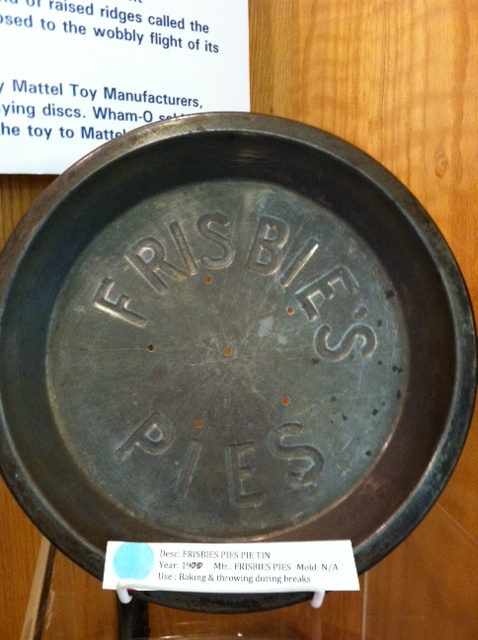 Frisbie pie tin look like?
"The Frisbee started as an obscure fad with a beginning as modest as a five-cent pie tin. It is widely believed that restless Yale students
discovered it when they decided to throw pie tins instead of returning them to the Frisbie Pie Company in Bridgeport, Conn., for their nickel
deposit."
---"Technology: The Wonders of the Frisbee," New York Times, July 5, 1978 (p. D5)
"It's one of Richard Burton's favorite forms of exercise. Carol Greiltzer, a New York City councilwoman, does it at every opportunity....What they
do is fly Frisbees, and they have lots of company. A Frisbee is a plastic disk about the size of a pie pan that can soar, dip or bank like a glider
when thrown properly. First introduced commercially about a dozen years ago by Wham-O Manufacturing Co., Frisbees until recently were
regarded primarily as novelties for children. But of lately the flying of Frisbees has become something of a national craze among adults...Soldiers
in Vietnam find a Frisbee session relaxing after a day in the bush chasing the Vietcong...Guts Frisbee is played by two five-man teams standing
about 15 yards apart. They hurl the plastic disks at each other with awesome force, scoring points when an opponent fails to catch a throw
one-handed...Legends about the origins of Frisbee are many--all probably apocryphal. One has it that way back in 1837 a Yale man named
Frisbee sailed a church collection plate 200 feet across the campus in protest against compulsory chapel. Movie people claim it all started in
Hollywood in the 1940s when film editors relaxed at lunch by scaling empty film tins. But most Frisbee historians agree that the modern era began
after World War II when the clientele of the now-defunct Frisbie Baking Co. of Bridgeport Conn., found that the tin plates holding Mother
Frisbie's pies were great for soaring. In the late 1950s, Fred Morrison, a pie-tin tosser of notable skill, took the idea to Wham-O. The company.
The company has since sold several million Frisbees, and Mr. Morrison has raked in close to $500,000. in royalties."
---"Frisbee Fad Attracts Fans Seeking Sport." W. Stewart Pinkerton, Wall Street Journal, July 2, 1969 (p. 1)
"In the beginning, of course, a Frisbee was a tin plate holding a pie that was produced by the thousands in a Bridgeport bakery. The Frisbee Pie
Company was its name, and somewhere between 1871 (When William R. Frisbie started the business) and 1920 (when somebody saw the fun in
tossing the empty tins), Frisbee started on its way to becoming one of America's rare native sports. A mispelling early in the game changed an 'i'
to 'e' a man on the West Coast (W. Fred Morrison) began manufacturing aerodynamically improved version of the disk in 1957. ..A lot has
happened to a Frisbee since it held a pie, but a lot more has happened to the ability of Frisbee tossers. This becomes very evident in an Ultimate
Frisbee match, where a team, of seven players tries to pass a Frisbee down a 60-yard field without letting it hit the ground or be blocked by an
opposing team of seven...The ball is dead, as far as Frisbee freaks are concerned. A ball holds no mystery, they contend, has a slavish
attachment to the earth and falls quickly if missed in the initial attempt to catch it. But not the Frisbee, which exists just to fly."
---"To Frisbee Fans, It's the Ultimate," Parton Keese, New York Times, August 7, 1977 (p. CN1)
"Students at Yale University insist they were the first to pick up a Frisbie Pie Company plate and fling it into the air. But similar claims have
come
from Princeton and other Easter colleges and universities. Olin Robinson, Middlebury College's president, said both were wrong...'it started here.'
To honor its certainty, the college unveiled a bronze sculpture a few weeks ago by Patrick Farrow, and artist, of a dog catching a flying disc in its
mouth. Middlebury officials contend that a group of Delta Upsilon fraternity brothers tumbled into the game while traveling to a fraternity
convention in Nebraska 50 years ago. Short on cash while on the road, the men took Frisbie fruit pies with them to eat, the story goes. They
tossed the leftover tin back and forth to amuse themselves while waiting for a flat tire to be repaireid. Frist Pie-Tin Throwers. It was 1939. 'That
fall in Middlebury the air was filled with flying pans, every size and shape,' said a story in Middlebury's alumni newspaper in the spring of 1976.
'Grade-point averages dropped, football atttendance suffered and all stores were out of pie pans.' But even the college's official version is
disputed by one of the Middlebury students, who said he had participated in the fateful event. Elbert Cole, a retired chemist living in Palo Alto,
Calif., said he and another fraternity brother found a pie tin in a Nebraska cornfield and tossed it to each other, yelling 'Frisbie.' 'People have
been throwing pie pans forever, but that's how it got to be called Frisbie.' [said] Mr. Cole...Yale suggests that its students were the first to
throw pie-tins because the Frisbie Pie Company, which was based in Bridgeport, Conn., likely sold pies near Yale. David Iovanne, director of the
New Haven Convention and Visitor Bureau, said it is part of New Haven lor that Yale students were the first pie-tin tossers...After World War II,
the travels of the flying pie tins became easier to document, said Daniel Roddick of the Wham-O Manufacturing Company in San Gabriel, Calif.,
which makes the modern plastic Frisbee. In 1948, Walter Fred Morrison, a West Coast inventor and building inspector, made plastic versions and
marked them as flying saucers, In 1957, Wham-O discovered the popularity of a game called Frisbie that was played mostly on college campuses
on the East Coast. The company liked the name and began selling Frisbees under a registered trademark. They later learned of the Frisbie Pie
Company...'As to the documentation on who cast the first one without a blueberry pie in it, that's a bit of a challenge,'...I think what you have
here is a pretty spontaneous response to a natural opportunity...It just brought a lot of happiness and joy to people at a time when the world
was getting ready for World War II...It just brought release."
---"It All Started With Pie Tins in the Air," New York Times, July 9, 1989 (p. 31)
The ingredients and method of Gateau Saint Honore date the possibility of this recipe to the 17th century. Primary evidence confirms master Parisian patissieres often employed choux and cream to effect grand dessert presentations. Croquant was "invented" at this time. Chantilly creme (sometimes referred to as Chiboust) was also "invented" in the 17th century. We find nothing close to Saint Honore in La Varenne [1651], but Ude's French Cook [1828] contains several recipes which might been precursors. These are generally composed of choux artfully arranged and filled with chantilly cream. Unlike Gateau Saint Honore, however, do not employ shortcrust.
Escoffier [1903] contains a recipe for Creme a Saint-Honore (#4345), but not (at least that we can find) Gateau Saint Honore. Neither does it show up in Richardin [1913]. The original edition of Larousse Gastronomique [1938] includes both description and recipe (en Francais, we can send if you like).
What is Gateau Saint Honore?
Gateau Saint Honore, a confection of two kinds of pastry with a cream filling. Shortcrust pastry
provides a
firm base for the soft and flexible choux pastry piled round it on top. Glazed profiteroles are stuck
to the ring
of choux. The centre of the ring is filled with a creamy mixture (creme chiboust) stiffened with
gelatin and
lightened with stiffly beaten egg whites. This cake is sometimes said to have been named after St.
Honore,
the patron saint of bakers, but others say that it owes its name to the rue Saint-Honore in Paris,
where it was
created (possibly as a development of some existing product) in 1846 by a patissiere, Chiboust.
The
learned authors of the Ile-de-France volume listed under IPCF (1993) explain why they regard the
matter as
an unsolved mystery."
---Oxford Companion to Food, Alan Davidson [Oxford University Press:Oxford] 1999
(p. 333)
[NOTE: Mr. Davidson's reference to IPCF (1993) refers to Inventaire du Patrimoine Culinare
de la
France, 27 volumes published between 1992-2000. The Ile-de-France contains the
information on
gateau St. Honore. We don't have ready access to this volume, but your librarian may be able to
locate/borrow a copy.]
"Saint Honore, a gateau consisting of a layer of shortcrust pastry (basic pie dough) or puff pastry
on top of
which is arranged a crown of choux pastry, which is itself garnished with small choux glazed with
caramel.
The inside of the crown is filled with Chiboust cream (also known as Saint Honore cream') or
Chantilly
cream. A Parisian gateau, Saint Honore takes its name from the patron saint of bakers and
pastrycooks. It
is also said that its name comes from the fact that the pastrycook Chiboust, who create the cream
which is
used in it, set himself up in the Rue Saint-Honore in Paris."
--- Larousse Gastronomique, Completely revised and updated [Clarkson Potter:New
York] (p. 1016)
Pastry: notes on shortcrust, puff paste, choux, and profiteroles
"Grasshopper pie. A dessert pie made with green creme de menthe cordial, gelatin, and whipped
cream. It
derives its name from the green color of the cordial. The pie is popular in the South, where it is
customarily
served with a cookie crust, and probably dates from the 1950s."
---Encyclopedia of American Food and Drink, John F. Mariani [Lebhar-Friedman:New
York] 1999 (p.
144)
"Grasshopper pie. The name of this mint-chocolate pie corms from the after-dinner drink, which is
made by
shaking 1/2 ounce cream, 1/2 ounce white creme de cacao, and 1 ounce creme de methe together
with ice
cubes, then straining. This pie may have had its start in the Fifties when creme de menthe had
considerable
cachet, and by the Sixties it had quite a following."
---Fashionable Food: Seven Decades of Food Fads, Sylvia Lovegren [Simon &
Schuster:New York]
1995 (p . 256)
"Q. Do you know the origin of the name chiffon as related to cooking and the origin of a chiffon
pie known
as a grasshopper? A. The word chiffon obviously applies to foods that have a delicate or light and
fluffy
consistency. I seriously doubt that any book could date the exact origin of the word. A
grasshopper pie is
made with green creme de menthe, white creme de cacao and cream. The filling comes out a
delicate
green color. The word derives from the cocktail that bears the name grasshopper, It is made with
those
ingredients, which are shaken with ice and strained."
---"Q & A," New York Times, December 21, 1983 (p. C11)
"Grasshopper Pie. That Queen of Pies, the Grasshopper. Here's the recipe from the Hiram Walker
people
just as it appeared in all sorts of advertising a couple of years ago."
---Best Recipes from the Backs fo Boxes, Bottles, Cans and Jars, Ceil Dyer [Galahad
Books:New
York] 1979 (p. 393)
[NOTE: Book contains recipe, no date.]
The earliest reference to grasshopper pie in the New York Times was published in 1904. It
is for the "real" thing:"
"Big grasshoppers, such as grow fat and buzz loudly in the Orient, are looked upon as table
delicacies in
the Philippines. There are several methods used by the natives for catching grasshoppers. The
most
effective is the net...The hopper is first so thoroughly dried out in the head of the sun or in the
bake oven
that there is nothing left that is really objectionable, and a nice crispy article of food results. This
states
sweet of itself, and something like ginger biscuits. The natives usually sweetend the grasshopeer
more by
using a sprinkling of brown sugar. Then the confectioners make up grasshoppers with sugar,
chocolate
trimmings, and colored candies in such a way a very nice tasting piece of confectionery is
obtained. The
housewife of the Philippines takes considerable delight in placing before you a nice grasshopper
pie or
cake. The grashopper pie is the most wonderful dish, as the big hoppers are prepared in such a
way that
they do not lose their form."
The earliest NYT recipe for Grasshopper Pie, as we Americans know it today, was published in
1963. It
does not reference any specific name-brand products. It does, however, confirm the propularity of
this
dessert in the time frame established by the food historians:
The origins of Impossible Pie (aka mystery pie, coconut amazing pie) are sketchy at best. A
survey of newspaper/magazine articles suggests this recipe originated in the south (where
coconut custard pies are popular). It was *discovered* by General Mills (Bisquick) and
General Foods, who capitalized on the opportunity to promote their products. Corporate
recipes surfaced in the mid-1970s. There are conflicting reports about the dates of
introduction. The earliest recipe we have on file was published in 1968. None of the ingredients are name-brand.
This article sums up it best:
[1971]
[1978]
[1979]
[1983]
---"Grasshoppers for the Table," New York Times, March 27, 1904 (p. SM8)
"Grasshopper Pie
Crumb shell:
1 1/4 cups chocolate wafer crumbs
1/4 cup sugar
1/3 cup melted butter
1. Preheat oven to 450 degrees.
2. Mix the chocolate crumbs, sugar and butter. Press the mixture against the bottom and sides of a
nine-inch pie plate. Bake five minutes and chill.
Filling:
1 envelope gelatin
1/2 cup sugar
1/8 teaspoon salt
1/2 cup cold water
3 eggs, separated
1/4 cup green creme de menthe
2 tablespoons cognac or creme de cacao
1 cup heavy cream, whipped.
1. Combine in the top of a double boiler the gelatin, half the sugar and salt. Stir in the water and
blend in the
egg yolks, one at a time. Place the mixture over boiling water, stirring constantly until gelatin is
dissolved
and mixture thickens slightly, four to five minutes.
2. Remove the mixture from the heat and stir in the creme de menthe and cognac. Chill, stirring
occasionally, until mixture has a consistency resembling unbeaten egg white.
3. Beat the egg whites until stiff but not dry, then gradually stir in remaining sugar. Continue
beating until
whites are very stiff. Fold them into the gelatin mixture. Fold in the whipped cream and turn
mixture into
chocolate crumb shell. Chill until firm and garnish. If desired, with additional whipped cream.
Yield: One nine-inch pie."
---"New Menus and Recipes Suggested for Weekend," New York Times, May 9, 1963 (p.
43)
Impossible pie
Is it possible to mix up several ingredients, pour it into a baking recepticle and have the layers naturally settle into
a pie formation (crust on the bottom; filling on the top). Yes, according to the makers of Impossible pie. This 20th century
novelty recipe took some parts of our country by storm.
"Amazing. Mysterious. It could be none other than Impossible Pie, one of the most successful
corporate recipe projects in the U.S. food-marketing history. Versions of Impossible Pie were
also named Mystery Pie or Amazing Coconut Pie. By any name, though, Americans took to
the easy recipe that is adaptable for making both sweet dessert pies and savory meat, vegetable
and cheese pies. Back when quiche was trendy, the Impossible Pie formula called for
ingredients similar to those for quiche yet eliminated the need to make a separate pastry
crust...Not one but two huge food corporations benefited by popularizing the simple recipe
formula for the Impossible Pie mixtures: the two big "Generals." One was the Minneapolis-based General Mills, home of mythical Betty Crocker and maker of Bisquick all-purpose
baking mix. The other was General Foods of White Plains, N.Y., marketer of Angel Flake
processed coconut...The real mystery: Where did this recipe originate? We know the two
"Generals" took a basic formula and then developed variations to showcase their respective
products. Lisa Van Riper, spokeswoman for Kraft General Foods, said the company's well-advertised recipe for Amazing
Coconut Pie, "was developed as a result of a creative
adaptation of the Bisquick Impossible Pies. We took a Bisquick Impossible Pie and did a
creative twist by adding coconut, raisins and some other things. That was developed in June
1976 by our test-kitchen's task force from a recipe submitted by various sources. Essentially
that source was the Bisquick Impossible Pie. The Amazing Coconut Pie recipe also forms its
own crust--with the baking mix sinking to the bottom of a custard mixture--and has been used
ever since 1976, according to Van Riper. General Mills' Marcia Copeland, director of Betty
Crocker foods and publications, recalls that "we first saw the recipe for (crustless) coconut
custard pies in Southern community cookbooks." So it was a grass-roots recipe first, origin
unknown. Some very old community cookbooks contain pie recipes that make their own
crusts just from flour; others call for homemade biscuit mix. Copeland said that the
Impossible Pie phenomenon lasted from the late 1970s through the 80s...
General Mills' home economists developed variations for Impossible Chicken n' Broccoli
Pie, for Enchilada, Lasagna, Taco, Pizza and Beef Mushroom Impossible Pies, even an
Impossible Turkey n' Stuffing Pie..."
---"Mission: Impossible Pie: The Secret's in the Batter," Joyce Rosencranz, Houston
Chronicle, June 9, 1993, Foo (p. 1)
[1968]
"Impossible Pie
4 eggs, beaten well
2 cups milk
1 3/4 cups sugar
1/2 cup melted butter
1 tablespoon vanilla
1 can (7 ounces) flaked coconut
Blend together sugar and flour. Add milk to beaten eggs; stir in melted butter and coconut. Pour into two buttered nine-inch pie
pans; bake at 350 degrees 30 to 40 minutes."
---"New Cake Easy to Take," Evelyn Comer, Charleston Gazette [WV], May 27, 1968 (p. 19)
"Impossible Pie
4 eggs
1/4 cup melted butter or margarine
1 3/4 cujp self-rising flour
2 cups milk
1 4-oz. can shredded coconut
Beat eggs thoroughly. Add melted butter, sugar, flour and milk and beat again unti well blended. Stir in coconut. Pour filling into
two ungreased deep 8-in. pie plates and bake at 350 deg. 40 min. Cool thoroughly, then cut into wedges and serve. Note: Do not use a
pie crust as this pie makes its own top and botton. The mixture is rather thin when poured into the pan but after baking and cooling, cuts
clean."
---"My Best Recipe: Different Treatment for Pie," Los Angeles Times, May 6, 1971 (p. J7)
"Blender Impossible Pie
2 cups milk
1 cup sugar
1 cup shredded coconut
1 teaspoon vanilla
1/2 cup buttermilk biscuit mix
4 eggs
1/4 cup margarine, cut in bits
Place milk, sugar, coconut, vanilla, biscuit mix, eggs and bits of margarine in a blender and whirl for 3 minutes. Turn batter into
a greased and floured 10-inc pie plate and bake at 350 degrees 40 to 45 minutes or until a brown crust is formed. If desired, sprinkle
addtional coconut on top before baking. Note: Regular flour may be substituted for biscuit mix, but add 3/4 teaspoon baking powder."
---"Culinary SOS: Blending Your Way to the Impossible Pie," Rose Dosti, Los Angeles Times, August 17, 1978 (p. M26)
"Impossible Reuben Pie
8-ounce can sauerkraut
1/2 pound cooked corned beef, diced medium-fine (1 3/4 cups)
4 ounces Swiss cheese, chredded medium-fine (1 cup packed)
1 cup milk
3/4 cup biscuit mix
1/3 cup mayonnaise
2 tabplesooons chili sauce
3 large eggs
Drain sauerkraut, pressing out liquid--there should be 1/2 cup kraut. Sprinkle the bottom of a buttered, clear-glass,
9- by 1 1/4-inch pie plate with corned beef; top with the cheese and then with the kraut. In an electri blender, at high speed,
whirl together until smooth the milk, biscuit mix, mayonnaise, chili sauce and eggs--about 15 seconds; pour into pie plage. Bake
in a preheated 400-degree oven until bottom and sides are well-browned and top is golden--30 minutes. Let stand about 5 minutes
and serve at once. Makes 6 servings. Note: In testing this recipe I used real (not imitation) mayonnaise.--C.B."
---"'Impossible' Reuben Pie is New, Savory," Los Angeles Times, December 6, 1979 (p. OC_D40)
The Best of Bisquick from Betty Crocker (company booklet) offers a section titled "The Best of Impossible Pies." Here you
will find recipes for: Impossible Cicken 'N Broccoli Pie, Impossible Beef Enchilada Pie, Impossible Pizza pie, Impossible
Lasagne Pie, Impossible Cheeseburger Pie, Impossible Beef and Mushroom Pie, Impossible Turkey 'N Stuffing Pie, Impossible
Chicken Pot Pie, Impossible Ham and Vegetable Pie, Impossible Ham 'N Swiss Pie, Impossible Shrimp Pie, Impossible Tuna-Dill Pie,
Impossible Spinach Pie, Impossible Green Chili-Cheese Pie, Impossible Pumpkin Pie, Impossible French Apple Pie, Impossible Coconut
Pie, Impossible Cherry Pie, Impossible Banana Cream Pie, Impossible Cheesecake, Impossible Pecan Pie, Impossible Brownie
Pie & Impossible Chocolate Cream Pie. Happy to share recipes, let us know what you need.
Key lime pie
Certainly, such a popular pie would have much available in the way of history. Not! Food
historians confirm
the popularity of limes (a gift from 16th century Spanish explorers), presence of pies (an "Old
World"
recipe), and eager acceptance of condensed milk (mid-19th century). Presumably, the
"inspiration" for Key
Lime pie is Lemon meringue.
"According to John Egerton (Southern Food, 1987), Key Lime Pie was known in the Florida
Keys "as far
back as the 1890s." It don't doubt it a bit because in those pre-refrigerator days, fresh milk was a
poor
keeper. What local cooks had learned to rely on was the sweetened condensed milk Gail Borden
had
begun canning shortly before the Civil War."
---The American Century Cookbook: The Most Popular Recipes of the 20th Century, Jean
Anderson
[Clarkson Potter:New York] 1997 (p. 377)
[NOTE: This book has a recipe for Key Lime Pie.]
"Key lime pies were first made in the Keys in the 1850s. Jean A. Voltz, in The Flavor of the
South
(1993), explains that the recipe developed with the advent of sweetened condensed milk in 1856.
Since
there were few cows on the Keys, the new canned milk was welcomed by the residents and
introduced into
a pie made with lime juice. The original pies were made with a pastry crust, but a crust made from
graham
crackers later became popular and today is a matter of preference, as is the choice between
whipped
cream and meringue toppings. There are three recipes for Key lime pie in The Key West Cook
Book
(1949), only one of which refers to a graham-cracker crust, and two of which do not require the
pie to be
baked. One has no topping, one whipped cream, and one meringue."
---Encyclopedia of American Food and Drink, John F. Mariani [Lebhar-Friedman:New
York] 1999 (p. 184)
[1940]
Key West has also an unusual menu to whet the appetiteturtle steaks, black bean soup and delicious lime pie, are epicurean pleasures not to be overlooked.
---Key West, Unique Resort City, S.R. Bayley, Washington Post, January 14, 1940 (p. A7)
[1947]
Food costs are most reasonable in comparison with the mainland, and the menus are slightly exotic to make up for the lunch-room appearance of most downtown restaurants. Their appeal is in their lime pie, the equivalent of a lemon meringue pie made with the small, juicy key limes
---Manana in Key West, Paul J.C. Friedlander, New York Times, February 23, 1947 (p. X14)
[1948]
"Famous Key Lime Pie has been popular with residents and visitors on the Florida keys for many years. Until now Key Lime Pie has been unknown in Biloxi and other
sections of the United States. At considerable expense, we sent our chef to the Florida Keys to learn te method of making this most delicious Pie, under the
direction of the Wills Famiy, who conceied the iea and originated the recipe."
---display ad, Sport Center Coffee Shop, Biloxi Daily Herald [MS], April 17, 1948 (p. 10)
[1949]
Mrs. Moore likes unusual foods and has a special recipe she obtained from the Cubans in Key West, Florida. It is for Key Lime Pie which Mrs. Moore says is very good, but also expensive and the type of dessert used only on special occasions.
---Time For Picnics: Recipes Better for Spring Days, Barbara Reed, Denton Record Chronicle, April 28, 1949 (p. 11)
[1949]
"Key Lime Pie
4 eggs
1 can condensed milk
1/2 cup lime juice
Break eggs in bowl and beat lightly. Add condensed milk and beat until well blended. Add lime juice slowly mixing well. Custard will thicken as you add lime juice. Pour into baked pie shell and top with meringue. Bake in slow oven until brown.Meringue
Beat whites of 2 eggs unitl stiffl. Add 3 teaspoon sugar and 1/2 teaspoon baking powder beating constantly. Put on custard and brown.--Eva Navarro (Mrs. Dan Navarro)."
Recipe for The Breakers Key Lime Pie?
THE BREAKERS' KEY LIME PIE
About condensed milk
About Key
(Mexican) limes
Frozen lime pie is an interation of Key lime pie. The oldest mention we find in print for the frozen
pie implies
the recipe existed at least as early as the 1970s. Of course, most recipes exist long before they
appear in
print.
"Mabel Brotzman asked for help in finding a lost recipe for a Key Lime Pie that can be frozen for
serving later. We
received dozens of replies from readers. Marcia H. Kenward said she'd clipped the recipe from
The Miami Herald "at
least 30 years ago." That recipe calls for stirring in 1 to 2 drops of green food coloring if desired.
As Dot Schuck of Key
Largo puts it: "Most folks from up North think Key lime should be green." The vintage recipe
calls for separated eggs in
the filling, which makes it more involved but airier in texture. The more popular recipe, at least as
far as our mail
indicates, is made with frozen whipped topping. Barbara Bliss sent her boyfriend Dave's incredibly
easy recipe, which is
similar to many we received. Tips: If you are making your own graham cracker crust, try brushing
egg white on the top
just before baking to keep the crust crisp. Remove the pie from the freezer no more than 5
minutes before serving. Paula
Prouty of Key West and Scarborough, Maine, where she is a newspaper food editor, simply
makes a regular Key lime
pie, with a meringue top, and then freezes it.
Vintage Frozen Key Lime Pie
"Q. I would like to make a good key lime pie. I think the version at The Breakers in Palm Beach is outstanding. Could you get the recipe?-- M. Herzog, Highland Beach
A. Executive chef Michael Norton provided the recipe, which uses typical key lime pie ingredients -- but with several significant differences in their use. The recipe calls for about twice as much condensed milk as the standard recipe, and then the pie is baked, rather than simply refrigerated. The result is a very creamy filling, a bit stiffer and higher than the usual, that lacks the raw egg flavor one sometimes encounters in a key lime pie. The use of cake flour in the pastry makes the crust very tender and delicate; use some extra care in the rolling process.
Crust:
5 tablespoons shortening
7 tablespoons cake flour
2 tablespoons sugar
1 egg
3 tablespoons milk
Filling:
3 egg yolks
5 ounces (10 tablespoons) lime juice
2 14-ounce cans, minus 4 tablespoons, sweetened condensed milk
Garnish:
Lightly sweetened whipped cream
Lime slices
To make the crust: Cut the shortening into the flour. Sprinkle on the sugar, then blend in the egg and milk. Roll on a lightly floured surface into a circle to fit a deep, 10-inch pie plate. Place in plate, prick bottom and sides, weight with beans or rice and bake about 6 minutes at 375 degrees, or until pastry is a light brown. Cool before filling.
To make the filling: Beat the egg yolks, lime juice and condensed milk until smooth and creamy. Pour into pre-baked pie shell and bake 15 minutes at 350 degrees. Watch pastry crust during this time; if the rim starts to get too brown, shield with foil. Cool pie and then top with whipped cream. Garnish with slices of fresh lime. Makes 8 to 10 servings.
Several readers wrote with suggestions for those who suffer from the hard brown sugar blues. "I take it out of the cardboard box as soon as I bring it home from the
store," said Sally Lewis of Miami. "I then repack it in an airtight Tupperware container. In 11 years of using this method I've never had a case of hard brown sugar,
even when I've kept the same sugar for a year." Dorothy Ligush of Pompano Beach advocates using the same method. "It will save a lot of tempers." She says that
if the sugar does pack some from nonuse, "I just run a fork or knife through it to fluff it." J. Pierce says she uses a wide-mouth glass jar to store her brown and confectioners' sugars and never is faced with hardness or too much moisture."
---"Breaker's Key Lime Pie is Creamier Than MostREAKERS' KEY LIME PIE," Linda Cicero, The Miami Herald, April 21, 1988 (p. E10)
Dave's Frozen Key Lime Pie
2 graham cracker pie crusts
8 ounces Key lime juice
1 14-ounce can sweetened condensed milk
2 8-ounce tubs frozen whipped topping, defrosted
Bake pie crusts following package instructions and cool. Beat together the Key lime juice and
condensed milk. Fold in 1 tub
of the whipped topping. Divide filling into the 2 crusts. Top both pies with the remaining frozen
whipped topping. Chill, or
freeze as desired. Makes 2 pies, 16 servings. Per serving: 338 calories (40 percent from fat), 15 g
fat (8.1 g saturated), 11.3
mg cholesterol, 4 g protein, 45.4 g carbohydrates, 0.5 g fiber, 214 mg sodium.
2 eggs, separated
1 14-ounce can sweetened condensed milk
1/2 cup lime juice
1 teaspoon grated lime zest (if desired)
1/2 cup sugar
1 graham cracker pie crust
Beat egg yolks until thick and lemon-colored. Combine with sweetened condensed milk. Stir in
lime juice and zest, stirring
until mixture thickens. Beat egg whites until they stand in soft peaks. Gradually add sugar and
continue beating just until
mixture stands in firm peaks. Do not overbeat. Fold egg whites into lime mixture. Pour into crust
and freeze six hours or
overnight. Makes 8 servings. Per serving: 431 calories (30 percent from fat), 14.5 g fat (5.6 g
saturated), 75.8 mg
cholesterol, 8.2 g protein, 69.4 g carbohydrates, 0.5 g fiber, 271 mg sodium.
---"Frozen Key Lime Pie; Poached Salmon with Cucumber Sauce," Miami Herald, The
(FL), Apr 09, 2001
Lemon meringue pie
According to the food historians, lemon flavored custards, puddings and pies have been enjoyed
since Medieval times. While Renaissance European cooks used whisked egg-whites in several
dishes, it was not until the 17th century that they perfected meringue.
Lemon meringue pie, as we know it today, is a 19th century product. About lemons.
ABOUT LEMON MERINGUE PIE IN AMERICA
"Lemon-meringue pie, made with lemon curd and topped with meringue, has been a favorite
American dessert since the nineteenth century."
---Encyclopedia of American Food and Drink, John F. Mariani [Lebhar-Friedman:New
York] 1999 (p. 182)
Elizabeth Coane Goodfellow (1767-1851) is credited for introducing lemon meringue pie to America in her Philadelphia shops [The Larder Invaded: Reflections on Three Centuries of Philadelphia Food and Drink, Mary Anne Hines, Gordon Marshall & William Woys Weaver, Historical Society of Philadelphia, Philadelphia 1987 (p. 66). Becky L. Diamond's Mrs Goodfellow: The Story of America's First Cooking School [2012] devotes an entire chapter to the evolution of Lemon Meringue pie. The author states "no one know...exactly how or when [lemon meringue pie] was originally conceived." (p. 158). Mrs. Goodfellow's Cookery as it Should Be (1865) offers three recipes for lemon pudding, some in pastry shells (p. 229, 230 & 243), no lemon pies, and the sole reference to meringue(s) (p. 199) is for small confections, not as topping.
Where is lemon meringue pie considered a "traditional" dessert?
Many places are associated for this
particular pie. Most of them are in the South. Lemons are a favorite component of southern
cooking. Think lemon chess pie and lemonade.
"Lemon meringue pie has been around a long time in the South and most likely grew out of the
vast repertoire of puddings, whose popularity pies eclipsed in the late nineteenth century. It is
remarkably similar ot the Queen of Puddings."
---Biscuits, Spoonbread, and Sweet Potato Pie, Bill Neal [Alfred A. Knopf:New York]
1996 (p. 275)
"A pie can always be turned out for dessert as long as there are lemons in the house, and
American cooks have devised many recipes. President Calvin Coolidge is said to have favored a
simple lemon custard pie. The even more common lemon meringue, ever present in public eating
places, is one more dish served at Boston's Parker House that has become a classic in the
American repertoire. And a special version gained fame swiftly when it went on the menu of the
Lion House Social Center in Salt Lake. The following version is based on a method worked out in
the 1960s by the late Michael Field in collaboration with Dr. Paul Buck, a food scientist at Cornell
University. The determined Mr. Field devoted days to making lemon meringue pie after another
until he eliminated the "weeping" common to meringues that sit around on counter; his trick was
to use a little calcium phosphate powder, a food-grade phosphate product available in drugstores
and suggested by Dr. Buck."
---American Food: The Gastronomic Story, Evan Jones [Vintage Books:New York] 1981,
2nd edition (p. 465-6) [includes recipe]
Many 17th and 18th century cookbooks contain recipes for lemon custard, pudding (sometimes served in a puff-paste base), pies, and tarts. These are often topped with pulverized sugar. It is not until the middle of the 19th century we find recipes that would produce lemon meringue pie, though they are not titled as such:
[1769] "A Lemon Pudding
Blanch and beat eight ounces of Jordan almonds with orange flower water. Add to them half a pound of cold butter, the yolks of ten eggs, the juice of a large lemon, half the rind grated fine, work them in a marble mortar or wooden basin till they look white and light. Lay a good puff paste pretty thin in the bottom of a china dish and pour in your pudding. It will take half an hour baking."
---The Experienced English Housekeeper, Elizabeth Raffald, with an introduction by Roy Shipperbottom [Southover Press:East Sussex] 1997 (p. 82)[1847] "Meringue Pie
This may be made by adding to a nicely made and baked tart, a nice whip, made as follows: to the white of a fresh egg, add two tablespoons of finely pulverized white sugar; flavor with lemon, vanilla, or any other flavor, which may be liked, whip the same as for kisses, then with a knife lay it on the top of the tart, and whape it nicely off at the edges, then set it into an oven and close it for a few minutes until it is delicately browned."
---Mrs. Crowen's American Lady's Cook Book, Mrs. T. J. Crowen [Dick & Fitzgerald:New York] 1847 (p. 256)
[NOTE: A recipe for lemon pie immediately precedes this recipe. It has both top and bottom crust.][1871] "Lemon Custard Pie No. 2
Grate one-half outside of a lemon and squeeze out the juice, yolks of two eggs, two tablespoonsful heaped of sugar, half a cup of water, one teaspoonful of butter; stir well, and bake in a deep dish lined with crust; beat the whites of the eggs to a stiff froth; stir in two tablespoonsful of pulverized sugar and spread over the top of the pie as soon as it is baked set in the oven till the top is nicely browned."
---Mrs. Porter's New Southern Cookery Book, Mrs. M. E. Porter [1871] (p. 296)[1879] "Lemon Pie.
Yolks of four eggs, white of one, beaten very light; grated rind and juice of one large lemon; five heaping tablespoonfuls of sugar. Bake in an undercrust till the pastry is done. Froth the whites of three eggs with five tablespoonfuls sugar. Spread over the pies and bake again till brown.--Mrs. Col. S."
---Housekeeping in Old Virginia, Marion Cabell Tyree [1879] (p. 406)[1882] "Lemon Pie (no. 3)
3 eggs
1 great spoonful butter
3/4 cup white sugar
Juice and grated peel of lemon
Bake in open shells of paste.
Cream the sugar and butter, stir in the beaten yolks and the lemon, and bake. Beat the whites to a stiff meringue with three tablespoonfuls powdered sugar and a little rose-water. When the pies are done, take from the oven just long enough to spread the meringue over the top, and set back for three minutes. This mixture is enough for two small, or one good-sized pie. Eat cold."
---Common Sense in the Household: A Manual of Practical Housewifery, Marion Harland [1882] (p. 350)[1885]
"Lemon pie.
Grate the rind and express the juice of three lemons; rub together a cup and a half of powdered sugar and three tablespoonfuls of butter; beat up the yolks of four eggs, and add to the butter and sugar, lastly the lemon; bake on a rich puff paste without an upper crust. While the pie is baking beat up the whites of the four eggs with powdered loaf sugar, spread it over the top of the pie when done; then set back in the oven a few moments to brown slightly."
---La Cuisine Creole, second edition [F.F. Hansell & Bro:New Orleans] 1885 (p. 191)
ABOUT MERINGUE
Food historians tell us the precursor for meringue was an Elizabethan-era dish called "Snow".
(aka snow eggs). What exactly is meringue and who is credited for the discovery?
"Meringue...an airy, crisp confection of beaten egg white and sugar. The word probably entered
French from German, as did many other French words ending in -ingue. It first appeared in print
in Massailot [1691], although earlier recipes for the same thing but without the name had been
published. The name travelled to England almost at once and first appeared in print there in
1706....It seems to have been only in the 16th century that European cooks discovered that
beating egg whites, e.g. with a whisk of birch twigs (in the absense of any better implement),
produced an attractive foam. At first the technique was used to make a simple, uncooked dish
called snow, made from egg white and cream. However, cooking such a foam would not have
resulted in meringue, for any fat in the mixture, as represented by the cream, prevents the egg
whites from taking on the proper texture...When true meringue made its appearance in the 17th
century, it still lacked its name and was often called "sugar puff.""
"Meringue. The name for this confection of sugar and beaten egg white is a direct borrowing from
French "meringue." but beyond that its origins are obscure. Legend has it variously that it was
named after the town of Meringen in central Switzerland of after the Saxon town of
Mehringyghen, seat of the operations of the Swiss pastrycook Gasparini who supposedly invented
it there in 1720. However, the fact that the word had even entered the English language before
this (it is first mentioned in Edward Phillip's dictionary The New World of English Words,
in John Kersey's 1706 edition) casts considerable doubt on the story. In fact, mixtures of beaten
egg white and sugar cooked in a slow oven had been popular since the early seventeenth century
(they were called "Italian biscuit"), and it was the great increase in the proportion of egg white
which marked the inception of the superlight meringue towards the end of the century."
"Whites of eggs produced the Elizabethan dishful of snow, a spectacular centrepiece for the
banquet course following a festal meal...The beating of egg whites was not altogether easy before
the fork came into common use late in the seventeenth century...A 1655 recipe for cream with
snow suggested a cleft stick, or a bundle of reeds tied together and roll between your hands
standing upright in your cream....at the turn of the [17th] century a still lighter creation was
introduced from France, in which the proportion of frothed egg white to sugar was greatly
increased. The new arrival was quickly added to the sweetmeats of Britain, among which it is still
to be found. Its French name remains unaltered. It was the meringue."
The 1938 edition of Larousse Gastronomique tell us that meringue was invented in 1720
by a
Swiss pastry chef named Gasparani. Queen Marie Antoinette is said to have enjoyed these. Recent
editions of this book do not reference the 1720 date and they attribute the invention of meringue
to Gasparini, a Swiss pastrycook who practiced his art in a small the small German town of
Meiringen. Recent editions also add that until the early 19th century, meringues cooked in the
oven were shaped with a spoon; it was Careme who first had the idea of using a piping bag.
Meringue recipes here.
RECIPES FOR MERINGUE through time:
[1604]
[1828]
"Meringues au Marasquin au Sucre Chaud
[1869]
"Meringue with Coffee Cream
[1907]
"4348: Italian Meringue
"4349: Italian Meringue made with cooked sugar
[1929]
[1941]
Where did lemons come from?
Where did lemons originate?
"The lemon...owes its name entirely to the botanists, for it was unkown to classical writers.
However, it was widely used from the Middle Ages onwards. It was regarded as an essential in
the seventeenth century...Originally from the foothills of the Kashmir, the lemon did not reach
China...until around 1900BC. In China, it was given the name limung, which it retained almost
unchanged when it moved on to Persia and Media. From the tenth century AD onwards the
Arabs, who called it li mum...took it all around the Mediterranean basin, eastwards to Greece by
way of Constantinople, westwards to Spain by way of Maghreb and Fezzan. The Spanish and
Russians retained the name limon, which becomes lemon in English..."
"Lemons were one of the most sought after fruits in early modern Europe. Being associated with
sunny southern Europe they were considered healthy, much the same way we think of
Mediterranean foods today. Their juice was used as a condiment, especially on fish because its
acidity was thought to cut through the "gluey humors" abounding in seafood, making them more
digestible. Northern Europeans generally had to import lemons, but eventually a way to grow
them indoors was devised. Lemon peel, grated or candied lemon was also a typical garnish."
Lemons and scurvy
Lemons, Fruits of
Warm Climates/Morton
Lemons in 19th century America
"Legend has it that Columbus brought lemon seeds to Florida, and Spanish friars grew the fruit in California, where it flourished in the middle of the nineteenth
century--especially in Eureka (possibly first cultivated in California or brought from Sicily)...In 1874 James W. Parkinson, writing of American dishes at the
Philadelphia Centennial, noted that "citron"...a lemon-like fruit, had "lately been transplanted in California..." In 1934 Irvin Swartzberg of Chicago began selling
gallon bottles of fresh lemon juice to bars and restaurants, and, after perfecting a method of concentrating the juice with water, sold the prdouct in the market under
the name Puritan-ReaLemon."
Grocer's notes, circa 1883
"Lemon.--The fruit of a tree closely related to the orange, citron and lime...The lemon grows wild in the north of India and has been long cultivated among the
Arabs who carried its culture into Europe and Africa. It is now naturalized in the West Indies and other parts of tropical America...The pulp of the fruit abounds in
citric acid. There is, however, a variety cultivated in the south of Europe, the juice of which is very sweet. The acid juice of the common kind is laregley employed
in preparing the beverage known as lemonade...Lemons vary very much in size, and the ordinary boxes contain from two hundred and forty to four hundred and
twenty lemons each; the brands L and LL being used to designate sizes, single L;'s being the largest. They are wrapped separately in order to prevent decay by
crushing together. Thin-skinned lemons are the juiciest. There are over thirty varieties of lemons in cultivation, but they are generally classified according to the
place of growth or shipping. The principal importations into this country are from Sicily (Messina lemons) and from Valencia. The lemon can be successfully grown
in Florida and California--products which are receiving great attention. The oil of lemon is largley used in cooking and confectionery; the extract of lemon, sold for
domestic use, being simply a dilute solution of the oil in alcohol. The pure juice of the lemon is extremely efficacious in attacks of acute rheumatism."
These notes illustrate the growing popularity of lemons, as imported fruit, in the 19th century.
Lemons: Unit=box
How much did lemons cost?
[1888]
[1895]
[1928]
Lemons were actively promoted in 1928 for several different uses besides eating:
How many kinds of lemons were available in 1928?
"A new fruit--sweet lemons.
MEYER LEMONS
"The Meyer Lemon is not a hybrid but is a distinct citrus species found only a few years ago in a remote region of China by one of the famous plant explorers of the
United States Department of Agriculture, Mr. Fred Meyer. It is sometimes called the Chinese Dwarf Lemon because it does not grow as large as the ordinary
Lemon tree. If it bore no fruit at all, the Meyer would still be worth planting as an ornamental in our gardens because it makes a spendid, bush, dense-foliaged
shrub, growing to about eight feet and with flowers on it during almost the entire year....The fruit...is almost double the size of the usual Lemon, roundish-oval in
shape, and of a rich orange-yellow color; about halfway between the Orange and the ordinary Lemon in appearance. It will serve any purpose to which a Lemon
can be put and is available almost from the time the plant is put out, because the plants bear immediately and are almost never without fruit form that time on."
"...for home places where room is not plentiful, the new Chinese dwarf lemon, the Meyer, is possibly the finest lemon that can be planted. The late Frank Meyer,
plant explorer of the United States Department of Agriculture, did California a great service when he found this lemon in the door-yard plantings of China. It is much
hardier and easier to grow than the commercial lemons of California. It will thrive anywhere in Southern California, not only producing big juicy orange-colored
fruits, which can be used for all the purposes for which lemons are needed, but making a handsome ornamental plant. It reaches a height of eight feet and has
luxuriant foliage, with big fragrant blooms which are even more highly perfumed than those of the orange."
"One of the best varities for back-yard production is the Meyer lemon, which has proven its value since its introduction in 1908. Discovered in dwarf form growing
in the gardens of China by Frank Meyer, this particualr variety will stand slightly colder temperatrues than other types, although all lemons are susceptible to frost
damage. Fruit is of medium size, thin-skinned and smooth. Size of the tree may be an advantage in most gardens since it will only reach 8 ft. in height in 20 years,
while producting an abundance of fragrant flowers and yellow-orange fruit. Lemons ripen and begin to fall during the month of May."
Related fruits: Oranges & grapefruit.
Our food reference books state palmiers (also known as palm leaves) were invented around the
turn of the 20th century. The name suggests they were first made in France, but we find no
evidence confirming this. In fact, we find a recipe for palm leaves (Palmenblatter) in Viennese
Cooking, O. And A. Hess [Crown:New York] 1960 (p. 213), which suggests this pastry might
have commanded a broader swath of geography. We also find no attribute to the first
person/restaurant credited for cooking/serving this cookie. In the world of food history, this is not
uncommon.
"Palmier. A small pastry made of a sugared and double-rolled sheet of puff pastry cut into slices,
the distinctive shape of which resembles the foliage of a palm tree. First made at the beginning of
the 20th century, palmiers are served with tea or as an accompaniment to ices and desserts."
"Palmiers are small sweet biscuits made from puff pastry and shaped somewhat like butterflies.
To
their anonymous early twentieth-century inventor their shape evidently suggested more the
topknot of leaves on a palm, for French palmier means literally 'palm tree'."
"Palmier. Also called palm leaves, palmiers are small pastries made from sugar-encrusted puff
pastry. The sides of a rectangle of puff pastry are folded into the center, then folded over to make
four layers, and cut across the width into thin strips. These are laid on their sides on a baking
sheet and they fan out as they bake to resemble the leaves of palm trees. Palmiers are baked until
they are crisp and the sugar caramelizes to a rich golden brown. They are served with tea or
coffee or as an accompaniment to ice cream and other desserts. France."
"Sometimes, you just have to hand it to French culinary genius. Take the palmier (palm-YAY).
It's a cookie, nothing more than flour, water, salt, a light sprinkling of sugar and immoderate
amounts of butter. Yet as the palmiers bake, the moisture in the butter-riddled layers evaporates,
causing the dough to puff into hundreds of paper-thin flakes. Meanwhile, the sugar caramelizes
ever so slightly, casting a glassy sheen. The result? A pastry whose crisp, caramelized exterior
gives way at the slightest pressure to countless crisp layers. Ironically, such a delicacy originated
as a means for resourceful pastry chefs to salvage leftover puff pastry dough. (When you consider
the labor-intensive nature of puff pastry, you understand why one would want to use every last
piece.) Though simple, the technique used to make palmiers can be fraught with peril. When
rolled too tightly, sliced a smidgen too thick or underbaked by even a minute, the interior remains
soggy and leaden. When rolled too loosely or baked at excessive temperatures, the pastry
becomes brittle and shatters upon touch. And when caked with sugar, the delicate balance is lost
and the pastry becomes one-dimensional. Athough ubiquitous throughout France, the proper
palmier is hard to find here. At some American bakeries the Frisbee-size confection is as sweet
as saccharin and dubbed the "Elephant Ear." At Latin American markets, they may be labeled
orejas ("ears" in Spanish) though the only ones I have come across are packaged in plastic, which
suffocates the crisp pastry. And at a German bakery, I once requested a palmier and received
nothing more than a polite, though perplexed, stare. It seems I should have requested the rather
inelegantly named "Pig's Ear." Some franchise French bakeries, such as La Madeleine, have
"palmiers" that are far inferior to the "elephant ears" offered by Fresh Fields/Whole Foods
Market. Though mass production is no friend to the palmier because the slicing and sprinkling
go largely unpoliced, a notable exception is the downtown Washington location of Fresh
Fields/Whole Foods Market, whose elephant ears put most palmiers to shame. (Though all of the
stores use the same frozen puff pastry dough shipped from a French bakery in Manhattan, the P
Street store's bakery consistently turns out a crisp, buttery, flaky palmier, albeit the size of a
dinner plate.) Buonaparte Breads at Historic Savage Mill in Savage and in Baltimore produces a
fine palmier, but they no longer ship them to their retail customers in the District since they are
too fragile. Whether sent out with after-dinner espresso at Michel Richard's Citronelle in
Georgetown or nibbled as an elegant something to satisfy a sweet tooth on a leisurely afternoon,
the palmier can be an amazing thing. When you can find them. They are usually priced by the
pound and vary greatly in size. SEN5ES For the palmier lover, the pastry case at Georgetown's
sedate Sen5es Bakery and Restaurant is a sight to behold. Row after flawless row of compact,
perfectly wound palmiers are nestled against one another. While they last. "Believe me," says
pastry chef, Bruno Feldeisen. "If I don't have them, I hear about it!"
Feldeisen says he doesn't make a profit on the palmiers. But it's one of the little things that chefs
do for their clientele. Most days, that is. "It needs to be made with love, and sometimes we don't
have the love," explains Feldeisen...PATISSERIE POUPON Ruth Poupon's
rendition of a palmier defines daintiness. Slightly larger than a silver dollar (or rather, a French
franc) and so thin as to be almost diaphanous, it seems as though it might shatter if breathed
upon. But it is surprising sturdy. (Those at the bottom of the bag do tend to break though.) The
appropriately faint sweetness is underscored by a crisp, barely colored pastry that, lacking much
caramelization, in truth seems almost more butter cookie than palmier...AMERNICK At first glance, Amernick
bakery in Cleveland Park may seem an unlikely source for a palmier. Yet Ann Amernick, who
has held pastry chef positions with Michel Richard and White House pastry chef Roland
Mesnier, chose to include, amid her eclectic assortment of pastries, a rendition laced not with
sugar but a sharp, salty blend of Parmigiano-Reggiano and aged Dutch Gouda cheeses.
Amernick's savory rendition is best appreciated when taken home and warmed in the oven. Why
a savory palmier? It's a carry-over from the days when Amernick's bakery was in Wheaton, on
the site of a former Dutch bakery. The palmiers were a favorite of customers, says Amernick.
"And I liked them." An equally laudatory stick version is also available..."
The earliest recipe we find for
palm leaves (aka palmiers) in an American cookbook is from
Fannie Farmer's Boston Cooking School Cook Book [1896]
Recipe for traditional Afghani Goash-e-Feel (iced with nuts) here:
Elephant's ear pastry is the literal meaning of goash-e-feel, a name given because of the shape and size of these crisp, bubbly, sweet pastries. They are usually served with tea; and often a bride's family sends them to the bride and groom the day after the wedding. They are also made for Nauroz (New Year's Day, 21 March, the first day of spring).
"For the best results, the pastry must be rolled paper thin, and the oil for frying must be very hot.
"1 egg
[1977]
[1997]
"Elephant Ears
"The farther east the letters came from, the more frequently their writers suggested the deep-fry method using bread dough (either frozen or homemade). Lots of our readers
sent in this one. Shape a loaf-size portion of dough into 15 ovals or rounds, roll out until 5 1/2 inches round and 1/8 inch thick. Deep fry in 375 degree oil for 3 minutes on
each side until golden brown. Drain well and sprinkle with sugar and cinnamon. By the time we got to New Hampshire, elephant ears had turned into the following. This
recipe was sent to us by Lanceine Frizzel of Claremont, N.H.
"Elephant ears
Related food? French palmiers, Mexican sopaipillas & Navajo
fry bread and
funnel cakes.
"As a good daughter of the South practically weaned on pecan pie, I had always assumed that it
dated back
to Colonial days. Apparently not. Still, I find it difficult to believe that some good plantation
cook didn't stir
pecans into her syrup pie or brown sugar pie. Alas, there are not records to prove it. In fact, I
could if no
cookbooks printing pecan pie recipes before the early twentieth century. And only in the 1940s did
"Fannie"
and "Joy" begin offering recipes for it. In Southern Food: At Home, on the Road, in
History
(1987)...John Egerton writes: "We have heard the claim that Louisianans were eating pecan
candies before
1800, and with sugar and syrup produced from cane at that time, it is conceivable theat they were
eating
pecan pies, too, but there are no recipes or other bits of evidence to prove it."...If Karo did not originate pecan pie, it certainly
popularized the recipe as a rifle through twentieth-century cookbooks large and small quickly
suggests.
Nearly all pecan pie recipes call for Karo corn syrup."
[1898]
[1914]
[1931]
[1938]
[1941]
[1942]
"Utterly Deadly Southern Pecan Pie
"My Reasonable Pecan Pie
[1952]
[1960s]
[1970]
"Pecan Pie #2
Related desserts?
Syrup/Shoofly pie & Sugar/Chess pie.
Pecans
"Pecan. The most important nut of N. America, is bourne by one of the hickory trees, Carya
illinoiensis. The
hickories, which are related to walnut trees, include several species of edible nuts...but the pecan
is much
the best. Its native habitat is the central southern region of the USA. The name comes from the
Algonquin
Indian paccan, which denoted hickories, including pecans...Most pecans now some from
cultivated trees,
although many old, wild trees continue to produce nuts which are gathered and marketed. ..The
main uses
of pecans are in sweet dishes and confectionery, although they are also used in a stuffing for
turkey. Pecan
pie is one of the most famous American desserts. Pecan butter is also made."
"Pecan. A North American nut (actually a kind of hickory nut) sometimes said to be a native of
Oklahoma,
the pecan...is really indigenous to an area extending from the U.S. Midwest throughout the South
and
Southwest into Mexico--a region where it still grows wild today. Pecans are commerically
cultivated in the
band of states running from Georgia west to New Mexico, as well as in Mexico, Brazil, and
outside of the
Western Hemisphere, in Israel, South America, and Australia. The first recorded instance of pecan
cultivation is said to have been when Thomas Jefferson carried the trees from the Mississippi and
gave
them to George Washington. But long before this--eons before the Europeans arrived--pecans
were an
important item in the diet of Native Americans living in the south-central region of North
America."
"Pecan. The nut of the tall hickory tree native to America, ranging from Illinois down to
Mexico...The name
comes from various Indian words (Algonquian paccan, Cree pakan, and others) and was first
mentioned in
print in 1773. Thomas Jefferson introduced the tree to the eastern shores of Virginia, and he gave
some to
George Washington fo planting at Mount Vernon. A Louisiana slave named Antoine was the first
successfuly to graft and cultivated pecan trees in 1846." Related food? pralines.
"...there is no earlier evidence than third century Macedonia for the use of a flat loaf of bread as a
plate for meat, a function which bread continued to perform in the pide of Turkey, the pita of
Greece and Bulgaria, the pizza of southern Italy and the trencher of medieval Europe. Although
meat and other relishes were seen earlier in Greece as accompaniments to cereal, the cereal had
taken other forms."
"It has been argued that the Italians did not "invent" pizza. Perhaps this is technically true, but
there can be no denying that Italy was most certainly the seedbed out of which the concept would
flourish to the fullest. In one form or another, pizza has been a basic part of the Italian diet since
the Stone Age, and Italians have devised more ways of interpreting the dish than anyone
else...Italian pizza evolved from the basic concepts initiated by two different cultures: the
Etrucans in the north and the Greeks in the south...The earliest pizza prototypes originated when
Neolithic tribes first gathered wild grains, made them into a crude batter, and cooked them on the
hot stones of their campfires...Italians may have made pizza famous, but they certainly did not
invent the concept of the dish...the Greeks, who occupied the southernmost regions of Italy for
over 600 years (from about 730B.C. to 130 B.C.), were the greatest bakers of ancient times...Flat,
round breads were baked with an assortment of "relishes" (in ancient Greek, a relish meant
anything spread or baked on bread), such as oils, onions, garlic, herbs, olives, vegetables, and
cheese, on tip. A rim of crust was left around the bread to serve as a kind of handle..."
"A pizza consists mainly of a flat disc of bread. This is normally the base for various toppings, and
it is safe to assume that since early classical times people in the general region of the
Mediterranean were at least sometimes putting a topping on their flat breads [ie foccacia]...the
word pizza itself was used as early as the year 997 AD in Gaeta, a port between Naples and
Rome...Abruzzi had something called pizza in the twelfth century. Calabria made pitta or
petta, Apulia pizzella or pizzetta, Sicily sfincione. Tuscany's
schiacciata...was first roasted on stones by the ancestral Etruscans...The
napoletana, i.e. pizza of Naples, can indeed be seen, and has been so far seen for over a
century, as the archtype of modern pizzas..."
Why do we call it "pizza?"
"The term pizza is clouded in some ambiguity, though it may derive from an Old Italian word
meaning a point, which in turn led to the Italian word pizzicare, to pinch or pluck. The word
shows up for the first time in print as a Neapolitan dialect word--piza or picea--about 1000 A.D.,
possibly referring to the manner in which something is plucked from a hot oven...While many
Mediterranean cultures and regions of Italy have long had their versions of flatbreads...the baked
flatbread most people now think of as pizza originated in Naples, and was a favorite snack of
occupying Spanish soldiers at the Taverna Cerriglio in the 17th century. The soft, baked crispy
dough that the Neapolitans called sfiziosa would be folded over into a libretto (little book) and
consumed in the hand. It was baked by men called pizzaioli, who worked in small shops called
laboratori. By the middle of the 19th century the word pizza had become common parlance for
the food item..."
Neapolitan pizza
Pizza alla Margherita?
Primary evidence suggests this popular story is a fanciful recounting of earlier events:
Pizza in America: New York traditions & Chicago-style
Pizza was imported to the United States by Italian immigrants. For many years, pizza was mostly
available in cities with large Neapolitan populations [New York, Boston, New Haven,
Philadelphia, Baltimore etc.]. It wasn't until American soldiers returned from WWII that pizza
became a national phenomenon.
"Pizza came to America at the end of the nineteenth century with immigrants from southern Italy.
Italian immigrants built commercial bakeries and backyard ovens to produce bread they had eaten
in Italy. In addition, Italian bakers used their ovens for flatbreads: northern Italians baked
focaccia, while southern Italians made pizza. Initially, pizza was made by Italians for Italians, but
thy the late 1930s after the Great Depression many Americans were eating pizza in Italian
restaurants and pizzerias on the East and West Coasts...Over time, two basic and distinct styles of
American pizza appeared. A thin-crust pizza, commonly called "East Coast" or "New York"
style, is made with just a few toppings like pizza made in Naples...The crust of thick- or
double-crust pizza, also called "West Coast" style, serves as a foundation for a larger number of
toppings...There are several uniquely American pizzas. Deep dish, or "Chicago style," pizza
originated at Pizzeria Uno...in 1943...California or "gourmet" pizza originated in 1980 at Chez
Panisse, a restaurant in Berkeley, California."
"One of the first pizza sold in the United States was baked some fifty years ago by a 13-year-old
pizzaiuolo named Gennaro Lombardi at 53 1/2 Spring Street in Little Italy section of New
York...Pizza may never replace hot dogs as the great American "bite," but their amazing
acceptance in recent years prompts a question: Why pizza and not, say, Mexican enchiladas? The
guess is that a growing number of Americans of Italian origin aided by advertising and
refrigeration, have made pizza as delectable as such other postwar imports as Lollobrigida. The
entertainment weekly Variety, going gastronomic the other Wednesday, reported that the
"extent to which the pizza pies are replacing hot dogs at drive-ins was demonstrated at the
concession trade show at Allied States Ass'n convention which featured more pizza-making
machines than frankfurter heaters." At the Texas State Fair, largest exhibition of its kind, pizza
evoked great interest on the midway. More inquiries were made about pizza than any other food
with the exception of the "corny dog," the dressed-up hot dog on a stick...
...A Neapolitan pizzaiuolo might be startled by pizza in the United States...At a "pizza bar" in a
large Manhattan department store--where thousands are absorbed weekly by hungry
shoppers--three kinds are for sale: plain pizza (a pie); pizzaret (a muffin), and a best-seller called
the pizza-bagel, created, after some protest, by a turncoat pizzaiuolo from Florida...There are
fresh pizza,
warm-over pizza, refrigerated pizza, warm-over pizza and frozen pizza, selling everywhere from
sidearm joints to pizza palaces. (Though "pizza" means pie or pies, some Americans insist on
saying "pizza pies.")...Gennaro Lombardi seemed to be the man to turn to. Nobody has disputed
his claim to having the oldest pizzeria in the United States....Gennaro said, "They all came here to
eat my pizza, all the opera stars, Scotti, Tetrazzini, Caruso..."
How much did the first pizzas cost?
"Nov. 10, 2005, marks our 100th anniversary. I'm selling everything for 5 cents," says Brescio
[manager of Lombardi's]. "That's what it cost back in 1905. Now that's history." "The first American cookbook recipe for pizza appeared in Specialita Culinarie Italiane,
137 Tested Recipes of Famous Italian Foods, a fund-raising cookbook published in Boston in
1936. That recipe, for Neapolitan pie or Pizza alla Napolitana, directed that pizza dough
be hand-stretched until it was one-quarter-inch-thick. The dough was topped with salt and
pepper, Scamozza (Scamorza) cheese, tomatoes, grated parmesan cheese, and olive oil in that
order. There were no ingredients for the pizza dough itself; instead, the reader was told that the
dough "can be purchased in any Italian bake shop.""
"While not yet a bona fide fast food, pizza was soon giving the fast foods run for the consumer's
money. By the mid-1950s, thanks to the popularity of spaghetti and tomato sauce, a taste for a
white farinaceous base slathered in thick and salty tomato sauce had become an integral part of the
American palate. The country was therefore well primed for the invation of pizza....In the
1950s...pizza suddenly burst onto center stage. In part this was because it fit so well in the culture
of the times. It was regarded as an ideal family food, equally acceptable to all ages and both sexes.
Its taste hardly departed from the tried and true, yet its form could be readily accomodated to the
era's newer, more casual way of eating: children's parties and snacking in front of the television
set. The informal, communal way it was eaten in restaurants made it particualrly popular with
teenagers, and by the mid-1950s boisterous "pizza parlors" dotted the main streets of Italian
neighborhoods, their oversized booths for six or eight crammed with voracious young eaters,
while others lounged by the entrance waiting for take-home orders...Pizza also became the hottest
restaurant item of the 1950s because, unlike most pastas, it was not particularly affected by delays
between cooking and eating. This made it ideal for the two main growth sectors in the
television-battered restaurant industry, drive-ins and take home places. By 1956 it had shunted
aside hot
dogs as the most popular item in both. By the late 1960s, American were consuming two billion
pizzas annually."
New York style pizza
"Legend has it that Neapolitan pizzailo Raffaele Esposito of the Pizzeria de Pietro was the first
to make a pie with tomato, basil, and mozzarella pizza (the colors of the Italian flag) to honor the
visit of Queen Margherita, consort of King Umberto I, to Naples in 1889. This thereafter was
called pizza alla margherita and became very popular in that city.
But the pizza remained a local delicacy until the concept crossed the Atlantic in the memories
of immigrants from Naples who settled in the cities along the Eastern Seaboard, especially in New
York City. The ingredients these immigrants found in their new country differed from those in the
old: In New York there was no buffalo-milk mozzarella, so cows's milk mozzarella was used;
oregeno, a staple southern Italian herb, was replaced in America by sweet marjoram; and
American tomatoes, flour, even water, were different. Here pizza evolved into a large, sheet-like
pie, perhaps eighteen inches or more in diameter, reflecting the abundance of the new
country....The first record of a pizzeria in New York was Gennaro Lombardi's, opened in 1905
on Spring Street, but others quickly followed in the Italian communities around the city. Still,
pizza and pizzerias and, later, pizza parlors' were little known outside the large cities of the East
until after World War II, when returning American GI's brought back a taste for the pizzas they
had had in Naples along with the assumptions that pizza, like spaghetti and meatballs, was a
typical Italian dish, instead of a regional one."
"The city's selection of restaurants was enriched by the arrival of immigrants during the late
nineteenth century. The food served in the first Italian restaurants in the city was adapted from
recipes of Naples and Sicily, the home of many Italian immigrants. Pizza was a Neapolitan food
uncommon in most of Italy but popular in New York City after G. Lombardi opened a pizzeria on
Spring Street in 1905."
"New York pizza did not exist before 1905, when Gennaro Lombardi, a Neapolitan immigrant,
began to sell pies in his grocery store in Little Italy. Lombardi's was by most accounts the first
New York pizzeria, and Mr. Lombardi, who hired and trained a series of other immigrants,
became the sturdy tap root of a tree of family and acquaintances that would go on to define great
New York pizza."
Other articles of interest (your librarian can help you get copies):
"The Top Pizzas In New York: Bred and Baked By Tradition ," The New York Times,
June 16, 1995, Section C; Page 1; Column 1
If you need extensive historic research materials on NY pizza (or other NY foods) contact these
organizations:
Chicago-style (deep dish) pizza
Of course, few foods are truly invented. Pizza was certainly known to Chicago for several decades before the Sewell's opened shop.
Most are creative iterations of existing dishes. There is
some speculation, based on the fact that Chicago-style pizza is thickly-topped and sometimes
served in square pans, that the recipe was influenced by Sicilian cuisine. Did you know recipes
for tomato pie, both open tarts and double-crust (what we now call "stuffed pizza"), were also
known to American cooks in the early 19th century?
"The pizza...first made its appearance in Chicago around 1912. It was introduced by a man who went around with a pizza filled
basket on his head...At that time there was some doubt whether these pizzas were to be used as shingles or munched."
The Windy City's first pizzeria opened at 907 Taylor St. in 1924:
The second pizzeria opened (according the general concensus of local food experts), opened on the southwest corner of Onio Street and Wabash
Avenue in 1943:
"In 1943 Ike Sewell, a liquor-company executive and former All-American guard from Wills Point, Tex., and Ric Riccardo Sr., an
artist, seaman, apache dancer, and tavernkeeper born in Biella, Italy, decided to team up and open a Mexican restaurant in
Chicago. A site was leased, and Riccardo began painting bullfights and cockfights on the walls. Sewell was a lover of and an expert
on Mexican cuisine. Riccardo knew nothing about it, and there was no decent place in Chicago (according to Sewell) to taste it. One
of Riccardo's bartenders, a chap named Raoul, offered to cook up a fine Mexican meal. Riccardo ate what Raoul had wrought and
got violently ill. He painted out the cockfights and bullfights and left to vacation in Italy. Riccardo returned having stumbled
upon a better idea--pizza. Sewell was the one in the dark this time. He had never tasted tht stuff, never even heard of it, but
agreed with Riccardo that it should serve as a meal not just an appetizer as it was in Italy. They came up with a balance of cheese
and sausage and spices and decreed that it should be used in abundance. They experimented with pans of various sizes and shapes and
came up with the "pizza-in-a-pan" (some call it "deep dish") method of cooking that yielded a crust neither Neopolitan nor Sicilian
but something else, something brand new. And no one cared. "At first," Sewell said, "we had to cut it into little slivers and give it
away to people who were drinking at the bar." Now, 33 years later, Uno, together with its nearby sister, Pizzeria Due, seres 2,500
pizzas on a big day...What Sewell and Ruccardon began has been imitated, perhaps improved upon...and occasionally ripped off."
"Mrs. Sewell, 95, whose husband, Ike, gained fame as the co-inventor of deep dish pizza, died
early Sunday morning at her Chicago home. Ike Sewell, along with partner Ric Riccardo Sr., is
credited with inventing deep dish pizza in 1943, but Mrs. Sewell also helped concoct the pizza
that put Chicago on the map, according to Chicago Blackhawks owner Bill Wirtz, a family friend.
"If Ike was the godfather of deep dish pizza, she was the godmother," Wirtz said. Mrs. Sewell
married Ike, a liquor company executive, in 1939, and in the 1940s and '50s helped him with
recipes and decor for his Pizzeria Uno, Pizzeria Due and Su Casa restaurants."
"What is this pizza called Chicago deep-dish, and what makes it so different from other pizzas? In
the truest sense, deep-dish pizza (pizza-in-the-pan is the alternate nom de pizza) is a
first-generation descendant of what Italian-Americans commonly referred to as "tomato pie." A
sideline of Italian bakeries at the turn of the century, a tomato pie was baked in a large rectangular
pan with 1-inch-high sides. It had a crust two fingers thick and a generous layer of seasoned
tomato puree that was dusted with grated Romano cheese just before it went into the
oven...Chicago-style deep-dish pizza came into being in 1943 when two savvy entrepreneurs, Ike
Sewell and Ric Riccardo, opened Pizzeria Uno on the corner of Wabash and Ohio. It was a time
when a restaurant serving only pizza was unheard of. The story goes that it took six months of
experimentation to produce that "cheese, tomato, and meat pie" called deep-dish pizza. It was so
thick that it required the use of a knife and fork -- which brought down another wall of pizza
tradition: Pizza had always been something that you ate with your hands. Utensils to eat pizza?
Incredible."
Tomato pie
[1901: Green Tomato Pie (sweet, like apple pie made with tomatoes)]
[1921: Tomato Butter Pie made with apples, NJ]
[1937: Tomato Pie with macaroni base]
[1947: Tomato Pie synonymous with pizza]
[1950: Jersey Shore Tomato Pie]
[1973: Tomato pie different from pizza]
[2002: Jersey Tomato Pie]
[2008: Jersey Tomato Pie]
[2010: Trenton Tomato Pie]
[2012: Southern New Jersey Style Tomato Pie]
French pizza? Oui!
"Pissaladiere. A specialty of the Nice region, consisting of a flan filled with onions and garnished
with anchovy fillets and black olives. It is traditionally coated with a condiment pissalat before
being cooked, hence the name. A good pissaladiere should have a layer of onions half as thick as
the base if bread dough is used; if flan is made with shortcrust pastry (basic pie dough), the layer
of onions should be as thick as the flan pastry. It can be eaten hot or cold...Pissalat. Also known
as pissala. A condiment originating from the Nice Region, made of anchovy puree flavored with
cloves, thyme, bay leaf and pepper and mixed with olive oil. Originally pissalat was made from the
fry of sardines and anchovies, but because this is not readily available outside the Mediterranean
area, anchovies in brine may be used instead."
"A pissaladiere is in effect a Provencal version of the pizza. It consists of a base of bread dough
(or sometimes fried slices of bread) with a savoury topping. Nowadays this is usually onions
stewed in olive oil, or a mixture of tomatoes and anchovies, or a puree of anchovies and
garlic...all threee decorated with black olives, but originally it would have been a mixture of tiny
fish, typically fry of sardines, anchovies, etc., preserved in brine. This was known as pissala
(presumably a derivative of Latin piscis, 'fish'), and gave its name to the pissaladiere. (Despite the
striking similarity, there does not appear to be any direct etymologial link with Italian
pizza.)"
"Though the French influence is everywhere in this country, a few foods that are common in
France have managed to escape our dragnet. The French pizza is one example. Yes, pizza.
Although it is most often known as a pissaladiere, it is what it is: a round, flat bread, crisp on the
bottom, simply garnished on top, rustic and yet urbane. Travel through the regions of France with
your eyes open for anything that looks like pizza, and you'll come back impressed not only by
how plentiful these pizzas are but also by their variety. Some, like the galette de Perouges, are
sweet rather than savory. And many of them are served at room temperature. In fact, the pizzas of
France and Italy, despite having different tendencies in herbs and cheese, have more in common
with each other than they do with most of those produced here...The Provencal version of the
pissaladiere is often garnished with two of the region's signature ingredients: black olives and
sliced tomatoes, both in minuscule amounts by our standard. It is usually served at room
temperature as often as not because in Provence, and throughout France, pizza is snack bread.
Because it lacks gobs of cheese congealing on top, it retains its appeal even when cool. It is so
simple--mostly just sweet onions on a wonderful crust. And yet it was so much more.If
pissaladiere is the most familiar of the French pizzas, galette de Perouges is the most surprising.
This is the best-known product of Perouges, a well-preserved and perfectly restored medieval
village not far from Lyons. Although galette is a word used for many free-form tarts in France,
this particular galette seems more familiar than most: a large, round pie, slid into an oven on a
paddle and cut into crisp wedges. On closer inspection, however, and especially on tasting, this is
no common variation on pizza. The crust is rich and sweet--a yeasted dough made with butter and
sugar, and rolled nearly flat. And the topping is butter and sugar; no more. The galette is baked in
a hot oven until the sugar caramelizes and the crust becomes brittle; unlike most pizzas, this
dough is not chewy but crunchy. The tarte flambee of Alsace may be the world's northernmost
indigenous and legitimate pizza. You see it everywhere, although it is most common in the north,
around Strasbourg. Alsace is French, of course, but the food, language and appearance are quite
German in character. In this regional crossroads, there are many variations, based largely on the
background of the baker. Tarte flambee is a bit puffier and less flat than most pizza. Although it is
usually spread with fromage blanc, bacon and onion before baking, there are many variations.
There is a peculiar convention in tarte flambee: Each wedge is rolled from the wide crust end to
its point, and the rolls are eaten end to end. Because French pizzas are so difficult to find outside
France--and are among the easiest of all pizzas to make--it makes sense to try them at
home."
First pizza delivery?
"The first pizza delivery was in 1889, by Raffaele Esposito owner of the famous pizzeria Pietro il Pizzaiolo in Naples. The recipients were visiting King Umberto I
and Queen Margherita. Refusing to go to the likes of a pizzeria, the queen ordered in."
Our survey of articles published in the New York Times (ProQuest database) uncovered an advertisement for this franchise opportunity "Fresh Pizza Trucks, "The
Pizzeria on Wheels" (NYT, June 5, 1960, p. F26). Another article from 1971, describing the meeting of the North American Pizza Association, clearly indicates
home pizza delivery was a long established and popular activity. Then, as today, the industry was plagued with bad drivers having accidents while on company
time:
"During a discussion on pizza delivery, one man asked his fellow pizzamakers what he could do about his high accident rate. He said that his delivery men had
wrecked six cars in the last six years and that his insurance had been cancelled. "How about a rubber car?" one man jokingly suggested from the rear."
Frozen pizza
[1950]
[1951]
[1951]
[1951]
[1953]
[1954]
[1954]
[1954]
[1954]
"A war cloud, no bigger than a press agent's mind, is hanging over Chicago, if you are going to believe Folger S. Decker, a man
of his word--thousands of them, in fact. This is to be a gustatory grapple, Mr. Decker said, with the pizza pie on the one side,
and the hot dog, weiner or tepid puppy, on the other. He said is would be cold war, of course, as many of these pizza pies are frozen.
..."Do you realize," continued Mr. Decker, "that the pizza has made terrific infroads on the hot dog market? During the last two
years alone, Mr. Emil De Salvi, who purveys frozen pizzas, has blanketed the country with 5 million pizza pies.""
[1955]
[1957]
[1966]
[1967]
[1972]
[1976]
"The British pork pie...are survivals of the medieval tradition of raised pies, and have changed surprisingly little. This particular
pie, simply known as 'pork pie', is of a form distinct from other pies which merely happen to be made with pork. The filling is of
fresh pork without other major ingredients, seasoned with salt, pepper, and a small quantity of herbs, especially sage.
At Melton Mowbray in Leicestershire, long famous for its pork pies, anchovy essence was added not only for its flavour but
because it was thought to give the meat an attractive pink colour, while pies from other districts were brownish or greyish."
Sweet vs savoury?
"By the middle of the seventeenth century, pies had become a peculiarly Engish specialty; even the French were prepared to concede
superiority. By the time [Eliza] Smith was writing, they had a long an honourable past, and were thus less susceptible to
foreign influences than the made dishes at which the French were held to excel. If it is true that there was a parallel trend in
both countries towards separating savory from sweet, it is not surprising that the English pies should have followed the
general movement, but it is noticeable that they did so very much more slowly than made dishes. English books of the eighteenth
century contain many receipts for meat pies with sweet and sour elements...What is perhaps the best-known English mixture of meat
and sugar, the mince-pie, retained this combination until well into the nineteenth century, and survives, without the lean meat but
with beef suet, to our own day. But even in the area of pies, the distinction between sweet and savory was beginning to operate and was
visible in English texts before 1700. A sweet element, either sugar or dried fruit, was almost always present in Markham's
receipts...The distinction between savoury and sweet pies did not become really obvious in the cookery books until around
1720. The cooks closest to French culinary practice removed the sugar entirely...E. Smith gave pies with chicken and with lamb in
both savoury and sweet versions, but allowed the confustion of flavours to persist in her vegetable and mince pies--in other words,
those where the sweet-savoury association lingered the longest."
Selected 19th century British recipes
LITTLE RAISED PORK PIES.
[1875]
"Pork Pies, Pastry for.--Put a quarter of a pound of finely-shred beef suet--or five ounces of lard, or a quarter of a pound of mutton suet--and an ounce of fresh
butter into a saucepan with half a pint of boiling water and a pinch of salt. Stir the mixture until the fat is dissolved, and pour it boiling hot into a pound and a half of
flour. Knead well to a stiff paste, and add a little more warm water if required. Shape the dough, and get it into the oven while it is warm. If the pie is to be baked
in a mould, lay a piece of the proper shape in the bottom. Press long pieces into the sides, and fasten thesee to the top and the bottom with white of egg. If a mould
is not to be used, cut off as much apstry as will make the cover, and wrap it in a cloth to keep warm. Mould the rest with both hands into the shape of a cone, and
make the sides smooth and firm. Press the top down with the knuckles of the right hand, and with the left press the outside closely to keep it firm and smooth. Be
careful that the walls are equlally thick in every part. Fill the pie, put on the cover, pinch the edges, fasten securely with white of egg, ornament the outside in any
wan thay may suit the fancy, brush over with yolk of egg, and bake in a slow oven if the pie be large, in a quicker one if it be small."
[1894]
Cheshire Pork Pie
"Cheshire Pork and Apple Pie. Since I wrote about this pie some years ago, readers have occasionally queried its status as a raised pe. Unless the pastry walls are
thick, the juice burst out and spoil its appearance...So I returned to Hannah Glasse. Her instructions are vague, but it is placed among the dish pies (raised pies
start six recipe later). Later in the book she gives instructions for a Cheshire pork pie to be made at sea, with salt pork, and potatoes instead of apples; and this pie
is clearly a double crust pie made in a dish. The question remains, should the pie be eaten hot or cold? By its position, I would say hot, like the chicken pie before it,
and the Devonshire squab pie that follows. But it tastes so good cold. By leaving the pie for 24 hours, you wil find that the flavours blend together in the most
delicious way.
Compare these 18th & 19th century recipes:
"Cheshire Pork Pye fo Sea
[1817]
Cape Breton Pork Pie
Why are they called pork pies when they have no pork?
Canadian English, a real mouthful
[1977]
"A tourtiere is a shallow meat pie with onions, often flavoured with the traditional French medieval spice combo of cinnamon and
cloves. In kitchens along the majestic Saguenay River, a tourtiere can be quite a production, consisting of cubed meat, potatoes, onions
baked in many layers in a deep, pastry-lined casserole: in other words, what would have been called a cipaille or pate de famille
in older days is here a tortiere de Saguenay. In 1836 in Quebec, a tourtiere was a pork pie. One local tourtiere became a
favourite of Scottish and British soldiers posted to the citadel at Quebec City who then stayed on, buing outskirt farms and growing
oats. Thus, in one Quebec City tourtiere oatmeal thickens the ground pork filling instead of the traditional French
potatoes. The food tourtiere took its name from the utensil in which it was baked, The original tourtiere, in French print by 1573, was
a pie pan for baking tourtes. In old French cookery, a tourte was a round pastry pie with a pastry top and filled either with meat and
vegetables if it was a savoury or with fruit and cream if it was a dessert tourte. This word stems form the street Latin phrase totus panis
'a round of bread.' The word tourtiere also names the mould used to make these pastry tourtes. This tourtiere has an expandable
circumference, can be made of porcelain, clay, or glass, and can serve as a pie dish, a tart mould, or a flan ring."
"Tourtiere. A hundred years ago, the tourtiere was a must on every Christmas table. It can also be served in small tartlets as an
apertif. You can find almost as many Quebec tourtiere recipes as there are cooks, since each one has her own ways and variation...
Tourte de Noel. The pastry for the tourte is very special, and different from the tourtiere type. It is rich, flaky, light and always
flavored with savory. In the old days wild savory was gathered in the autumn and hung on the kitchen rafters to dry until
Christmas. The tourte is quite different from the tourtiere."
"Tourtiere. Food historians like to explain the name of Quebec's meat pie, some tracing it to the French cooking utensil of the
same name, others to a passenger pigeon called the 'toure' or 'oiseau blan,' which was plentiful in eastern Canada into the
20th century. The birds, gamey in flavour like grouse or pheasant, were unafraid of man, Montrealer Louis Amos told me, quoting
his grandfather. If farmers scattered corn on a field, a flock would come to feed and it would be possible to kill them with clubs or trap
them under a net. The birds could be plucked, cleaned, and preserved in brine for winter meals, and sometimes mixed with pork, beef, and
seasonings to make a tourtiere. Around 1920, so his story goes, a severe storm blew the last flock of the birds out to sea, never to
return. 'That's the folklore,' he said."
[1926]
"Cipaille (Etym.: sea-pie, anglais)
Ancien pate canadien
[1970]
"Special Dough for Tourtieres
"Tourte de Noel
"Pastry:
General history notes from the food historians:
"There is reason to believe that [sanbusak] is the progenitor of the empanada and calzone.
Sanbusak, an Arabic word that comes from the Persian sanbusa, meaning anything triangular, was
first described as a stuffed pastry in the early ninth century by Ishaq ibn Ibrahim (d. 851), a well
known author from Iraq...In a thirteenth-century Arabic cookery book of al Baghdadi, sanjusaj is
described as a stuffed triangular pastry fried in sesame oil...By the thirteenth century, sanbusak
appears in Spain, almost as the same recipe, a triangular fried pastry."
Craig Claiborne sums this topic nicely:
"Turnovers, which are festive and are almost infinate in their variety, also pinpoint to a degree the
migrant influences in America. Just consider their backgrounds: There are Cornish pasties, which
indicate the early presence of Welsh miners in Michigan, the Mexican-influenced empanadas and
empanaditas of the West and Southwest, and the curiously named hot-ta-meat pies of Louisiana
that indicate a borrowing from the Spanish. Even spring rolls--the more refined version of egg
rolls, which can most certainly be classified as turnovers--can be found almost anywhere in the
nation where Chinese chefs have settled.
Where American history is concerned, I find the Cornish pasties the most interesting, not
because of their flavor especially but because of the uses to which they have been put in this
country. The concept was brought here in the late 1700s and early 1800s with the influx of miners
from Wales...Once the pasties were established in this country, it did not take long for the
non-Welsh of the region to take to them with relish and add a distinctly American touch..."
TURNOVERS
Turnovers are one of the most popular examples of portable pies. Pastry choices range from
classic European puff paste to Mediterranean filo.
"A turnover is a sort of small, typically individual pie or pasty, in which the filling is placed on one
side of a piece of rolled-out pastry and the other side is then turned over' to cover it, forming a
semicircular shape. The term is first recorded at the end of the eighteenth century: an old woman
preparing her turnovers, commonly called apple-pies' (Sporting Magazine, 1798). It is
occasionally used for savoury fillings, such as meat, but a sweet fruit filling is the norm, and, as
the above extract suggests, most turnovers are in fact apple turnovers."
The Oxford English Dictionary confirms the 1798 date reference above: "5. A kind of tart in which the fruit is laid on one half of the rolled out paste, and
the other half turned over it; a child's sweetmeat resembling this. Also attrib. as turn-over shop.
1798 Sporting Mag. XI. 176 An old woman..preparing her turnovers, commonly called apple-pies. 1825 S. R. in Hone Every-day Bk. I. 1291 Our tart and
turn-over shop. 1847 in HALLIWELL. 1882 Gd. Words 606 Venison pasties and apple turnovers and runlets of ale. 1892 Star 24 Dec. 3/2 There were sweets
called turnovers, in which were coins of various values."
Culinary evidence confirms turnover-type recipes precede their appellation in both British and
American culinary texts. A careful examination of ingredients and method bear
witness:
[1792]
[1841]
[1874?]
"Fruit Pasties or Turnovers.--Boil down fruit of any kind with a little sugar, and let it
grow cold. Take one pound of puff pastes; cut it into as many pieces as you require pasties; roll
out in a circular form, and put the fruit on one half, turn the other half over on the fruit, and pinch
the edge, which should first be wetted with white of egg. Raw fruit may be used, but in this case
the paste must be thicker, and not quite so rich. Meat, or savoury pasties, form the princial food
of the agricultural classes in Cornwall; but a mixture of meat, potatoes, and turnips is more
generally used for their pasties. Time for fruit pasties, twenty minutes. Sufficient for one dozen
and a half."
[1902]
Related food? Apple pie.
Pop Tarts
According to the records of the U.S. Patent & Trademark Office, Pop
Tarts (a Kellogg's trademark) were introduced to the American public July 14, 1964:
Word Mark POP-TARTS Goods and Services IC 030. US 046. G & S: FRUIT PRESERVE
FILLED PASTRY BAKERY PRODUCT. FIRST USE: 19640714. FIRST USE IN
COMMERCE: 19640714 Mark Drawing Code (1) TYPED DRAWING Serial Number
72198180 Filing Date July 20, 1964 Registration Number 0791514 Registration Date June
22, 1965 Owner (REGISTRANT) KELLOGG COMPANY CORPORATION DELAWARE 235
PORTER ST. BATTLE CREEK MICHIGAN
What were the first Pop Tart flavors?
Product introduction and marketing strategy
"On Feb. 16, 1964, Post unveiled its new product, Country Squares. The food industry oohed and aahed; the business press buzzed; grocers waited expectantly.
And waited. But Post was slow getting Country Squares onto store shelves. "They kept fooling around with it in our labs," recalls Stan Reesman, a retired Post food technician who invented the cereal Fruity Pebbles.
In September 1964, just six months after the public unveiling of Country Squares, Kellogg introduced Pop-Tarts in several test markets around the country. Reesman insists Country Squares were superior, but he says, "We could see the handwriting on the wall."
The names given to the two products were one more indication of Kellogg's superior marketing savvy. Kellogg appreciated that kids were the primary target
audience for Pop-Tarts because they had yet to establish breakfast habits of their own. Post seems to have been more confused. As awful a name as Country
Squares seems in 1994, it was arguably worse in 1964, when the word "square" was widely used to mean "nerdy." When paired with "country," it seemed to
describe a food for middle-age rubes from the sticks...Once Pop-Tarts were in the markeplace, Kellogg threw its full marketing muscle behind them. With huge revenue from its cereals at its disposal, Kellogg was sponsoring a whole zoo of kids' shows, includng Yogi Bear, Woody Woodpecker, Huckleberry Hound, Atom Ant, Bugs Bunny, Mighty Mouse and Secret Squirrel. Pop-Tarts quickly joined the cast of sugared cereals being hawked between cartoons.
Kellogg had won the toaster-pastry game in the first inning. By 1967, toasted pastries were a $45 million market, most of which belonged to Kellogg. Post's Country Squares had evolved into Post Toast-Em Pop-Ups, but Post finally gave up and sold the marketing rights in the early 1970s. General Mills' Toastwich, which had to be refrigerated, appeared on grocery shelves for less than a year.
Nabisco's Toastettes, which debuted in 1967, have survived and were recently repositioned, according to a Nabisco spokesman, meaning they now come eight to
a box and can be microwaved. This is not an advantage to be scoffed at; microwave a Pop-Tart and it resembles nuclear waste. But Pop-Tarts continue to
dominate the toaster-pastry category, although significantly lower-priced generic brands are widely available."
"After gaining market share in sales in cereal, Kellogg searched for related breakfast items that
could both draw on and complement the recent success in breakfast cereals. The company settled
on a food of taste and convenience, the toaster pastry. "Toaster pastries joined the breakfast
line-up in 1964 as Kellogg's Pop-Tarts," according to a company pamphlet. Pop-Tarts
represented
both a diversification from cereal and an expansion of the cereal line into a breakfast line...When
Kellogg's Pop-Tarts were introduced, ads highlighted the item's convenience and often featured
"Milton the Toaster." Advertisements also consisted of the full brand name and the slogan "drop
em into the toaster-or eat em just as they are." printed across the side of the toaster with
Pop-Tarts popped up. Pop-Tarts were marketed than and now as a food of convenience and a
snack of
nutrition...Kellogg's marketing strategy of claiming nutrition for Pop-Tarts is a part of the larger,
historic strategy to market Pop-Tarts to adults as well as children. Hoping to appeal to grown-up
baby boomers as well as today's children and adolescents, Kelloggs continues to direct marketing
schemes for pre-sweetened cereals and Pop-Tarts to all age groups..."
Nostalgic? Pictures of
Pop Tart boxes from the 1960s & 1970s/courtesy of Dan Goodsell's Imaginary World (scroll down).
Notable competetitors:: General Foods
Toastem Animals (owls)[introduced August 31, 1964]
CALZONES
"Calzone means "pant leg" in Italian. Calzone are usually associated with Naples, where they can
also be made with sausage and mozzarella cheese, but are found, famously, throughout southern
Italy, sometimes deep-fried. Every town has its own variation...Carol Field, author of several
books on Italian food, suggests that calzone may have existed in medieval Latin as early as 1170,
according to a reference in Padua, although the historian Luigi Sada, also the author of several
Apulian cookbooks, suggests a statute from Bisceglie around 1400 as being the first appearance
of the word. Chef Carlo Middione, the author of The Food of Southern Italy, makes the
plausible suggestion of a Muslim introduction in medieval Arab times. If this is true, then the
calzone, not to mention the empanada, is related to the old fried pastry of the medieval Arab
world, sanbusak....Sanbusak, an Arabic word that comes from Persian sanbusa, meaning
anything triangular, which was first described as a stuffed pastry in the early ninth century by
Ishaq ibn Ibrahim...a well-known author from Iraq."
"Calsones...a Sephardic Jewish stuffed pasta which is widely consumed in the Middle East. They
may be square in shape like ravioli or in half-moon or oblong shapes. Calsones are mostly home
made, using egg in the dough, and usually filled with a cheese and egg mixture. Calsones with
reshteh were a famous Jewish dish in Aleppo, Syria. The calsones and reshteh were mixed
together, dressed with melting butter, and served with yoghurt. As for the origins of calsones,
Claudia Roden [in her book The Book of Jewish Food, 1996] suggests that they came to
the
Aleppo community with the Italian Jews who left Italy at various times, beginning in the 16th
century, when there was a mass emigration eastwards following the expulsion of Jews from Italy."
STROMBOLI
"Stromboli. A sandwich made with pizza dough folded over a variety of ingredients, most often
mozzarella and sliced pepperoni. The stromboli is a specialty of Philadelphia, though similar to
an Italian confection called the calzone...The name may derive from the Italian island of
Stromboli, but more probably refers to a very big, strong character in the fairy tale The
Adventures of Pinocchio (1882) by Carlo Lorenzini, whose pen name was "Collodi."
"Stromboli is a crusty brown, overstuffed loaf dish which is popular in several US regions with numerous Italian-American residents. The of the term remains
uncertain although there is a resort island near Sicily which is called Any stuffing can be used for such as cold cuts, cheese, roasted peppers, vegetables, among
others. The dish is a welcome addition to Italian menus that usually offer pizza and pasta. Stromboli is a resort island off the coast of Sicily that features an active
smoldering volcano. Stromboli (the dish) isn't that hot on this side of the Atlantic, but in Philadelphia, Providence, R.I., New York City, and other places with
established Italian-American communities, it's a long-standing favorite. How the crusty brown, overstuffed loaf became known as "stromboli" is anyone's guess,
since there's no food by that name in Italy. Perhaps the moniker was tagged on by an immigrant baker with a knack for marketing. What we do know about it is
that virtually any stuffing goes--from cold cuts and cheese to roasted peppers and other vegetables--and that it's the ideal do-ahead food to feed a crowd or a
single diner, to take out or eat in, and to build add-on sales. A likely forebear is the Sicilian 'nfigghiulata antica, which Carlo Middione details in The Food of
Southern Italy... It's a rolled bread filled with ground veal and pork, Swiss chard, cauliflower, provolone, and black olives, shaped like a crescent
to recall the Arab domination of Sicily. We also know that stromboli can go by different names. Shops around New Haven, Conn., for example, make
"broccoli bread" stuffed with the vegetable and Italian sausage. What distinguishes the stromboli from its better-known cousin calzone is its multiple-serving loaf
shape. Calzones are more apt to take the form of individual pizza-dough turnovers."
Related food? Calzone!
EMPANADAS
"Empanadas, meat and fish pies from Galicia, are rarely found elsewhere in Spain. One
explanation for the popularity of empanadas in Galicia is that they suit the character of these
northern peoples, for the pies hide their contents from public view, just as the Gallegos often
remian aloof and secretive. The idea may be a bit farfetched, but there is little doubt that Gallegos
make better meat pies than anyone else, using fillings as varied as the produce of Galicia. Most
empanadas contain lots of onion and green or red pepper, in combination with meat or fish. The
doughs take many different forms, from puff pastry to those made with cornmeal. There are other
areas of Spain known for their pies, but these are called pasteles instead of empanadas."
"Empanada. A Spanish and Latin American savoury turnover. Empanada' means covered with
bread'; and bread dough may be used, but the usual covering is shortcrust pastry. Often the
semicircular seam is decorated by twisting it at regular intervals. The pastry may be baked or deep
fried. Fillings vary from one country or region to another. In Spain a mixture of minced meats and
sausage is common, but in writing about empanadas in Galicia Janet Mendel [Traditional
Spanish Cooking, Garnet Publishing, 1996] lists no fewer than 18 examples of fillings,
ranging from clams to rabbit, sardines to pigeon, and octopus to ham. In S. And C. America and
the southwest of the USA a similarly wide range of fillings are used. Mexican fillings are highly
seasoned with chilli peppers."
NATCHITOCHES
"...the curiously named hot-ta-meat pies of Louisiana that indicate a borrowing from the Spanish...One of the most interesting of all turnovers is the
pastry-filled fried food that I dined on in a town in Louisiana called Natchitoches (the name is pronounced Nacky-tosh). These spicy turnover were once referred
to as hot-ta-meat pies, but now they're simply called Natchitoches meat pies. The most famous in town are served at a small restaurant called Lasyones. I am
certain these pies are very much related to empanadas and came about through the influence of Spanish settlers in the state. The are decidedly un-French."
"The meat pie's origins are shrouded in history, lost in the days when Indian met Spaniard in the forests around the oldest settlement in the Louisiana Purchase. But
James Lasyone is sure of at least two things. People were making and selling meat pies around Natchitoches when he took his first steps off the farm nearly half a
century ago. And today he sells nearly 160,00 of the delicacies every hear. 'My family was sharecroppers,' said Lasyone, who started Lasyone's Meat Pie Kitchen
with a one-eyed gas stove and a single iron pot. 'We walked into town on Saturdays and there would be people with little carts, pushing them up and down the
street. I talk to people that's much older and as far back as they can remember they've had meat pies. But until I opened my kitchen here, people made them in
their homes and sold them in their homes.' The Meat Pie Kitchen in an old downtown strip along the Cane River has become something of a landmark in recent
years--a haven for busloads of tourists, as well as for travelers armed with ice chests for long-distance takeout orders. 'Travel agencies call us from all over the
United States...We have buses booked year-round.'...According to Lasyone, the meat pies are tasty--even to strangers from Boston, Spokane or Sault Ste.
Marie. 'First they want to see one...They of course they still don't know anything. But 95 percent will take the meat pie lunch and the majority are well pleased with
it.' Like Col. Sanders and others who found a recipe for success, Lasyone is tight-lipped about exactly what goes into his product. He will let on that 50 pounds of
beef is mixed with 10 pounds of pork, that the fried pastry is something between a turnover and a taco and that a Louisiana-style dark gravy is added to the
mixture at the end of the cooking process. Beyond those slivers of guidance, however, Lasyone is silent...Despite his sense of ownership, Lasyone insisted he was
not interested in shepherding his meat pies to fast-food fame...'I would rather for someone else to buy the recipe...Making meat pie is really a job. It requires a lot
of time and careful handling. It's really a big thing. If you'd just see one laying there on the plate, you wouldn't think it was that much trouble.'...The initial burner and
pot, which cost $6.95, have evolved into a restaurant with three dining rooms capable of seating 100."
CORNISH PASTIES
[1909]
Destination Pasty (USA):
UP Michigan &
Rocky's in
Wharton, NJ.
Related food? Chicken Wellington.
Jamaican meat patties
"Patty. A delicious crescent-shaped meat pie made with highly seasoned mince meat, lobster, shrimps, chicken or vegetables in a flaky
pastry shell. Very popular as a snack, the patty is Jamaica's No. 1 fast food."
[1909]
[1936]
[1956]
PIEROGI
In Poland, pierogi are more like ravioli; in Russia they are more like pie. Both recipes are
generally
considered "food of the people," as they are traditionally inexpensive and filling. Pierogi/pirogi
made with
choux pastry (buttery, flaky crusts) are 19th century recipes. Our general history notes on the
topic of filled
pasta/pastry here:
POLAND:
"...on the more modest end of the culinary scale, we come to buckwheat, which was primarily
consumed in
the villages. During the Middle Ages, only two types of buckwheat were known in Poland:
Tartarian
buckwheat ...called paganca in old Polish texts; and true culinary buckwheat...The popular
dumplings made
with buckwheat and known today in Southern Poland as pierogi ruskie did not enter Polish
cookery until the
nineteenth century, when they came to Poland from Russia."
RUSSIA:
"Pirog or Pirogi: a flaky envelope of dough that can be filled with almost anything. This turnover
is usually
made large enough to feed six. The largest is called Kilebiaka, while the smallest is called by the
diminutive
Piroshki. Pirojok is the singular, but is never used because who eats just one? After baking in the
oven they
are served piping hot, and a Slav will betray his origins by adding the crust and adding just a little
more
butter."
"Pirogs and Pates...Pirogs (filled pastries) have always been essential for Russian festivities.
"Pirog
Day"...the third day after a marriage, was traditionally the time when the young bride offered
guests a
selection of pirogs and pirozhki. The quintessential pirog in Russian culture...were round, but
Molokhovets
(Elena Molokhovets as the author of an important 1861 Russian cookbook titled "A Gift fo
Young
Housewives") preferred rectangular ones. Pirozhki are small pirogs. Whether large or small, they
come in
many shapes and sizes with the doughs as varied as the fillings...Some have special names.
Karavaj...is a
large, round loaf that was part of the traditional offering of bread and salt, the Russian gesture of
hospitality;
rastegai is a small open-faced pastry with a fish filling htat was customarily served with ukhas and
other fish
soups; kurnik is another festive pie, one that was often served at weddings. ..Molokhovets' pirogs
encased
the filling in pastry; with a few exceptions, her pates just had a top layer of pastry or none at all.
Her pirogs
tended to include pieces of meat, fish, or poultry with grains and vegetables and almost no
forcemeat
(stuffing)..."
"Samosa...are small, crisp, flaky pastries made in India, usually fried by sometimes baked. They are stuffed with a variety of
fillings such as cheese, cheese and egg, minced meat with herbs and spices, vegetables such as potatoes, etc. Sweet fillings
are also popular. Samosas are usually eaten as a snack, often as a street food. The Indian version is merely the best known of an
entire family of stuffed pastries or dumplings popular from Egypt and Zanzibar to C. Asia and W. China. Arab cookery books of the
10th and 13th centuries refer to these pastries as sanbusak (the pronunciation still current in Egypt, Syria, and Lebanon),
sanbusaq, or sanbusaj, all reflecting the early medieval form of this Persian word: sanbosag. Claudia Roden...quotes a poem by Ishiq
ibn Ibrahim al-Mausili (9th century) praising sanbusaj...In the Middle East the traditional shape of sanbusak is a half-moon, usually
with edges crimped or marked with the fingernails; but triangular shapes are also used. In India triangular and cone-shaped
samosas are popular. In Afghanistan, where the name is sambosa, and in the Turkish-speaking nations, where is its called
samsa...it is made both in half-moon shapes and triangles. Sedentary Turkish people such as the Uzbeks and the people of Turkey
itself usually bake their samsas, but nomads such as the Kazakhs fry them...These pastries were still made in Iran as late as
the 16th century, but they have disappeared from most of the country today..."
"Sanbusak...There is reason to believe that this preparation is the progenitor of the empanada and calzone. Sanbusak,an Arabic word that comes from the Persian sanbusa, means anything triangular, was first described as a stuffed pastry
in the early ninth century by Isaq ibn Ibrahim (d. 851), a well-known author from Iraq. In al-Masudi's (died c. 956) Meadows
of Gold, there are foods described that sound like early sanbusak. The twelfth-century dietetic manual, the Liber
de ferculis et condimentis, which was translated from the Arabic...In the thirteenth century Arabic cookery book of al-Baghdadai,
sanbusaj is described as a stuffed triangular pastry fried in sesame oil. Another early written recipe for sanbusaq appears in the
thirteenth-century cookbook attributed to Ibn al-Adim (d. 1262, the Kitab al-wusla ila l-habib fir wasfi al-tayyibat wat-tib, where it is
described as a small half-moon of puff pastry stuffed with cheese, chopped meat, or qaymaq...By the Thirteenth century,
Sanbusak appears in Spain, almost as the same recipe, a triangular fried pastry. Sanbusak are possible, although
not as likely, the origin of the Turkish borek and therefore the origin, too, of the savory pastries, the Tunisian brik,
Algerian burak, Moroccan briwat, and the Armenian beoreg, as well as Spanish, Greek, Italian, and Sicilian versions."
"Samosa. A deep-fried snack, consisting of a crisp, triangular and layery wheat casing filled with spiced meat or vegetables. In about AD 1300 Amir Khusrau describes,
among the foods of the Muslim aristocracy in Delhi, the 'samosa, preapred from meat, ghee, onion, etc.'. About fifty yearsl later Ibn Battuta calls it a samusak, describing
it a s 'minced meat cooked with almonds, walnuts, pistachios, onions and spices placed inside a thin envelope of wheat and deep fried in ghee'. The Ain-i-Akbari
lists, among dishes of meat cooked with wheat, the qutab, 'which the people of Hind call the sanbusa'. All these descriptions suggest that the amosa was not an
item brought by these courts from their parent lands, but was an existing indigenous product, perhaps enriched in its stuffing to cater to royal courts."
Looking for historic recipes & descriptions? Ask your librarian to help you find Medieval Arab Cookery, Maxime Rodinson, A. J.
Arberry & Charles Perry [Prospect Books:2001]
Here is the legend:
These are the facts:
"Choux pastry is a thick batter made from flour, milk, butter, and eggs. Its most typical
application is in the making of small round buns (as used for profiteroles) known in French as
choux, literally cabbages, from their shape--hence pate a choux, the pastry used for making
them. The first reference to the term in English comes in the 1706 edition of Edward Phillips's
New World of English Words: Petits Choux, a sort of paste for garnishing, made of fat
Cheese, Flour, Eggs, Salt, etc., bak'd in a Pye-pan, and Ic'd over with fine Sugar.' But it was not
really until the late nineteenth century that it achieved any sort of general currencey in
English."
"From the sixteenth century onwards convents made biscuits and fritters to be sold in the aid of
good works...Missionary nuns took their talents as pastrycooks to the French colonies. The nuns
of Lima had a great reputation after the sixteenth century, and chocolate owes a great deal to the
convents. The puff pastries called feuillantines were first made in the seventeenth century in a
convent of that name...Sugar and chocolate had now arrived on the scene; from the time of Louis
XIV onwards those delicacies became extremely popular...Gastronomy flourished in the
nineteenth century...Fauvel, a chef working for the famous pastry cook Chiboust, invented the
Genoese sponge and also had a hand in the creation of the gateau Saint-Honore, so called in
honour
of the patron saint of pastrycooks. It is garnished with choux pastry puffs, and choux pastry is
also used in making eclairs and choux a la creme, and a kind of chocolate eclair known as the
religieuse (nun), though no one knows why."
What are Profieroles?
According to the Oxford English Dictionary, profiteroles entered the Englsih language from French in the 16th century:
Croquembouche
What is Croquembouche?
"A croquembouche is a spectacular cone-shaped confection constructed of scored of small choux-pastry buns. In
France it traditionally forms a centrepiece at celebrations such as weddings and first communions. The whole
edifice is usually glazed with caramelized sugar--hence the name, literally crunch in the mouth'."
"The typical shape of modern croequembouche is an inverted cone...However, when Alice Wooledge-Salmon
investigated the history of these confections she found herself in a whole new world of architectural structures
which had their origin in the subtleties displayed in medieval tables and evolved, under the influence of Careme
in particular, into the category for grosses pieces de fonds, where they kept company with Turkish mosques,
Persian pavilions, Gothic towers, and other pieces montees. The shape in those days was that of a Turkish fez,
something like that of the confections later known as sultanes. The same author goes on to explain, vividly and in
detail, how the whole genre spiralled upwards out of control towards the end of the 19th century, but then
subsided to manageable dimensions--permitting the survival of a relatively plain range of croquembouches
through the 20th century, the basic form being simply a conical pile of choux balls on a nougat base with spun
sugar aigrette (plume) or other decoration at the top."
"In France and Belgium there were two main styles [of wedding cakes]. Regarded as the more traditional was a
giant croquembouche. This is a cone, wide at the base, built up of small round choux pastries, which are filled
with confectioner's cream and dipped in hot toffee. As the toffee cools it solidifies, making a light brown glossy
construction. This can then be decorated with ribbons and sugared almonds, birds and flowers, and often, for
wedding, as small bride-and-groom model on the top. For baptisms, first communions and other events, a similar
though probably smaller cake may also be prepared with slightly different decorative motifs. Each guest will be
served a number of choux broken out from the whole as a sweet course in the wedding meal. Since the toffee
which maintains the structure will soon soften and the whole is liable therefore to sag or even collapse, it is a
confection that must be prepared and eaten with as little delay as possible. There will normally be one such cake,
its size determined by the number of guests. One Breton patisserie reported in 1990 that 60 per cent of the cakes
he supplied for wedding were croquembouches; ten years earlier it had been 90 per cent. It is possible to use the
same construction technique to produce a variety of objects...The same patissier reported that 65 per cent of his
croquembouche orders were for the basic type since others were 15 per cent more costly."
Italian Strufoli & Greek Loukumades
"Jalebi. A Indian sweet composed of whorls of batter, deep fried and soaked in syrup...Similar
confections are made all over the Middle East. In neighboring Afghanistan jalebi are
traditionally served with fish during the winter months...In Iran the jalebi are known as
zoolabiya...and are strill often made for special occasions, given to poor people at Ramadan,
etc...In the Middle East this item has interesting romantic and poetic associations. It is
menitoned in stories of the Thousand and One Nights...Some belive that the somewhat similar
Arabic luqmat el qadi (meaning the judge's mouthful) may be the original version of this
confection, dating back to early medieval times; there is a recipe in al-Baghdadi's cookery
book of the 13th century. The dough for luqmat el qadi is a plain yeast one, and made with
honey and including rosewater is preferred by many. The finished articles may be heaped in a
pyramid as the syrup sticks them together. They are sold by street vendors during festivals.
This name lives on in Greece and Cyprus as loukoumathes/loukdoumades, which are so
popular in Cyprus that in towns and large villages there are small shops which sell nothing
else."
"Luqam Al-Qadi. Make a firm dough. When fermented, take in the size of hazel-nuts, and fry
in sesame oil. Dip in syrup, and sprinkle with fine-ground sugar...'judge's mouthfuls': another
sweetmeat was called Calif's mouthful."
Italian Christmas strufoli
"Christmas-is one of Italy's most important holidays...Traditionally a 24-hour fast precedes
Christmas Day, which generally means that no meats or meat products are eaten. Eels for
Christmas Eve are a great favorite, but in many areas tuna, clams, or squid with pasta form the
main dish or may be served as an accompaniment to capitone...Some people prefer frito misto
di verdure, an array of precooked batter-fried vegetables. The pre-Christmas tradition of
meatless meals is climaxed with a display of treasured regional desserts, cookies, and sweets,
and many made only at Christmastime, such as cullurelli, the sweet pastries form
Calabria-Lucania made by deep-frying small balls of dough then serving hot with sugar; the
traditional Neapolitan sweet called struffoli alla napolitana, made with tiny drops of fried
dough bound in a rich honey syrup and garnished with tiny colored candies; the special
Christmas treat prepared in Abruzzo-Molise called calucuni di molise, actually a sweet ravioli
filled with a puree of chestnut and chocolate then fried and served with cinnamon sugar; and
Bologna's traditional Christmas cake, certosina, a rich dark honey cake with bitter chocolate,
fruits and nuts and the aroma of anise seeds and
cinnamon."
Related foods? Croqembouche & Fritters.
About eclairs
"Eclair. The primary meaning of eclair in French is lightning', and one (not very convincing)
explanation advanced for its application to these cream-filled choux-pastry temptations is that it
was suggested by the light gleaming from their coating of fondant icing."
The oldest recipe we have for eclairs in an American cookbook was published in 1884:
Boil the water, salt, and butter. When boiling, add the dry flour, stir well for five minutes, and
when cool add the eggs. This is such a stiff mixture, many find it easier to mix with the hand, and
some prefer to add the eggs whole, one at a time. When well mixed, drip, in tablespoonfuls, on a
buttered baking-pan, some distance apart. Bake twenty to thirty minutes, or till brown and well
pugged. Split when cool, and fill with cream.
Cream for Cream Cakes and Eclairs
Wet the cornstarch in cold milk, and cook in the boiling milk ten minutes. Beat the eggs; add the
sugar and the thickened milk. Cook in the double boiler five minutes. Add the salt or butter, and
when cool, flavor with lemon, vanilla, or almond."
Related foods? Napoleons & Baklava
One crust or two?
Oldest recipes
[1839]
A Peach Pot-Pie
[1845]
"Chicken Pot Pie
[1877]
Slippery Pot Pie (Pennsylvania Dutch/Maryland)
What made it "slippery?"
The earliest print evidence we find for "Slippery Beef Pot Pie" was a restaurant advertisement published in The Morning Herald, Hagerstown Maryland, July 2, 1965 (p. 32).
Relate foods? Cobbler, href="#porkpies">Pork Pies
If pumpkins are a "New World" food, why are they sometimes listed as ingredients in Medieval
European recipes? If you notice, these references are usually found in Medieval cooking books
with modernized recipes. The original recipes simply call for squash or gourds. Why substitute
pumpkin? Some Medieval recipes for members of the curcurbit family (gourds, calabash,
cucumbers, melons) are more palatable to contemporary tastes if you make them with pumpkin.
It's also readily available.
"3. Winter Squash or Pumpkin Soup...The curcurbits are a large, rich family including cucumbers,
melons, and squashes. But the Old World knew neither the winter squash (Curcurbita pepo) nor
the pumpkin (Curcurbita maxima), both of which were brought from the Americas. If we can trust
the title of the recipe, Congordes, and if we think of the depictions of squash (zucche) harvests in
the many manuscripts comprising the Tacuinum sanitatis--a medical treatise of Arab origin that
lists the medicinal properties of various foods--the cook is probably dealing here with gourds
(Lagenaria vulgaris). These came originally from southern Asia, and were well known in Western
Europe in the Middle Ages. But without fresh gourds to hand, you can prepare this soup with
winter squash or pumpkin."
"As for pumpkin pie, in particular, in sixteenth- and seventeenth-century England "people of
substance" were familiar with a form of pumpkin pie that both followed the medieval tradition of
"rich pies of mixed ingredients" and also bore resemblance to the consumption of apple-stuffed
pumpkins typically engaged in by people of lesser substance...Pumpkin pie went out of fashion in
Britain during the eighteenth century. Perhaps Edward Johnson reflected this emerging attitude in
the 1650s when he offered as a sign of New England's progress toward prosperity the fact that in
most households people were eating "apples, pears, and quince tarts instead of their former
Pumpkin Pies." Pumpkin had been superceded by the more civilized fruits (free of association
with the natives), of which the settlers had first been deprived. Such an anticipation that pumpkin
pie was on the way out was premature, as far as the developments on this side of the Atlantic
were concerned."
"Among vegetables, the Northeastern Indians made particularly lavish use of squash, even more
than other American Indians, and especially of pumpkin. Both squash and pumpkin were
baked, usually by being placed whole in the ashes or embers of a dying fire (in the case of squash,
the acorn and butternut varieties were preferred) and they were moistened afterwards wtih some
form of animal fat, or maple syrup, or honey; and both were also made into soup. When pumpkin
was made into a soup, it often underwent some enriching which converted it into something more
like a stew. A seventeenth century Oneida recipe specified that pumpkin should be "boiled with
meat to the consistency of potato soup."
Pumpkin pie then & now
"Potage of pumpkin with milk.
"Tourte of pumpkin.
[1685]
[1796] "Pompkin
(pie)
[1805]
[1824]
[1937]
Related recipes? Sweet potato pie & Carrot cake.
"Quiche. --The quiche or kiche (sometimes the word is spelt in this way) originates on Lorriane, although
some writers claim that this kind of savory custard tart belongs to German cookery, since in German cookery, the quiche is known under the name
kuchen, from which the word kiche could have come. There are several kinds of quiche. Each region of Lorraine of Alsace has its own, and each claims
that this alone is the real story. The name quiche is also used for some sweet custard tarts served as a sweet. That these should be so called is wrong,
because the real quiche, that of Lorraine, is always served as hors- d'euvre and never for the sweet course."
"A quiche is a pastry cooked a cooked savoury custard containing items such as vegetables, bacon,
or cheese. It is a specialty of the Alsace-Lorraine region, which has been bandied between France
and Germany over the centuries, and the term quiche itself is a French version of kuche, a word
from the German dialect of Lorraine...The authentic quiche Lorraine contains only smoked bacon
in adition ot the cream-and-egg custard, but many alternative versions have grown up that include
cheese and onion."
"Quiche. A French [dish]...most prominent in Lorraine...It was only at the beginning of the 19th
century that the term became current, and it then meant a tart with a filling of egg and cream...The
version now well known, which includes bacon (and sometimes cheese) in the filling, was
originally a variant known as quich au lard. Whereas the original could be eaten on meatless
days, this variant--now known around the world as quiche Lorraine--could not. Nonetheless, a
quiche Lorraine is perceived as something with only a slight meat content. This may account for
the reputation it acquired in some English-speaking countries, where it only became familiar in the
latter part of the 20th century, as a dish not suitable for "he-men" or " real men." At the end of
the
20th century the quiche has become the subject of innuerable variations..."
Quiche in America
"Although a rudimentary quiche appeared in Irma Rombauer's self-published Joy of
Cooking (1931), Hot Quiche Lorraine Tartlets in June Platt's Plain and Fancy
Cookbook (1941), and a full-sized Quiche Lorraine in the 1951 Joy of Cooking,
quiche madness didn't descend upon us until the late 1970s and go-go 80s, when chefs outdid
themselves dreaming off-the-wall combos..."
"In a review of New York's Leopard restaurant in the February 1970 issue of Gourmet,
Donald Aspinwall Allan praised the appetizers because "there is always a good quiche," including
onion, ham, leek, or anchovy and olive. Restaurants and caterers soon learned that while quiche
was both a popular and hearty appetizer, it was also sturdy, and could be held for
hours...Quiche's enduring popularity into the Seventies had a great deal to do with the scope it
allowed creative cooks. As one Bon Appetit reader commented, while inquiring after the
recipe for the moussaka quiche...served at The Cottage Crest in Massachusetts, "There seems to
be no end to culinary imagination when it comes to making quiches."...Gourmet (October
1971) even published a recipe for cranberry-carrot dessert quiche to be served with whipped
cream. Plain old quiche Lorraine--with cheese, of course--was still around, but it was generally
considered much too boring...By the early Eighties Americans had been served too many
quiches...Even Craig Claiborne, quiche's early promoter, declared that he wouldn't be caught dead
serving it."
Real men don't eat quiche
"Rejoice all you A,erican men who are sick of having Alan Alda held up as your role model, raquetball held
up as your sports model and quiche held up as your food model. You have a new hero. His name is Bruce Feirstein, he is
an author, and his credo is simple and pure: 'Real men don't eat quiche'. Feinrtien has set out to define, once
agaiin--to a nation that has somehow forgotten it--what real men are and what real men do. The first salvo of his Real
Men Manifesto appeaaars in the May issue of Playboy; it will be followed by a book and a movie...for your pleasure...a sampling
of Fierstein's philosophy:
"Egads, it looks as if the quiche-eaters really are about to take over the world. Recently, we discussed the real-men vs. quiche-eaters controversy...Now
I have come across startling evidence that incates the quiche-eaters are becoming a greater force than anyone may have previously imagined...'The world
is changing,' [Eric Weber, author of How to Pick up Girls] told me. 'There's a new kind of person out there--a beaten-up single who's been through the
wars. Generally he is past the traditional marrying age, or got divorced relatively young. He's in his late 20s, his 30s even his early 40s."
A selection of Quiche Lorraine recipes:
[1927]
[1931]
[1946]
[1953]
"Quiche.
[1960]
[1961]
"Quiche Lorraine (old recipe)--Roll out as thinly as possible some bread dough. Put this sheet of paste on a metal dish with raised and fluted edges, sprinkled with
flour. Put small pieces of very fresh butter all over the paste. Fill the pie dish with a mixture of thick cream and eggs well beaten together and seasoned with
salt. Cood in a very hot oven for a maximum of 10 minutes. Serve very hot.'"
---ibid, (p. 797)
"Quiche Lorraine
[1963]
[1965]
[1971]
[1972]
[1980]
[1987]
Related foods?
[1932]
[1933]
Orange Refrigerator Pie
"Cheers! Also a couple of tigers! For we just peered into the refrigerator and mother is baking a pie! No fooling. It's a real
refrigerator. Also, it's a real pie. it went in soft and soupy. it's coming out tremblingly firm, enticingly fluffy--the most palate
teasing morsel yet to call itself pie. And the answer--the newly arrived family of refrigerator pastries that is setting the town
buzzing and taking the floor even from the absorbing matter of jigsaws. The delicate backbone--if one day apply such a sturdy name
to such a quivering creating--is gelatin. But the result is like no gelatin dessert yet on the books...Chiffons and cream
pies start out the list, but lemon chiffon has now taken to itself relatives. Coffee chiffon, and chiffons glorified with crushed
pineapple or fresh spring strawberries shiver with glee as they are turned into crisp, baked shells and slid into the refrigerator
to be "cold-baked" to a cut-able firmness. For refrigerator pies (except for the pre-baked crust) never see the oven. Some of the
ingredients do, however, get acquainted with the top of the stove. And of the coffee chiffon, served up with hot chocolate, demi-tasse, or even a
cup of tea, as a light, relieving touch after a robust meal, is, to me, the perfect selection...gelatin isn't the only way we have
of putting standupableness into the new era of refrigerator pastries. Another pie--or it may be turned into a whole family of
tarts--stands up because someone discovered that lemon juice thickens condensed milk..."
[1936]
[1939]
Fruit Chiffon Pie.
[1949]
[1958]
[1971]
"Sawdust Pie.
"Japanese Coconut Pie.
1 recipe for Coconut Filling
"Coconut Filling (for Japanese Fruitcake)
The key to dating Shepherd's pie is the introduction (and acceptance) of potatoes in England.
Potatoes are a new world food. They were first introduced to Europe in 1520 by the Spanish.
Potatoes did not appeal to the British palate until the 18th Century. (Foods America Gave the
World, A. Hyatt Verrill, page 28). Shepherd's Pie, a dish of minced meat (usually lamb, when
made with beef it is called "Cottage Pie") topped with mashed
potatoes was probably invented
sometime in the 18th Century by frugal peasant housewives looking for creative ways to serve
leftover meat to their families. It is generally agreed that it originated in the north of England and
Scotland where there are large numbers of sheep--hence the name. The actual phrase "Shepherd's
Pie" dates back to the 1870s, when mincing machines made the shredding of meat easy and
popular." (The Oxford Companion to Food, Alan Davidson, page 717). Related dishes: Chinese
pie & Rappie pie.
Where does "Cottage Pie" fit in?
"The term cottage pie, often confused with shepherd's pie but probably denoting a similar dish
made with minced beef, has a somewhat longer history and is similarly effective in evoking a rural
and traditional context."
Survey of historic recipes
[1685]
[1747]
[1849]
[1861]
Baked
Minced Mutton (recipe 703) &
Baked
Beef (recipes 598 & 599)
[1881?]
[1886]
[1894]
"Tinned Meat, Shepherd's Pie
Compare with Moroccan Bastilla.
Chocolate pie & Chocolate cream pie
Chocolate pie recipes from "scratch" to "assemlby"
[1887]
[1896]
[1905]
[1925]
[1936]
[1938]
[1940]
[1949]
[1953]
Heavenly Chocolate Pie
[1959]
[1965]
Related recipes? Black bottom pie, Mud pie & Dirt dessert.
Chinese Pie, Maine style
There is no obvious connection between this dish and traditional Chinese cuisine. Why the name? There are three theories:
(1) The name was bestowed by French Canadians who first encountered the dish while living in a tiny town called China, Maine. These
skilled workers were mill employees. When the Canadians moved on (back home or to other New England mill towns), they
brought their Chinese Pie recipes with them.
(2) This dish was made by Chinese workers employed by Canadian railways and was adopted by the locals.
Chinese immigration to Canada.
But??? This does not explain why only the French Canadians call this dish Chinese Pie (pate chinois)?
(3) Maybe the connection has more to do with the preparation (chopping up several ingredients and cooking them together)
rather than the finished dish. Think:
chop suey.
New Englanders are also famous for their American chop suey (a chopped beef, vegetable, and tomato
casserole). Both dishes are particularly connected with Maine. Chinese pie was a regular entree on Maine public school
lunch menus in the 1960s; and popular throughout New England in from the 1970s forward. Coincidence? Maybe.
"China pie. A meat pie named "pate chinois" is found on menus in small, family-style
Quebec restaurants. It has no connection with Chinese cuisine. It's a French-Canadian
term for shepherd's pie, the combination of ground-up cooked meat, gravy, and mashed
potatoes. The name was traced by Quebec food historian Claude Poirier to a town in the
state of Maine called China. In the late 19th century, thousands of Quebecers migrated
to the northeastern United States to work in the mills. Those who settled in the town of
China eventually returned to Quebec with a recipe for shepherd's pie, which they called
"pate chinois."
There is a town called China, Maine. It was a mill town in the 19th century.
Pate Chinois (Chinese Pie)
Rappie Pie
"Rapure is anything that has been grated; in the case of this familiar Acadian main course, it's grated raw potatoes. This is yet again a dish of
necessity, for, in pioneer times, the grated raw potatoes were squeezed dry in a cotton bag, and the 'potato water' was used as
starch when the seek's laundry was cone. After removal of the 'starch water,' the potatoes were mashed in with whatever meat was being
used, perhaps salt pork or chicken or seafood, plus onions, eggs, and seasonings like summer savory, coriander, salt and pepper. It goes by
variant names, like pate rape or chiard, depending on which part of Acadia you're making it in. There are also several distinct
methods of making rappie pie, another of which involves making a broth of the chicken or clams or mussels or rabbit, and as part of the
preparation, scalding the squeezed potatoes in this broth. Le Pate in Acadian is the traditional meat pie. The French word pate has an
interesting etymology. Before 1165, it was spelled paste, stemming from Vulgar Latin pasta, itself from Greek paste 'flour sauce.' ...
Every region of Acadia has its local meat pie, and not just for supper. Some pates are served for breakfast or even as midnight, after-skating
snacks. In some places in New Brunswick, variations consisting of miniature, folded pates...are called petits cochons (piggly wigs), little
lunar crescents of golden-brown crust enclosing juicy bits of pork, chicken, potatoes, and onions."
You will need a grater; a large pan, measuring at least 17"X12X2"; a cloth bag, preferably a small flour bag, since it must be
sturdy and yet allow the water and starch to be squeezed through
"Rappie Pie, A Famous Acadian Dish
Related food? Tourtiere.
Shoofly pie
Many food history reference books attribute the origin of shoofly pie to the Pennslyvania Dutch.
A closer examination of
culinary evidence suggests this group may be able to claim the name, but maybe not the recipe.
This resiliant sugar-based formula is capable of adapting through the ages according to ingredient
availability and
cook ingenuity. Food historians tell us sugar-filled pastries originated in the Ancient Middle East.
Sweet treacle pies
were popular all over Medieval Europe. Renaissance diners preferred similar compostions made
with fine white sugar.
These recipes were introduced to America by European settlers from several nations. Molasses
was often substituted for
treacle in colonial American recipes. Some folks say the "original shoofly recipe" is descended
from
Centennial
cake. Both desserts
have striking similarities.
WHY SHOOFLY?
According to the book Rare Bits, Unusual Origins of Popular Recipes, by Patricia
Bunning Stevens (p. 262)
shoofly pie was created when "the pie-loving Pennsylvania Dutch ...found themselves short of
baking supplies in the late
winter and early spring...all that was left in the pantry were flour, lard, and molasses. From these
sparse ingredients they
fashioned Shoo-Fly Pie and found that their families liked it so well that they soon made it all year
round. The unusual
name is presumed to come from the fact that pools of sweet, sticky molasses sometimes formed
on the surface of the pie
while it was cooling, inevitably attracting flies." According to the The Encyclopedia of
American Food
& Drink, by John Mariani (p. 293) the term "Shoo Fly Pie" was not recorded in print until
1926.
"Shoofly pie.
WHAT IS AMISH SHOOFLY?
If you are looking for a Shoo-Fly pie recipe from the early 18th century, try this one from
"The Thirteen Colonies
Cookbook," by Mary Donovan. On page 135 appears this recipe attributed to Magdelena
Hoch Keim of
Lobachsville, Pennsylvania. (1730--?). This recipe has been modernized for contemporary
kitchens:
Combine flour, sugar, spices, and salt with the shortening. Work into crumbs with your hands.
Add beaten egg yolk to
molasses. Pour boiling water over soda until dissolved; then add to molasses mixture. Line a
9-inch pie plate with pastry
and fill it with the molasses mixture. Top with the crumb mixture. Bake at 400 degrees until the
crust browns, about 10
minutes. Reduce to 325 degrees and bake firm.
Sweet potato pie
"King Ferdinand and Queen Isabella may have liked [sweet potatoes] well enough to have planted
them in their court gardens. Their son-in-law, Henry VIII of England, liked them too, he thought
the plant was an aphrodesiac...Rareness and expense, besides that quality Henry VIII appreciated,
lent it chic. Also, "the most delicate root that may be eaten," as the sixteenth-century English
mariner and slave trader John Hawkins called it, suited European taste. ..Henry ate his sweet
potatoes in heavily spiced and sugared pies, a fashion that survived at least until the 1680s."
Sweet potatoes were introduced to West Africa soon thereafter. They were similar to yams ("Old
World" foods) and quickly incorporated into the local cuisine. Sweet potato pie seems to have
converged in the American South from very early colonial days. It quickly became a staple of the
region. Today this fine pie is considered by some to be a cornerstone of "Soul Food."
"Africans in the South knew the yam...from their homeland and the two tubers have
become virtually interchangeable in Southern cooking. Most Southern sweet potato recipes
have been developed by black from their traditional cuisine..."
Why are sweet potatoes pies sometimes served with marshmallows?
[1927]
A SURVEY OF SWEET POTATO PIE RECIPES THROUGH TIME
"A Pudding made thus.
Mix it as before, make it to the Shape of a Pudding, and bake it; pour Butter, Sack and Sugar
over it."
[1753]
[1792]
"Potatoe Pudding a second Way.
"Yam pudding.
[1828]
[1839]
[1878]
[1884]
[1897]
[1911]
[1930]
Sweet potatoes or yams?
What is a sweet potato?
"Sweet potato...the most important of the tropical root crops, is the starch tuber of a vine of the
...morning glory family. It is not related to the ordinary potato, although both plants
are of American origin. The sweet potato is the cultivated descendant of a wild plant, the remains
of whose tubers have been found in a cave in Peru inhabited before 8000BC. It was taken into
cultivation during the last centuries BC, well before the time of the Incas, and became a staple
food all over tropical America as far north as Mexico and on the Caribbean islands. It is likely that
it was during the 13th century AD that the sweet potato was taken westward to Easter Island
and Hawaii, and in the next century to New Zealand...The first European to taste sweet potatoes
were members of Columbus' expedition to Haiti, in 1492...Early accounts give various local
names, aji, camote, apichu, and others; but the name which stuck was the first known Haitian one,
batata...Native American sweet potatoes in use at that time were not all sweet. Some were plainly
starchy and others markedly fibrous...But the European explorers were interested only in the
sweet kinds, and it is these which have been spread by European influence while the others have
largely died out...The sweet potato was cultivated in the south of Spain from the early 16th
century, and proved a popular novelty."
Sweet potatoes in China
"China. Ping-Tio Ho writes that two theories exist for the introduction of sweet potatoes into China. The first involves an overseas merchant to brought the plants from Luzon, which were given to the governor of Fukein in 1594 to alleviate a famine...The second claim suggests that sweet potatoes arrived via the southern port of Chang-chou, but no specific date of this alleged introduction is known...Ping-Ti Ho indicates that whereas the former story may be true, the sweet potato was already in China by 1594, having been observed by 1563 in the western prefecture Ta-li, near Burma...Ho concludes that the introduction could have been either overland or by sea via India or Burma, well before the generally accepted date of 1594."
Sweet potatoes in Japan
"Japan. An English factory at Hirado was allegedly responsible for first introducing the sweet potato to Japan about 1615. It did not, however, 'catch on,' and the plant was reintroduced from China in about 1674 to stave off a famine."
16th century Europe
William Shakespeare's reference:
Thomas Dawson's recipe, c. 1596:
"The sweet potato, Ipomoea batatas, and the white potato, Solanum tuberosum, both plants from the New World were not remotely
related, yet their identities were hopelessly entangled in the sixteenth and seventeenth centuries. Sources, even highly regarded
ones, are contradictory, not to say self-contradictory. Turner, in 1548, makes no mention of either potato, but in 1577, Harrison
speaks of 'the potato and such venerous roots as are brought out of Spaine, Portingale, and the Indies to furnish up our bankets
[banquets]. By 1586, there appears in Thomas Dawson's The Good Huswifes Jewell, Part 1, a recipe entitled: To make a tart that is a
courage to man or woman, that calls for Potaton...In 1597, Gerard correctly identified the two plants. (He was by no
means the first to have done so, but his work was popular and had clear drawings.) He called sweets simply Potatoes, saying that
they grew in Spain; what he called Potatoes of Virginia are whites...This nomenclature persisted til nearly mid-century. Both kinds grew
in his garden, Gerard days, but the sweet potatoes 'perished' of damp and cold. Sweet potatoes 'comfort, nourish, and strengthen
the body...' he claims...The potatoes of Shakespeare were sweet potatoes, and they were frequently sliced and conserved with sugar
exactly as eryngo roots. Markham, in 1615, mentions potatoes at least twice: in a recipe for Olepotrige, a dish from Spaine, and again
in discussing a potato pie; they could only have been sweet potatoes. It seems to have take several decades for the Virginia
potato to make from horticultural displays to general cultivation...The sweet potato was never cultivated in Britain, but trade with Spain
was lively and continued to flourish; the price was high, but such white potatoes as reached the market, around mid-century, were nearly
as dear. As for the potatoes in our manuscript...we can only speculate as to what was in the mind of the copyist, possible as late as
the second half of the seventeenth century."
"On the North American mainland sweet potatoes had long
been grown by the Indians in Louisiana, where de Soto found them in 1540, and as far north as
Georgia. By 1648 the colonists in Virginia were cultivating them. The sweet potato was especially
valued during the war against the British and the Civil War, for it grows quickly and its
underground habit makes it less vulnerable than surface crops to deliberate destruction."
"Sweet potatoes are mentioned as one of the cultivated products of Virginia in 1648, perhgaps in 1610 and are mentioned
again by Jefferson, 1781. They are said to have been introduced into New England in 1764 and to have comne into general
use. John Lowell says that sweet potatoes of excellent quality can be raised about Boston, but they are of no agricultural
importance in this region. In 1773, Bartram saw plantations of swet potatoes about Indian villages in the South, and Romans refer to their use by
the Indians of Florida in 1775."
"The term "sweet
potato" was not in use in America until the 1740s, but then distinguished from the white potato
that had come to Boston about 1719 with Irish immigrants...In the nineteenth century George
Washington Carver devised more than a hundred uses for the sweet potato...By the 1800s
American were enjoying candied sweet potatoes, along with less lavish preparations of boiled,
roasted, or mashed tubers. Today some of the most popular market varieties include "Centennial,"
Goldrush," "Georgia Red,"...The sweet potato has long been associated with southern and soul
cooking..."
"In America, sweet potatoes were grown extensively in Virginia, Georgia, and the Carolinas, but
there were a luxury in the North before 1830."
About yams
African yams enjoy a rich and interesting history, figuring prominently in cultural traditions.
"Dioscorea cayenesi" is the principal species grown in West Africa. The African name for this
vegetable is "allato."
"While much emphasis had been placed on cereal cultivation, there is increasing evidence that
tubers also played an important role in African diets as well and seem to date back to 18,000 to
17,000 years ago. Yams became so important within the western section of the continent that they
took on mythical proportions. Festivities mark their planting and harvesting in countries like
Ghana and Nigeria...It is generally agreed upon by botanists that certain species of yams were first
protected and later domesticated in the tropical rainforest zone of western Africa..."
"The Yam Spirit was a powerful force present in much of Oceania and in Nigeria as well. Yam
planting in Nigeria, as in the Oceanian lands, was accompanied by elaborate rituals. In Nigeria, the
Yam Spirit, called Ifejilku by some, has a special cult...The yam ceremonies performed in these
cultures are similar to agricultural rites surrounding numerous other crops throughout the
world..."
If all you need is a basic overview of the history of African yams, ask your librarian to help you
find this article:
"West African Prehistory," S. K. McIntosh, American Scientist 69 (6): 160 1981
When is a sweet potato not a sweet potato?
"Sweet Potato Buns. Boil and mash a potato, rub into it as much four as will make it like a bread, add spice an sugar to your taste, with a
spoonful of yeast; when it has risen well, work in a piece of butter; bake it in small rolls, to be eaten hot with butter, either
for breakfast or for tea."
Contemporary confusion
"The sweet potato (Ipomoea batatas, not remotely related to either the white potato or true yam)
is
native to tropical America and is mentioned in 1494 as growing in Hispaniola by Chanca,
physician to the fleet of Columbus, according to Sturtevant. The confusion started with potato,
from Haitian batata (OED), came to be applied no only to sweet potatoes but also to
papas, an
Inca name for white potato, thus endlessly entangling their identities in early chronicles. Gerard in
his Herball (1597) correctly identified them: sweets, already well known in England, he
called simply Potatoes, saying that they grew in "...Spaine, and other hot regions."
Modern USA fuzziness between sweet potatoes & yams is not a matter of linguistic, social or botanical heritage.
It's all about business:
"The sweet potato is the true storage root of Ipomoea batatas, a member of the morning glory family...There are many different
varities, ranging from dry and starchy varieties common in tropical regions...the moist, sweet version, dark orange with beta-carotene, that is popular in the United States was confusingly named a 'yam' in 1930s marketing campaigns."
Related foods? Sweet potato pie, Pumpkin pie & Carrot cake.
Tarts
"The term 'tart' occurs in the 14th century recipe compilation the Forme of Cury [a cook book],
and so does its diminutive 'tartlet'. The relevant recipes are for savour items containing meat. A
mixture of savour and sweet was common in medieval dishes and typical of the elaborate,
decorative tarts and pies which were served at banquets. There was, however, a perceptible trend
towards sweet tarts. These usually contained egg custard and fruits of various kinds, which could
be used to provide the brillant colours of which medieval cooks were fond: red, white, and pale
green from fruits; strong green from spinach, which was used in sweet tarts; yellow from egg,
with extra colour from saffron; and black from
dark-coloured dried
fruits. There are many 16th century recipes for coloured tartstuffs'."
"Tart...In America, the word tart tends to indicate a small individual open pastry case with a
sweet, usually fruit filling. In Britian, this usage survives in the particular context of jam tarts, but
on the whole tart refers to a larger version of this, with jam, fruit, or custard filling, that is cut into
slices for serving, or to a similar fruit-filled pastry case with a crust--in other words, a fruit pie."
Medieval European tarts (savory & sweet)
Elizabethen England's fruit tarts
Apple & orange tart
Apple and orange tarts are an excellent choice for a Shakespearean feast. The recipe, however is
much older. Pie was made by ancient cooks. Apples were introduced to England by the Roman
conquerors. They were commonplace by the 16th century. Oranges came later, in Medieval times.
These were expensive items in Shakespeare's age because they were imported. Therefore, only
the wealthy could afford apple and orange tarts. Recipes for apple and orange tarts appear in 16th
century English cookbooks. Coincidentally? These cookbooks were also written by and for the
wealthy. Example? Pear tart
17th century French tarts
18th century English tarts
[1753]
Colonial American fruit tarts
"Too make sring tarts
[1796]
ABOUT APPLES IN ENGLAND
ABOUT ORANGES IN ENGLAND
"The same ships that carried spices also tended to carry fruit, such as oranges, of which a
surprising number were brought to England. These were frequently imported in the tens of
thousands per ship, and occasionally as many as a hundred thousand (in March 1480). These
oragnes were probably always a bitter variety. For customs purposes they were declared at about
ten for 1d."
"Besides the food associated with certain occasions there was luxury food which was served
whenever it could be obtained and which was intended to delight and impress. One such food was
fruit. A better-off person's meal in the sixteenth century finished with fruit...Henry VIII's meals
also ended with fruit, although exactly what fruit is not specified apart from the fact that oranges
and pippins (a variety of apples) are often included on the menu. Ordinary people could also enjoy
the fruit they grew in their own gardens, but imported luxuries like oranges were far beyond their
means."
About pear tarts
Likewise? Tarts (generally pies-like recipes without top crusts) were known during these
times. The earliest printed evidence we find for pear pie in an English cookbook is from
1615. Gervase Markham's English Huswife contains a recipe for "A warden pie." Wardens
were a particular kind of pear. Robert May's Accomplisht Cook [1685] contains
this recipe:
18th century cookbooks often contained recipes for puddings that would be classed today as
tarts:
COLONIAL AMERICAN TARTS
About Tart Tatin
"Tarte Tatin, an upside-down French apple tart. The Larousse Gastronomique explains that the
name commemorates the Tatin sisters, who popularized it in their restaurant at Lamotte-Beuvron,
to the south of Orleans, in the early 20th century. Later in the century, chefs devised variations,
using pear, pineapple, or rhubarb, to give but three examples."
"Tatin. The name given to a tart of caramelized apples that is cooked under a lid of pastry and
then inverted to be served with the pastry underneath and the fruit on top. This delicious tart, in
which the taste of caramel is combined with the flavour of apples cooked in butter under a golden
crispy pastry crust, established the reputation of the Tatin sisters, who ran a hotel-restaurant in
Lamotte-Beuvron at the beginning of the 20th century. However, the upside down' tart, made of
apples or pears, is an ancient specialty of Sologne and is found throughout Orleanais. Having
been made famous by the Tatin sisters, it was first served in Paris at Maxim's, where it remains a
specialty to the present day."
"...How these Tatin girls accidentally inventd the famous tart involves a small sally into French social history. The Solognes region
is the paradise of French hunters, a wild, forested area along the upper reaches of the Loire River, near Joan of Arc's City of
Orleans...The hunters come with dogs and guns to spread out along the forest roads that pass isolated villages where they stay
in small hunting auberges. Most of these tiny inns are owned and run by women who are also superb game cooks...
In one of the villages, Lamotte-Buevren, about 24 miles from Orleans, the Auberge Tatin has been owned by the Tatin family for almost
70 years. The most famous cooks in the family were the Tatin sisters Marie and Jeanne, who ran the auberge about 40 years
ago. As well as their game specialties, they had a dessert that was quite popular with regular visitors. You might call it a kind
of deep-dish one-crust fruit pie. They made it in a copper pan about 9 inches across and 3 inches deep. They neatly filled it with
circles of fruit cut, covered it with a single pastry crust, put a lid and baked it by sliding it under the glowing wood embers in
the huge hearth. When the crust was golden brown, they carried the pie in its pan to the table. One day, just as she stepped into
the dining room, Marie Tatin dropped the pan. The pie stayed in the pan, but the crust cracked badly right across its center. In
a flood of tears, Marie scooped up the pan from the floor and rushed it back to the kitchen. It obviously could not be served
with the big crack. There was no time to bake another. What could be done? Jeanne had the brilliant idea that was to make them
famous. Quickly she ran a knife around the edge of the crust and overturned the entire pie onto a serving platter with the cracked
crust underneath. The fruit, now on top, looked very neat, but a bit pale. In a heavy iron skillet Jeanne quickly caramelized some
butter and sugar, then dribbled the shiny golden syrup over the fruit. When Marie carried the newly invented upside-down tart into
the dining room, it we recieved with acclamation. Within a few months, it was being copied all over the Sologne region. Within a
few years, it was a favorite all over France. For the rest of their lives the Tatin sisters basked in the glory of their tart.
Thousands of visitors came to their tiny auberge, not to hunt but just for the pleasure of meeting the sisters and looking at the
circle painted on the floor to mark the spot where the tart fell. Yet the Tatin girls deeply resented all the imitation of their
tart. They struggled for the rest of their lives to keep their recipe a secret. They never published it or even wrote it down, so
an "authentic recipe" does not exist, only hundreds of different interpretations by other cooks."
Coincidentally? Upside-down desserts were all the *rage* in the early years of the 20th century.
Consider Pineapple Upside Down cake!
Related foods? cheesecake & quiche.
Timbale
"Timbale. By definition this word (which comes from Arab thabal meaning drum) means a small metal receptacle, round in shape and mostly intended to hold a
beverage. Timbales of this kind are chiefly made of silver, sometimes of gold, or sometimes of silver plate, and are of many kinds. Some are simple; others are ornamented.
The word timbale, which in the early days was only applied to individual drinking cups, has taken on a much wider meaning, and is used to describe all sorts of bowls,
of metal, earthenware and china, lagrer than those that our fathers used at table, which were of a size to serve two guests together ...These timbales of the new type were used
chiefly to serve vegetables and food in sauce. In French culinary parlance today the same word is still used in the phrase dresser en timbale to describe the serving of
some preparation in a large bowl, which may be a vegetable dish or leguimier, although used for many other foodstuffs than vegetables. Thus in these timbales-legumiers are served scrambled
eggs, food in sauce, purees, custards and othe prepartions, all to some extent liquid. Dresser en timbale in modern culinary parlance often means to heap the food on a
platter in a pyramid shape, usually garnished. Culinarily the word timbale means a preparation of an kind cooked or served in a pie crust. Timbales of this kind are simply a
sort of hot pie, which instead of being made in a special mould or dish, usualy inged, are made in plain round mould with high sides. These moulds are sometimes
embellished...their sides are either goffered or decorated with motifs or [sic] different kinds. These timbales are filled before cooking with forcemeat and meats of various
sorts...Ther eare many...kinds of timbale which are not filled until after the crust has been cooked...To meet the needs of the ordinary housewife, timbale cases are made
in fireproof porcelain in the same shape and colour as the real pie-crusts. But the true gourmand, is not satisfied with a timbale whose crust is not edible; when served
with a real timbale, this gourmand enjoys not only the contents but the container too."
English/Anglo definition
"Timbales are part of classic French cuisine, and there are numerous specialized recipes...by the end of the nineteenth century it was firmly in place on the best
Victorian and Edwardian tables."
Italian applications
"Timballo. Timbale. A dish, often with pasta or rice, made in a form and unmolded. Timballini are small molds. From the Arabic at-tabl (the drum). The most famous
timballo is the Sicilian timballo di anellini, made with ring-shape dried pasta, balsamello, ground beef and chicken, peas, and vegetables, all wrapped in lettuce
leaves and baked in a mold. Timballo di crespelle is crepes layered with spinach, ground meat, giblets, mozzarella, and parmigiano, from Abruzzo."
"Timballo di riso is very simply made, with butter stirred carefully into the rice until each grain is glistening, the timbale then being served with meat, fish, or
vegetable sauce."
"...popular Abruzzi dishes are...Timballo...based on pancakes, built up in layers with fillings between each two pancakes, built up in layers with filling between each
two pancakes of previously fried tiny meat balls, small pieces of chicken, peas, mushrooms which have been pre-fried in butter, diced milk with beaten eggs in it,
meat-and-tomato sauce, and nutmeg..."---ibid (p. 532)
"There are homemade dishes, but for holidays and other festive occasions the family may resort to store-bought macaroni, the nearest baker's oven and perhaps
even to a professional cook for a mess of maccheroni al forno, oven-baked macaroni, for which the pasta is combined with buffalo cheese, sausage and meat balls
into a sort of pie. This is a festive dish in all three of the southern-most provinces, sometimes under the alternative name of timballo di maccheroni."---ibid (p. 554)
"Rice is...the protagonist of tummala [timbale], an elaborate casserole from eastern Sicily, which is said to derive its name from that of Mohammad Ibn Thummah,
an empire of Catania during the Saracen occupation."
"...Lampedusa's timballo is perhaps the summa of an ancient tradition rather than the product of a single recipe. It is curiously reminiscent of the patina apiciana from
classical Rome, in which layers of laganum, an early version of lasagna, alternate with layers of chicken, fish, or songbirds. The sugar and the cinnamon recall the
timbales and the torta described in fourteenth-century Tuscan cookbooks; the ham and truffles sound a note of nineteenth-century France. Its presence on a
princely table in the middle of the nineteenth century, albeit as a provincial alternative to consomme, speaks volumes about the evolution of the Sicilian 'baronial
cuisine'."
USA recipes
Vinegar pie
"Vinegar pie. A spiced pie made with vinegar, common in the North and Midwest since the nineteeth
century. In America Eats, written in the 1930s for the WPA Illinois Writers Project but not published until
1992, Nelson Algren noted that as winter wore on midwestern setters' systems craved fruit and tart
flavors: To satisfy their craving, ingenious housewives invented the vinegar pie...When baked in a pie tin,
the resulting product was much relished and remained a favorite springtime dessert until young orchards
coming into bearing provided real fruit pies to take its place.'"
"Vinegar Pie. This recipe was adapted from a lemon pie recipe used by prairie cooks when the nearest lemon was "fifty miles away
by oxcart."
Vinegar pie crust?
The earliest print reference we find in an American newspaper was published in 1968:
"Visitors to the Truman Library in Independence, Mo., often follow the path the Trumans themselves took once when Mrs. Lyndon Johnson
came to visit them. They dine out at Stephenson's Apple Farm Restaurant, a sprawling, countrified place just over the Kansas
City line...Stephenson's recipes are in great demand. Here are three that have been published...Egg 'N Vinegar Pie Crust
Pastry."
About culinary research & about copyright
---Oxford Companion to Food, Alan Davidson [Oxford University Press:Oxford] 1999 (p.
197)
---An A to Z of Food and Drink, John Ayto [Oxford University Press:Oxford] 2002 (p.
211)
[The 2008 online Oxford English Dictionary confirms the earliest Englis print reference for meringue dates to 1706:
1. a. A light mixture of stiffly beaten egg whites and sugar, baked until crisp; a shell or other item of confectionery made of this mixture, typically decorated or filled with whipped cream.
In some recipes, esp. when meringue is used as a topping, cooking of the mixture is stopped before it is completely crisp: cf. SNOW n.1 5a.
1706 Phillips's New World of Words (ed. 6), Meringues (Fr. in Cookery), a sort of Confection made of the Whites of Eggs whipt; fine Sugar, and grated Lemmon-peel, of the bigness of a Wal-nut; being proper for the garnishing of several Dishes.
---Food and Drink in Great Britain from the Stone Age to the Nineteenth Century, C.
Anne Wilson [Academy Chicago:Chicago] 1991 (p. 148)
"To Make White Bisket Bread
Take a pound & a half of sugar, & an handfull of fine white flower, the whites of twelve eggs, beaten verie finelie, and a little
annisseed brused, temper all this together, till it bee no thicker than pap, make coffins with paper, and put it into the oven,
after the manchet is drawn."
---Elinor Fettiplace's Receipt Book, original recipes published in London, 1604; edited and modern notes added by Hilary
Spurling [Elisabeth Sifton Books:London] 1986 (p. 118)
[NOTE: The editor of this book states this recipe produced meringues. Our survey of historic meringue recipes
indicates flour was never a traditional ingredient. Book includes modernized recipe/instructions.]
"Dry Meringues.
It is to be observed, that meringues, to be well made, require the eggs to be fresh, and that you
are not to break them till the very moment you are going to use them. Have some pounded sugar
that is quite dry, break the white of the eggs into a clean and very deep pan, break them without
loss of time, tell they are very firm, then take as many spoonsful of sugar as you have whites, and
beat them lightly with the eggs till the whole is well mixed. Observe, that you are to be very
expedtious in making the meringues, to prevent the sugar from melting in the eggs. Have some
boards thick enough to prevent the bottom of the meringues from getting baked in the oven. Cut
slips of paper two inches broad, on which place the meringues with a spoon; give them the shape
of an egg cut in half, and let them all be of an equal size: sift some sugar over them, and blow off
the sugar that may have fallen on the paper; next lay your slips of paper on a board, and bake
them in an oven moderately hot. As soon as they begin to colour remove them from the oven:
take each slip of paper by the two ends, and turn it gently on a table; take off a little of the middle
with a small spoon. Spread some clean paper on the board, turn the meringues upside down on
that paper, and put them into the oven, that the crumb or soft part may be baked and acquire
substance. When you have done this, keep them in a dry place till wanted. Then you send them up
to table, fill them with creme a la Chantilli, or with something acid. Remember, however, that you
are not to use articles that are very sweet, the meringues being sweet in themselves. Mind that the
spoon is to be filled with sugar to the brim, for the sweeter the meringues are, the better and
crisper they are; but if, on the contrary, you do not sugar enough, the meringues are tough. The
pink is sometimes made by adding a little carmine diluted in some of the apareil, but the white
ones are preferable; if a clean sheet of paper is put into a small stock-pot, and the meringues also
put therein, and well covered, they will keep for one or two months as good and crisp as the first
day: on which account, if you have a vacancy for one dish, which is wanted in haste, it will be
found very advantageous to have them made beforehand."
---The French Cook, Louis Eustache Ude, photoreprint of 1828 edition published by
Carey, Lean and Carey:Philadelphia [Arco Publishing Company:New York] 1978 (p. 408)
For a pound of sugar take the whites of ten eggs, and clarify the sugar as directed in its proper
place. Reduce it almost au casse, then let it cool, while you beat your eggs well; next put them
with the sugar. When the sugar begins to get cool, mix the eggs well with it with a wooden
spoon; then mix two spoonsful of marasquin with the whole; dress the meringues on some paper
as above, and glaze with sugar sifted over them, before you put them into the oven, which, by the
by, is not to be so hot as for other meringues. As soon as the top gets a substance, take them from
the paper, stick two together, and put them into the hot closet to dry. Leave the most part in the
middle. These meringues belong more particularly to confectionary, as they are sweeter than any
other."
---ibid (p. 408-9)
"Meringues.
Put 10 whites of egg in a whipping bowl, and whip them very firm; add 1 lb.
of pounded sugar; mix; and, with a spoon, set the mixture at intervals on sheets of paper, in
portions of the shape and size of an egg; dredge some pounded sugar over the meringues, and,
after a minute, shape off the superfluous sugar; Cook the meringues in the oven of some baking
boards; and, when they assume a pale yellow tinge, take them off the paper; Remove some of the
inside with a spoon,--being careful not to spoil the shape of the meringues; dredge a little sugar
over, and put them on a baking-sheet, in a slack oven, to dry; Reduce 1/2 pint of very stron coffee
with 3/4 lb. of sugar, to obtain a syrup registering 38 degrees F. On the syrup gauge; when cold,
mix this syrup to some well-shipped double cream; Fill the meringues with the cream, reversing
one, meringue over the other, and pile them up on a napkin on a dish."
---Royal Cookery Book, Jules Gouffe, translated by Alphonse Goufee [Sampson Low,
Son, & Marston:London] 1869 (p. 517)
Whip 6 whites of egg, and, when very firm, mix in 1/2 lb. of pounded sugar; Cut 5 rounds of
paper, 6 1/2 inches diameter; Put the meringue in a paper funnel, and press it out on each round of
paper into rings 5 1/2 inches in diameter; sprinkle some sifted sugar over the rings, and put them
on baking boards in the oven; When they are of a nice yellow colour, turn the rings over on to a
baking-sheet, and dry them in a slack oven; Make some Geonoise Paste, as directed for Timbale
de Genoise with Orange Jelly (vide page 527); When the paste is done and cold, cut out a round,
5 1/2 inches diameter, and put the 5 rings of meringue on it, one above the other; Reduce 1 gill of
strong coffee and 1/4 lb. of sugar to a syrup registering 36 degrees F.; when cold, add it to one
quart of well-whipped double cream; Fill the centre of the meringue with this cream, piling it up 2
inches above the meringue; and serve."
---ibid (p. 529)
[NOTE: This books also contains recipes for meringues filled with creams...chocolate, strawberry,
and vanilla creams.]
"4347: Ordinary Meringue
Whisk 8 egg whites until they become as stiff as possible. Rain in 500 g (1 lb 2 oz) fine caster
sugar mixing lightly with a spoon so that the egg whites do not lose their lightness. Note:
The proportion of whites used in the making of meringues is variable and it is posible to use as
many as 12 egg whites for 500 g...of sugar. It should be noted, however, that the lighter the
meringue the lower the cooking temperature should be; they should be dried rather than
cooked."
---The Complete Guide to the Art of Modern Cookery, A. Escoffier, translated by H.L.
Cracknell and R.J. Kaufman [John Wiley:New York] 1979 (p. 518)
Place 500 g. Fine caster sugar and 8 egg whites into a copper bowl and mix together. Place over a
gentle heat so as to warm the mixture slightly and whisk until it is thick enough to hold its shape
between the wires of the whisk. If not for immediate use, place the meringue in a small basin and
keep in a cool place covered with a round of paper."
---ibid (p. 518)
Whisk 8 egg whites until very stiff whilst 500 g (1 lb 2 oz) sugar is cooking to the hard ball stage. Pour the sugar on to the whites
in a continuous thin stream whisking vigorously intil it has all been absorbed."
---ibid (p. 518)
"Meringues or Kisses
Whites 4 eggs, 1 cup fine granulated sugar, 1/2 teaspoon vanilla
Beat whites until stiff and add, a spoonful at a time, two thirds cup sugar, beating vigorously
between each addition, and continue to beat until mixture will hold its shape. Carefully cut and
fold in vanilla and remaining sugar. Drop from tip of spoon, or force through pastry bag and tube
on tin sheet or wet board covered with a sheet of paper. Bake thirty minutes in a very slow oven,
not allowing them to change color until the last few minutes, when they should become a very
delicate brown. Remove from oven, invert paper and kisses, and wet paper with a damp cloth,
wehn kisses many be easily removed."
------The Candy Cook Book, Alice Bradley [Little,Boewn & Company:Boston] 1929 (p.
175-6)
[NOTE: This book also contains recipes for French Meringues (2 cups sugar, whites 5 eggs, 2/3
cup water, 1 teaspoon vanilla), Mushroom Meringues (meringue mixture shaped like mushroom
caps & stems, topped with grated chocolate or cocoa), Turkey Meringues (ice-cream filled
meringues shaped like turkeys served on spun green sugar), Nut Meringues (any kind of chopped
nutmeats) and Cocoanut Meringues (whites of 2 eggs, 1/2 teaspoon vanilla, 1/2 cup fine
granulated sugar, few grains of salt, 1/2 cup cocoanut shredded).
"Iced Meringue
10 egg whites, 1 lb granulated or powdered sugar.
Whip the egg white almost stiff and then gradually add the sugar and continue whipping until very
stiff. Put the mixture in a big pastry bag with a large plain tube and form into round or oblong
shapes on white paper placed on a baking sheet. Bake in a very slow oven of about 250 degrees F.
until very lightly browned. Remove from the paper and press the bottom lightly with the thumb to
make a slight impression. To serve, put two of these meringues together with ice cream of any
desired flavor. Decorate with whipped cream."
---Cooking a la Ritz, Louis Diat [J.B. Lippincott Company:New York] 1941 (p. 399)
Lemons (and other citrus fruits) were known to ancient cooks. This fruit's
acid flavor was appreciated and incorporated into many dishes. In the beginning, lemons were expensive and
usually preserved (dried) then used in cakes reserved for special occasions. Fruitcake, great bride's
cake, Gallette du Roi are European examples.
The lemon cakes, we know today, trace their roots to Medieval European cooks. These cooks
often
used "perfumed waters" (such as rosewater) to flavor their foods and for medicial purposes.
Recipes
for these "perfumes" were later employed to make fruit flavorings. Orange water (aka
orangeflower
water) was popular in France during the seventeenth century. Culinary evidence confirms cakes,
cookies, puddings, cheesecakes, tarts, jellies, and other sweet desserts often incorporated orange
flavoring. Lemon recipes followed, often as a simple ingredent substitition for oranges.
18th century English cookbooks list lemon cakes as a recipe variation for Orange Cakes (Mrs.
Raffald, The Experienced English Housekeeper [1769]. By the 19th century, lemon cakes
were
standard fare in American cookbooks. Popular American recipes featuring lemons include:
Lemon Meringue Pie, Lemon Bars
& Lemonade.
"Lemon
The fruit of Citrus medica, a tree whose original home may have been in the north of India. It only
reached the Mediterranean towards the end of the 1st century AD, whemn the Romans discovered
a direct sea route from the sourthern end of the Red Sea to India. Tolkowsky...adduces complex
arguments in favour of this view (as against the earlier view that the lemon did not arrive until the
10th century), and refers to frescos found at Pompeii (and therefore prior to AD 70) which show
what he regards as indisputably lemons; also a mosaic pavement probably from Tusculum...of
about 100 AD in which a lemon is shown with an orange and a citron.
Thus the fruit which can reasonably be regarded as the most important for European cookery was
a comparatively late arrival. Nor was its use in cookery, as an acid element, appreciated at once.
Nor, indeed, was there a Latin word for lemon. It seems likely that in classical Rome the fruit was
treated as a curiosity and a decoration, and that lemon trees were not grown in Italy until later.
The Arabs seem to have been largely responsible for the spread of lemon cultivation in the
Mediterranean region...Arab traders also spread the lemon eastward to China...During the Middle
Ages lemons were rare and expensive in N. Europe, and available only to the rich...Lemons
reached the New World...in 1493, when Columbus, on his second voyage, established a
settlement on Haiti."
---Oxford Companion to Food, Alan Davidson [Oxford University Press:Oxford] 1999 (p.
449)
[NOTE: this book has much more information on the history of lemons than can be paraphrased
here. Ask your librarian to help you find a copy of this book.]
---History of Food, Maguelonne Toussaint-Samat [Barnes & Noble Books:New York]
1992 (p. 662)
---Food in Early Modern Europe, Ken Albala [Greenwood Press:Westport CT] 2003 (p.
51-2)
"In the eighteenth century and earlier, citrus juices were among many articles of diet used in
attempts to find a cure for scurvy...Lemon juice was favored by the early Spanish explorers as an
antiscorbutic, and Dutch and English voyagers also included it in their ships' stores, although it
was more likely to find a place among the medicines than as a regular article of diet....Captain
Cook...was supplied with lemon juice as a concentrated syrup, with most of the vitamin C
unwittingly boiled out in the preparation..."
---Cambridge World History of Food, Kenneth F. Kiple & Kriemhild Conee Ornelas,
[Cambridge University Press:Cambridge] 2000 Volume 1 (p. 704)
---Encyclopedia of American Food and Drink, John F. Mariani [Lebhar-Friedman:New York] 1999 (p. 182)
---The Grocer's Companion and Merchant's Hand-Book [New England Grocer Office:Boston] 1883 (p. 74-5)
"Volume of Average Annual Imports and Exports at Cincinnati by Canal,
River, and Railway for Five-Year Intervals, 1846-1860 (years Ended August
31). Seleccted Textiles and Groceries:
Imports (in thousands)
1846-1850=3.1
1851-1855=5.9
1856-1860=9.9
SOURCE: Western Prices Before 1861, Thomas Senior Berry [Harvard University Press:Cambridge MA] 1943 (p. 320)
The cargo of 2,400 boxes of oranges and 5,500 boxes of lemons that the
steamer Iniziativa brought from Messina was sold yesterday by Brown &
Seccomb of 25 State Street. Prices of lemons had been steadily advancing
for over a week, until an advance of $1 per box was reached, and a story
was started that a storm in the Mediterranean had shaken down a very
large number of lemons from the trees at Messina, and that consequently
there was a scarcity of that fruit, as the shaken lemons had rotted on
the ground. Mr. Brown, however, denied that there had been any storm about
Messina, and said that the advance in price was owing to the light
receipts and the warm weather. There were plenty of lemons in Messina, and
as soon as prices advanced here the shippers there would sent on all that
were needed. After the first sale yesterday prices declined 50 cents per
box."
---"Lemons Going Down," New York Times, June 15, 1888 (p. 8)
"There has been a considerable advance in the price of lemons, owing
partly to the increased demand for them, caused by the hot weather and
partly to a shortage in the Sicilian crop. A box of lemons which would
sell in ordinary seasons for $2.50, is now worth between $5 and $6. The
dealers in this crop feel sure that nothing but prolonged cool weather can
diminish the present price of the fruit."
---"Lemons Advance in Price," New York Times, June 21, 1895 (p. 2)
Our survey of historic newspapers confirms lemons were sold by the dozen in 1928. Prices ranged from 21 to 41 cents a dozen,
39 cents most prevalent. The majority of the ads were for Sunkist brand lemons. We cannot confirm packaging (sold in prepacked bags?). Of course, it is possible the were sold as individual units. Generally, individual items are priced higher than
larger quantities. Take the price of a dozen, divide by 12, and add extra (round up for profit).
"In this era of beautiful women, lemons are becoming very popular as cosmetics for the hands, face and hair. There seems to
be some kind of belief that a highly decorated jar with a pretty ribbon helps the beautifier, but lemons are probably the most
inexpensive as well as one of the most effective cosmetics obtainable. Every beauty shop uses lemons in some of its preparations, and
many housewives make it a rule to use the juice of a lemon on their hands after washing the dishes or on their hair after a shampoo.
The mild citric acid removes the soap curd that attaches itself to the hair after washing...[lemons] make an excellent
dentifrice to use on sore and bleeding gums. Used night and morning it will make a remarkable change in tightening up loose gums
and improving the circulation and cleanliness of the mouth. There are a number of household uses of lemon juice for removing rust,
ink or fruit stains, polishing aluminum ware and piano keys. The lemon is chiefly valuable for its antiscorbutic vitamins. Bottled
lemon juice, sterilized at low temperature may be kept for a long time and should be carried by those who are compelled to make long
trips into regions that will be deficient in fresh fruit and vegetables. Lemons may be preserved from drying out by
immersing in fresh cold water."
---"Many Uses for Lemons," Dr. Frank McCoy, Muscatine Journal [IA], July 11, 1928 (p. 3)
"Fancy Sunkist Lemons, 29 cents dozen. These are Southern California lemons. There is a big difference between
Southern California and Northern California Lemons."---display ad, Reno Evening Gazette [NV], February 24,
1928 (p. 2)
Sweet lemons may take their place besides oranges and plumbs as a table delicacy. A new variety, as large as grape fruit and sweet
enough to eat without sugar, has been developed by growers in Porto Rico, it is reported. Another unusual quality of the fruits,
says Popular Science Monthly, is said to be a reasonably sweet penetrating odor. The lemons are being used as perfume in linen
closets an the Island. Cultivators of the new fruit claim that the flavor lasts as long as two months."
---"A New Fruit--Sweet Lemons," Syracuse Herald [NY], December 12, 1928 (p. 8)
[NOTE: We wonder if this variety is related to Meyer lemons.]
Sweet, tangy, delicious and amazing. If you have the opportunity to taste one of these special lemons, go for it!
Originating in China, introduced to the USA in 1908, popular in the 1930s.
Who was Frank Meyer?
---"Garden Notes," John A. Armstrong, Los Angeles Times, February 12, 1933 (p. H12)
---"Why Mourn About Peaches?," John A. Armstrong, Los Angeles Times, May 6, 1934 (p. H3)
---"Sunday's Gardener," Los Angeles Times, June 19, 1960 (p. M50)
Palmiers
The practice of fashioning sweet desserts from many-layered pastry is an ancient tradition originating in the Middle East.
Baked or fried, thick or thin, large or small, they are often served at festive occasions.
According to the food historians, filo/phyllo was of Turkish origin. One of the most popular
foods
made with this kind of dough is baklava. Milles-feuilles (literally, thousand leaves) was a 19th
century French invention based on the same principle and adapted to the tastes of the day. Today there are several variations
on this culinary theme. French Palmiers, Afghan Elephant Ears
Spanish sopaipillas, & Native American fry bread descend from these traditions.
---Larousse Gastronomique, Completely revised and updated [Clarkson Potter] 2001 p. 832)
---An A-Z of Food and Drink, John Ayto [Oxford University Press:Oxford] 2002 (p. 237)
---The International Dictionary of Desserts, Pastries and Confections, Carole Bloom [Hearst
Books:New York ] 1995 (p. 210)
--- "A Palmier by Any Other Name . . .," Renee Schettler, The Washington Post, November 7,
2001 (p. F7)
Elephant Ears & Goash-e-feel
This sweet pastry means different things to different people. From Afhgan national cuisine to USA country fair fare. Each
is delicious in its own right. Recipes and cooking methods vary according to place and expectation.
"Goash-E-Feel (Elephant's ear pastry)
Compare with this sampler of modern American Elephant Ear recipes
makes 8
milk
8 oz (225 g) plain white flour
salt
vegetable oil for frying
2 oz (50 g) icing sugar
2 oz (50 g) ground pistachio
Break the egg into a bowl, beat it, and add enough milk to make the liquid up to 8 fl oz (225 ml). Sift the flour with a pinch of salt, add it to the egg and milk mixture, and mix well to form a firm dough. Knead on a lightly floured board for about 10 minutes until smooth and elastic. Divide the dough into eight equal balls, cover with a moistened cloth and set to one side in a cool place for about half an hour. On a lightly floured board, roll out each of the eight balls until paper thin; they should be approximately 7" (18 cm) in diameter. Shape the 'ears' by pleating one side of each round piece of dough. Nip together with wet fingers, to prevent the pleats from opening during drying. In a frying-pan of similar diameter, heat enough oil to shallow-fry the pastries. When the oil is very hot, put in the 'ears' one at a time and fry until golden brown and bubbly, then turn and fry the other side until golden brown. As you remove the pastries from the pan, shake off the excess oil gently, then sprinkle them on both sides with a mixture of sifted icing sugar and ground pistachio.
"There are many variations of goash-e-feel, so do not feel limited as to the size and shapes you can make."
---Noshe Djan: Afghan Food and Cookery, Helen Saberi [Prospect Books:London] 1986 (p. 136-137)
[1939]
"Elephants' Ears
Beat three eggs, add pinch of salt and a tablespoon of milk. Mix very stiff with flour. Pinch off a piece about the size of a
walnt, roll out very thin, fry in deep hot fat. Serve with hot maple syrup.
---New York World's Fair Cook Book, Crosby Gaige [Doubleday, Doran & Company:New York] 1939 (p. 115)
"Elephant Ears
2 to 2 1/2 cups unsifted all-purpose flour
1/4 cup sugar
1/2 teaspoon salt
1 package active dry yeast
1/4 cup milk
1/4 cup water
1/4 cup margarine
1 egg (at room temperature)
1 cup sugar
1 cup chopped pecans
Melted margarine
In a large bowl, thoroughly mix three-fourths cup of the flour, the quarter-cup sugar and undissolved dry yeast. Combine milk, water and quarter-cup margarine in a
saucepan. Heat over how heat until liquids are warm. (Margarine doesn't need to melt.) Gradually add dry ingredients and beat two minutes on medium speed of
electric mixer, scraping bowl occasionally. Add egg and another quarter-cup of the flour, or enough flour to make a thick batter. Beat at high speed two minutes,
scraping bowl occasionally. Stir in enough additional flour to make a soft dough. Turn out on lightly floured board; knead until smooth and elastic, about eight to
10 minutes. Cover: let rise in warm place, free from draft, until doubled in bulk, about one hour. Punch down and let rise an additional 30 minutes. Combine one
cup sugar and pecans. Punch down dough; run out on lightly floured board. Roll dough into a rectangle, nine by 18 inches. Brush with melted margarine. Sprinkle
dough with half the sugar-nut mixture. Roll up fro long side as for jelly roll; seal edges. Cut into one-inch slices. Roll each slice into a four-inch circle, using
remaining sugar-nut mixture in place of flour on board, coating both top and bottom of each circle. Place on greased baking sheets. Cover; let rise in warm place,
free from draft, until double in bulk, about 30 minutes. Bake in a preheated 375-degree F. oven about 10 to 15 minutes, or until done. Remove from baking sheets
and cool on wire racks. makes 18."
---"The Kitchen Hot Line," Evelyn Larson, Winnipeg Free Press [Canada], January 8, 1977 (p. 46)
"Dear readers: We have had great fun over the past month of so reading the letters that have poured in about elephant ears and funnel cake. It all began when we pubished
a letter from Ann Mehr of Schaumberg, who wanted a recipe for the elephant ears sold at Wisconsin county fairs. She described them as batter fried in deep fat and
sprinkled with cinnamon. We replied that they sounded like the fried dough we get at our country fairs here in the East. We then got a letter from Linda Mao or Rocky
Mount, N. C., who said, no, no, a thousand times no! What Ann is looking for is funnel cake, and she kindly sent us a recipe, which we published. Letters poured in
from Nebraska to New Hampshire, telling us that funnel cake and elephant ears are totally different, and depending on who was writing, that elephant ears aren't deep-fat
fried anyway; they are BAKED. From Faye Bean of Friend, Neb.: "Here's the elephant ears recipe (my father used to call them 'shoe soles'). You can use any
dinner-roll or bread recipe if you want to make them from scratch our you can use frozen dinner rolls instead of frozen bread."
1 loaf frozen white (or sweet) bread dough, thawed
3/4 cup sugar
1 tablespoons brown sugar
2 teasoons cinnamon
3 tablespoons butter or margarine, melted
Let dough rise untildoubled in size. Combine sugars and cinamon. Roll out dough on a floured surface to a 16-by-12-inch rectangle. Brush with half the butter and sprinkle
with 2 tablespoons of the sugar mixture. Fold in half and roll out again into a 16-by-12-inch rectangle. Brush with remaining butter and sprinkle with 2 tablespoons of sugar
mixture. Roll up, starting with the 16-inch side. Cut into 16 pieces. Sprinkle rolling surface with sugar mixture. Roll out each piece into 1/8 to 1/4 inch, turning to coat both
sides with sugar. Place on well-greased cookie sheets. Let rise 15 minutes and bake at 375 degrees for 15 to 18 minutes.
3 egg yolks
1 whole egg
6 tablespoons cold water
1 teaspoon salt
2 cups flour
Confectioners' sugar
Beat eggs until fluffy. Beat in water and salt. Stir in flour, working with hands. Roll out dough onto a floured board and knead until not sticky but soft. Divide into 12 portions
and roll out VERY thin. These will be very large. Heat 1 inch of oil (she uses her electric frying pan) to 375 degrees. Fry until golden. Drain and sprinkle with
confectioners' sugar."
---"Letters get to 'sole' ear debate," Daily Herald [Chicago IL], June 3, 1997 (p. 78)
Pecan pie
Food historians generally agree pecan pie is a twentieth century invention inspired by traditional
sugar pies
and sweet nut confections. It is a favorite of the American south, as are pralines
and other pecan
infused foods. Late 19th newspapers offer pecan pie recipes. A Texas connection? German settlers might have been
recreating nusstorte in the Lone Star state.
---American Century Cookbook: The Most Popular Recipes of the 20th Century, Jean
Anderson [Clarkson Potter:New York] 1997 (p. 384)
[1886]
"Pecan Pie.
Is not only delicious, but is capable of being made a 'real state pie,' as
an enthusiastic admirer said. The pecans must be very carefully hulled,
and the meat thoroughly freed from any bark or husk. When ready, throw the
nuts into boiling milk, and let them boil while you are preparing a rich
custard. Have your pie plates lined with a good pastry, and when the
custard is ready, strain the milk from the nuts and add them to the
custard. A meringue may be added, if liked, but very careful baking is
necessary."
---"Pecan Pie," Harper's Bazaar, February 6, 1886 (p. 95)
"Texas Pecan Pie.
One cup of sugar, one cup of sweet milk, half a cup of pecan kernels chopped fine, three eggs and a tablespoonful of flour. When
cooked, spread the well-beaten whites of two eggs on top, brown, sprinkle a few of the chopped kernels over. These quantities will
make one pie.--Ladies' Home Journal."
---Goshen Daily Democrat, [IN] November 26, 1898 (p. 6)
"Texas Pecan Pie
Cook together one cup of sweet milk, one cupful of sugar, three well beaten eggs, one tablespoonful of flour and one half cupful
of finely chopped pecan meats. Line a pie tin with rich crust, fill with the mixture and bake until done. Whip the whites of two eggs
with two tablespoonfuls of sugar until stiff, spread over the top of the pie and brown slightly in the oven, sprinkling a few chopped
nuts over the top."
---"Tried Recipes," Christian Science Monitor, March 24, 1914 (p. 6)
"Karo Pecan Pie
By: Mrs. Frank Herring
3 eggs, 1 cup Karo (blue label), 4 tablespoons corn meal, 1/2 cup sugar, 1/2 cup chopped pecans or less if desired, 2 tablespoons melted
butter, pastry. Method: Beat whole eggs slightly, add Karo, corn meal, sugar and melted butter, then stir all thoroughly. Line pie tin with flaky
pastry andfill generously with mixture. Sprinkle chopped pecans on top, bake pie in a moderate oven until well set when
slightly shaken."
---"Favorite Recipe," The Democrat-American [Sallisaw OK], February 19, 1931 (p. 3)
"White House Pecan Pie
1 cup unbroken pecan meats
1 cup dark table syrup
2 tablespoons butter
2 eggs
1 cup sugar
1 teaspoon vanilla
Cream the butter and sugar, add the table syrup, the beaten eggs, the pecans and vanilla. Beat together well. Put in unbaked
pie shell and bake in a slow oven (275 degrees F.) for about 30 minutes. Serve with whipped cream."
---The Southern Cook Book of Fine Old Recipes, Lillie S. Lustig compiler [Three Mountaineers::Asheville NC] 1938 (p. 38)
"Surprise the Folks with karo Pecan Pie Tonight...it's wonderful!
Try this Texas favorite"
3 eggs, slightly beaten
1/8 teaspoon salt
1 teaspoon vanilla
1 cup sugar
1 cup Karo (Blue Label)
2/3 cup pecan meats, coarsely chopped
Mix together all ingredients, adding nut meats last. Pour into 9-inch pie pan lined with your favorite pie crust. Bake in hot oven
(450 degrees F.) ten minutes, then reduce heat to moderate (350 degrees F.) and continue baking until a silver knife blade inserted in
center of filling comes out clean."
---display ad, Karo, Big Spring Daily Herald [TX], April 17, 1941 (p. 8)
Pecan Pie
True Southern pecan pie is one of the richest, most deadly desserts of my knowledge. It is more overpowering than English
treacle pie, which it resembles in textrue, for to the insult of the cooked-down syrup is added the injury of the rich
pecan meats. It is a favorite with folk who have a sweet tooth, and fat men in particular are addicted to it.
4 eggs
1 1/4 cups Southern cane syrup
1 1/2 cups broken pecan meats
1 cup sugar
4 tablespoons butter
1 teaspoon vanilla
Boil sugar and syrup together two or three minutes. Beat eggs not too stiff, pour in slowly the hot syrup, add the butter, vanilla,
and the pecan meats, broken rather coarsely. Turn into a raw pie shell and bake in a moderate oven about forty-five minutes, or
untl set.
I have nibbled at the Utterly Deadly Southern Pecan Pie, and have served it to those in whose welfare I took no interest, but
being included to plumpness, and having as well a desire to see out my days on earth, I have never eaten a full portion. I do make a pecan
pie that is not a confection, like the other, not as good, if one is all set for a confection, but that I consider very pleasing
and definately reasonable. Make a thick custard as for Banana Cream Pie, using brown sugar instead of white, and adding two tablespoons
butter. Chill the custard, add one cup coarsley broken peanc meats, one teaspoon vanilla, and turn into a baked crisp pie crust.
Top with sweetened whipped cream. Dear knows, this is deadly enough."
---Cross Creek Cookery, Marjorie Kinnan Rawlings [Charles Scribner's Sons:New York] 1942 (p. 179-181)
"Karo Pecan Pie
Crispy nut-brown top...carmel-y filling
1/2 recipe pastry
2 eggs, beaten
1 cup KARO Syrup, Blue Label
1/8 teaspoon salt
1 teaspoon vanilla
1 cup sugar
2 tablespoons melted butter or margarine
1 cup pecan meats
Roll pastry 1/8 inch thick. Line a 9-inch pie pan. Mix remaining ingredients together, adding pecans last. Pour into pastry
shell. Bake in hot oven (400 degrees F.) 15 minutes; reduce heat to moderate (350 degrees F.) and bake 30 to 35 minutes longer or
until a silver knife inserted in center of filling comes out clean. *If salted nuts are used omit salt in recipe.
---display ad Better Homes & Gardens, December 1952 (p. 87)
[NOTE: "Blue Label" Karo was dark-colored corn syrup.]
"De Luxe Pecan Pie
(A traditional Southern favorite)
2 eggs, slightly beaten
1 cup KARO Syrup, Blue label
1/8 teaspoon salt
1 teaspoon vanilla
1 cup sugar
2 tablespoons melted butter or margarine
1 cup pecans, whole or chopped
1 unbaked 9-inch pastry shell
Mix eggs, KARO syrup, salt, vanilla, sugar and butter. Stir in pecans. Pour into shell. Bake in hot oven (400 degrees F.) 15
minutes; reduce heat to moderate (350 degrees F.) and bake 30 to 35 minutes longer. Filling should appear slightly less set
in center."
---Happy Holidays: recipes and 'Goodies for Giving,', Corn Products Refining Company [New York] undated, probably early 1960s](p. L)
[NOTE: Karo Kookery, 1956, offers a recipe for "De Luxe Peanut Pie," but no pecan pie. The recipes are identical
except for the nutmeats.]
"Pecan Pie # 1
Makes a crispy nut-brown top.
3 eggs
1 cup sugar
1 cup Karo syrup (Blue label)
1 tsp. vanilla
1/8 tsp. salt
2 Tbs. melted butter
1 cup pecan halves
1 unbaked 8-inch pie shell
Beat eggs until lemon-colored, then add sugar, Karo, vanilla, salt and melted butter. Spread pecan halves in unbaked pie shell.
Pour egg mixture over nuts. Bake in hot oven (400 degrees F.) 15 minutes; reduce heat to 350 degrees F. and bake 30 or 35 minutes longer.
3 eggs
1 cup light Karo syrup
1 pinch salt
1 tsp. vanilla
1 cup broken peanut meats
1 unbaked 8-inch pie shell
Beat eggs slightly; add sugar and Karo and beat again. Stir in salt, vanilla and pecan meats. Bake pie shell for 10 minutes at 350
degrees F. Do not brown. Beat filling once again and pour into partially baked pie shell. Bake pie at 350 degrees F. for about
45 minutes. Serve hot or cold. Serves 6 to 8."
---The Wide, Wide World of Texas Cooking, Morton Gill Clark [Funk & Wagnalls:New York] 1970 (p. 349)
Pecans are a "new world" food. They are indigenous to North America and were known to Native
Americans long before the Europeans settled there. Traditionally, these nuts are connected with
the
American south where they have been incorporated into many sweet treats, especially pecan pie and
candy. The earliest print references come from European explorers.
---Oxford Companion to Food, Alan Davidson [Oxford University Press:Oxford] 1999 (p.
592)
---Cambridge World History of Food, Kenneth F. Kiple & Kriemhild Conee Ornelas
[Cambridge
University Press:Cambridge] 2000, Volume Two (p. 1831)
---Encyclopedia of American Food and Drink, John F. Mariani [Lebhar-Friedman:New
York] 1999 (p.
236)
Pizza
Various combinations of cheese and flat bread [baked and
fried] were commonly eaten by ancient peoples. The tomato is a new world food introduced to Europe by returning Spanish and Portuguese explorers in the 16th century. By
the 17th century, tomatoes and their byproducts (sauces, soups) were staple ingredients of many
southern European recipes. We will probably never know the name of the first person to
combine and serve tomatoes, cheese and flat bread. References to Neapolitan-style pizza surface in English print in the mid-19th century.
Pizza Margarita, generally cited as the "first modern pizza" occurred a generation later.
---Siren Feasts: A History of Food and Gastronomy in Greece, Andrew Dalby
[Routledge:London] 1996 (p. 157)
---The Pizza Book: Everything There is to Know About the World's Greatest Pie, Evelyn
Slomon [Times Books:New York] 1984 (p. 3)
NOTE this book has much more information on the the history of pizza...ask your
librarian to help you find a copy or obtain reprints of pages 3-13.
---Oxford Companion to Food, Alan Davidson [Oxford University Press:Oxford] 1999 (p.
611)
"The origins of its name are not altogether clear. Its extreme similarity to the Provencal pissaladiere, a dough base covered generally with onions, olives, and
anchovies, would make it tempting to assume that Italian somehow acquired the word from French, were it not for the fact that Italian pizza actually denotes a far
wider range of items than what English-speakers would recognize as pizza. Essentially it means 'pie', and this can cover for example a cloased fruit pie as well as
the open pizza. The usual course suggested for it is Vulgar Latin *picea, a dervative of Latin pix, 'pitch' (in which case it would be an amost directly parallel
formation with English pikelet), but it could also be related to Greek pitta."
---An A-Z of Food & Drink, John Ayto [Oxford University Press:Oxford] 2002 (p. 259)
---Dictionary of Italian Food and Drink, John Mariani [Broadway Books:New York] 1998
(p. 196-199)
"I refer to the Neapolitan pizza. 'The pizza!' I hear your readers exclaim 'what do you mean by the pizza?' Well, the pizza is a favourite Neapolitan delicacy which is only
made and eaten between sunset and two or three in the morning, and it must be baked five minutes in the the oven; at the very moment when it is ordered it is pulled out of the
oven and served up piping hot, otherwise it is not worth a grano. The pizza baker takes a ball of dough, kneads it, and speads it out with the palm of his hand, giving it about
half the thickness of a muffin, then pours over it mozzerella, which is nothing more than rich cream, beaten almost like a cream cheese; then he adds grated cheese, herbs, and
tomato, puts the cake--which, made after this fashion, is termed pizza--just for five minutes into the oven, and serves it up as hot as possible. The cheese and the cream are of
source all melted, and unite with the herbs and the tomato. The outside crust must, in the case of the perfect pizza, possess a certain orthodox crispness. Now, at this season of the
year there is no person, high or low, from the first Neapolitan duke to the lowest lazzaroni, with who it is not aprimary article of faith to eat pizza. The pizza cake is your only
social leveller, for in the pizza shops rich and poor harmoniously congregate; they are the only places where the members of the Neapolitan aristocracy--far haughtier than those in any
other part of Italy--may be seen masticating their favourite delicacy side by side with their coachmen, and valets, and barbers. The pizza shops are abou the filthiest
in Naples, and whoever knows Naples will admit that is saying a good deal. They are generally in the meanest alleys and in the midst of the most disreputable quarters. No matter,
at this season of the year they are thronged all the same. At night, when the exquisites of the first water leave from the San Carlino or from the Sevoto, they both meeet
at the common centre of attraction in the haunts perfumed by the steaming fragrance of the pizza. There are other modes of preparing the pizza, by the substition of
freshly-caught anchovies, or slices of sausage, or mushrooms for the cream and grated cheese; but the highest authorities on these points treat with disdain all such modern
innovatoins, and protest that a pizza compounded after that fashion has no right ot the name at all. The pizza season is now at its height. Even graceful and elegant duchesses and
marchionesses exchange the velvet cushions of their opera boxes for the dirty wooden benches or straw-bottomed chairs of the pizza shop. A new feature is at the present moment
imparted to them by the Garibaldians who, just before starting, by this tribute to Neapolitan fashion, and, like all the rest of the world, find it capital fun to vary the monotomy
of life by making acquaintance with the pizza."
---The Morning Post [London] December 17, 1860 (p. 6)
[NOTE: This early pizza account was pubished in global UK media. Text strongly suggests the UK world was not yet familiar with this Neapolitan dish. There is no idication
that pizza is readily available/for sale in London. An abbreviated version of this article was published in The Argus [Melbourn Australia],
March 19, 1861 (p. 5).]
Current popular story credits Raffaele Esposito for "inventing" this pizza, circa 1889. In sum:
"...on June 11, 1889, an official of the Royal Palace asked a local pazaiolo named Raffaele
Esposito to create a special pizza for the visit of King Umberto I's consort, Queen Margherita, to
Capodimonte. Esposito created three examples, but the one most favored by the Queen was made
with ingredients in the three colors (tricolore) of the Italian flag--red (tomato), white (mozzarella)
and green (basil) atop the pizza dough. Esposito quickly named the newly fashionable pizza after
the queen, and thus was born the pizza alla Margherita and that was to become the classic
Neapolitan pizza, recognized as such by the Associazone Vera Pizza Napoletana (The True
Neapolitan Pizza Association)..."
---The Dictionary of Italian Food and Drink, John Mariani [Broadway Books:New York]
1998 (p. 197)
"Queen Margartet is in Naples at the palace of Capedimonte, and a story is related of her which explains the secret of her popularity among the people. A favorite eatable with the
Neapolitans is the pizza, a sort of cake...that is in a round form, and seasoned with various condiments. The Queen sent for a pizzainolo who is famous for his skill in making
these cakes, as she said 'she wanted to eat like the poor people.' The man went to the palace, was received, and having shown a list of thirty-fie varieties of pizza, was sent to the
royal kitchen to make the kind which the Queen had selected. He made eight which were the ideals of their kind, and the little Prince and his mother found them
excellent, but to eat as the poor people in Naples eat--that is often not all, and is more than could be expected. But she has visited the poor quarter of Naples, and sypathizes with the misery
she seet there."
---"Queen Margaret at Naples," Washington Post, July 25, 1880 (p. 2)
---Oxford Encyclopedia of Food and Drink in America, Andrew F. Smith [Oxford
University Press:New York] 2004, Volume 2 (p. 286)
---"Pizza a la Mode," Herbert Mitgang, The New York Times, February 12, 1956 (p. SM
133)
Early pizza prices are extremely difficult to research. These eateries did not (have to) advertise to
draw business. Nor were they *worthy* of recognition by mainstream newspapers or menu
collectors.
Our research indicates the first pizzas may have cost 5 cents:
---"Ten History Courses: There are some interesting stories behind NYC restaurant names--just
ask Jimmy," Sunny Lee, Daily News [New York], February 16, 2003 (p. 17)
[NOTE: there is no reference to product size sold in 1905 vs. today. Hamburgers and hot dogs were also sold for a nickel at this time.]
---Oxford Encyclopedia of Food and Drink in America, Andrew F. Smith editor [Oxford
University
Press:New York] 2004, Volume 2 (p. 286)
---Paradox of Plenty: A Social History of Eating in Modern America, Harvey Levenstein
[University of Californa Press:Berkeley] 2003 (p. 229-30)
According to the food historians the introduction of pizza to New York City is attributed to
Gennaro Lombardi when he opened up his pizzeria at 53 1/2 Spring Street in 1905.
---Encyclopedia of American Food and Drink, John F. Mariani [Lebhar-Friedman:New
York] 1999 (p. 244)
---The Encyclopedia of New York City, Kenneth T. Jackson editor [Yale University
Press:New Haven] 1995 (p. 1000)
---New York Pizza, the Real Thing, Makes a Comeback, The New York Times, June 10,
1998, Section F; Page 1; Column 2 (this article includes a list of notable historic pizzarias
including Totonno's in Coney Island and Grimaldi's in Brooklyn.
"Pizza a la Mode," The New York Times, Feb. 12 1956 VI 64:3 (profile of Gennaro
Lombardi)
"The pizza with an attitude," Travel Holiday, Jun97, Vol. 180 Issue 5, p44, 4p, 7c
"Bravo! Original New York pizzeria still serves up the best," Sacramento Bee, January 7,
2001, pg. E1
Food historians generally credit Ike Sewell and Ric Riccardo for the "invention" of Chicago's
deep-dish style pizza. The year? 1943. The restaurant? Pizzeria Uno. Uno's "legend" here
---"Cold War Looms: Pizza Pie Vs. Hot Dog," Thomas Morrow, Chicago Daily Tribune, August 3, 1954 (p. 18)
"The only place in Chicago where you can buy Italian pizza is at a little restaurant on Taylor street near Halsted. There you can
wath Tom Granato, for sixteen years the proprietor of Chicago's only pizzeria, concoct the delicacy and carefully deposit it in his
big brick oven slipping it off long handled shovels of well sandpapered wood onto the hot bricks. The foundation of pizza is a
dough similar to that in English muffins. To rolls out a piece the size of a pie crust on his marble slab, cuts up fresh
Italian cheese over it, covers it with tomato--the little Italian pear tomato--sprinkles olive oil over it, and deposits
it in the brick oven for a few minutes. It is served in a tin pie plate, cut into four sections, and eaten with the fingers. Try it with
a salad. Young Blackie, waiter at Tom's Pizzeria Napolitana, who tells you how Tom and his wife, Molly, took him off the street
ten years ago, made known the other specialties of the place--stuffed macaroni, eggplant parmigiano, and cannoli, an Italian
dessert, with sweet, cold Italian cottage cheese served in a fold of ice cream cone like pastry."
---"Front Views and Profiles," June Provines, Chicago Daily Tribune, October 17, 1939 (p. 17)
""When Riccardo opened the Uno, there was only one other place to buy pizza in Chicago and that was on Taylor street," [Ike]
Sewell said."
---"Story of 2 Pizzerias and 1.5 Million Pizzas," Chicago Tribune, July 31, 1964 (p. C6)
---"Ike and Ric: They were the first with the thickest," Chicago Tribune, August 1, 1976 (p. G16)
---"Florence Sewell, 95, Chicago philanthropist," Art Golab, Chicago Sun-Times, April
10, 2000 (p. 56)
--- Pizza Today, June
2005 [NOTE: page no longer connects, 10 April 2009]
19th century American cookbooks offer several recipes for "tomato pie." These were typically green or ripe tomatoes
baked in a traditional pie crust. The tomato was used as any other fruit; sliced and spiced.
Tomato pie, the pizza from South NJ/Trenton/Philadelphia, evolves from Italian culinary traditions. Tracing the origin and
evolution of this delicious regional specialty takes some sleuthing. Happy to share our notes.
"The pie connoisseurs who have been enumerating and classifying the different brands of pie in print of late have been guilty of a
grievous omission in leaving out green tomato pie. Like sweet potato pie, the green tomato articled is indigenous to the southern
section of the great pie belt, but there it is in high favor. There is no geographical reason why it should not become equally
popular up North. The tomatoes distinguishing it are sliced and stewed in sugar the in a way very taking to the sweet tooth, but they
must first of all be green. Pie is still hopelessly unfashionable, but now that the doctors have come out with a denial that it is unhealthy,
it bids fair to be in for a new lease of popularity, in which green tomato pie deserves to be included."
---"Don't Forget Green Tomato Pie," Washington Post, March 12, 1901 (p. 6)
"Tomato Butter Pie. Tomato pie is usually made by filling crust with ordinary tomato butter. To make the tomato butter
peel and cut tomatoes into halves and press out the seeds. To 5 pounds of tomatoes allow 8 pounds of apples, pared,
cored...Weigh the whole mixture and to each pound allow half a pound of sugar and the juice of half a lemon. Boil the
tomatoes and the apples together, stirring carefully until you have a thick, smoothe paste. Add the sugar and the lemon
juice. Boil for 20 minutes and it will be ready for future use."
---"Contributed Recipes, Trenton Evening Times [NJ], August 18, 1921 (p. 11)
"Chef Wasser's Tomato Pie. Boil one-half pound macaroni in salted water fifteen minutes. Drain and line bottom and sides
of nine-inch plate. Scald, peel and seed six large ripe tomatoes and quarter. heat tow tablespoons olive oil in skillet
and add some finely chopped garlic or onion and all but five of tomato quarters. Cook five minutes. Add one cup cornmeal
and cook ten minutes, then add some ground camino seeds and salt and pepper. Fill plate with mixture blended with one cup
cooked kidney beans, place slices fried tomato on top and arrange macaroni crisscross between slices. Sprinkle lightly
with bread crumbs and parmesan cheese. Bake in moderate oven about ten minutes, or until browned."
---"Tomatoes rate New Popularity," Lona Gilbert, Los Angeles Times, August 15, 1937 (p. D11)
"Who's that hiding behind the walrus mustache? That's Jerry Colonna, Bob Hope's pal, the professor. What's he doing in the
kitchen? Building a pizza, an Italian tomato pie, but one American-tailored. Jerry grew up in Boston...His folks are
Italian and Italian dishes were the thing at the home table."
---"Jerry Builds a Pizza," Clementine Paddleford, Los Angeles Times, August 31, 1947 (p. E16)
"Many boardwalk concessionaires plan to keep open their varied attractions--games, auctions, frozen custard and tomato
pie."
---"Autumn Shoreline: Jersey Resorts Expect Record Business to Continue Throughout the Fall,"
William M. Myers, New York Times, September 24, 1950 (p. X18)
[NOTE: no recipe or description for tomato pie.]
"On Tuesdays we had a thick crusted tomato pie (there is a version now called pizza) made with fresh tomatoes and melted slices of
provolone cheese cut from the hanging blimps bought at the Italian grocery."
---"Pasta Fazoolie, Without Beans," Joseph Mastrangelo, Washington Post, October 27, 1973 (p. D2)
"...you who want the crackerlike crunch of a crust against the hot and soft sweet tomato against the melted-to-almost-crusty mozzarella, with
crust bubbles tinged to deepest brown, even black...then De Loreno's Tomato Pies is where you'll want to stand in line and
eventually eat."
---"Thin is in: It was never out at a basic pizza place offering the classic Jersey Tomato Pie," Karla Cook, New York
Times,
July 28, 2002 (p. NJ 10)
"...Palermo's, an unassuming pizzeria that serves an exemplary rendition of a New Jersey specialty: tomato pie. Unlike pizza, the
Jersey tomato pie is 'cheese first, sauce on top,'...The sauce, ladled on in dollops, is chunky, fruity and finished with a little
olive oil...The crust is so thin that we can't serve tomato pie by the slice."
---"The United Plates of New Jersey," Betsy Andrews, New York Times, March 28, 2008 (p. F1)
"Compared to every other kind of pizza, Trenton tomato pies are put together backwards. Cheese and toppings go on first. Only then comes the tomato sauceseasoned, crushed plum tomatoes, to be precisespooned on with the individual pizzamakers signature flair.
It wouldnt be a true tomato pie if there was tomato sauce in every bite, as in a regular pizza. You dont want sameness in every bite. You want the tomatoes to have a bit of bulk and gather themselves in little red hillocks on the pie.
Normally, pizza is coated in cheese, and you take one bite and the cheese all comes off, says Rick DeLorenzo Jr., who runs DeLorenzos Pizza on Hamilton Avenue in Trenton. With tomato pie, you really taste the tomatoes.
Nick Azzaro remembers his grandfather, Joe Papa, one of the founding fathers of Trenton pizza, relating a tale that could, in part, account for the nature of the tomato pie. Back in Naples, Azzaro says, The story was they were making bread, and they put some sliced tomatoes on it, and cooked it, and that was it.
Papa opened Papas Tomato Pies on South Clinton Avenue in 1912, at age 17. He had emigrated from Naples during the prior decade and settled in Trenton in the
burgeoning Italian neighborhood of Chambersburg. Before launching his own restaurant, he worked at Joes Tomato Pies. Joes opened in 1910 and is regarded
as the second pizzeria established in America after Lombardis, which opened on Spring Street in Manhattan in 1905."
---New Jersey Monthly, January 2010
"Southern New Jersey Style Tomato Pie. On the surface, this pizza appears similar to the New York style, but there are several distinct differences. Typically dough formulation will not include olive oil. While the hand -stretching method is the same as New York style, this pizza is topped with locally-produced shredded mozzarella before the sauce is applied. Sauce is smooth, but thicker than New York style sauce and is splashed on the pizza randomly, with Romano or domestic Parmesan cheese added on top. The 'cheese first' method produces a crisper crust with creamier melted cheese. Traditional toppings are limited to anchovies, or sliced sausage that is pre-cooked and then distributed on thepizza before baking.
"Philadelphia Style Tomato Pie. While similar in name to the New Jersey pizza, this type is actually quite different.
Dough is made from all-purpose flour, allowed to ferment and then stretched and placed on a square black steel pan that
is coated with olive oil or baked directly on the stones of an oil-fired oven. A light sprinkle of shredded mozzarella is
generously covered by a chunky slow-simmered tomato sauce that contains yellow onion, fresh garlic and a large amount of
extra virgin olive oil. The pizza is topped with grated Parmigiano Reggiano before baking."
---A Slice of New Jersey: Your Ultimate Guide to Pizza in the Garden State, Peter Genovese [Star Ledger Munchmobile]
2012 (p. 21-22)
[NOTE: these definitions are attributed to John Arena, the co-founder of Metro pizza in Las Vegas.]
Many people assume pizza originated in Italy. Certainly there is ample
evidence. On
the other hand? Food does not respected man-made political boundaries. Countries sharing
common
borders likewise share similar dishes, ingredients, and flavors. Pizza-type foods are popular
throughout the
Mediterranean region.
Yes, there is French pizza. It flourishes in the balmy southeast region of the country. The
ingredients are
quite similar to those of neighboring Italy.
---Larousse Gastronomique, completely revised and updated [Clarkson Potter:New York]
2001 (p. 899)
---An A to Z of Food and Drink, John Ayto [Oxford University Press:Oxford] 2002 (p.
258)
---"Vive la Pizza: An Italiam Classic Gets a French Makover," Mark
Bittman, New York Times, Sept. 23, 1998 (p. F1)
Legend likes to claim the first pizza delivery took place in Italy, 1889:
---"PIZZA: SOME TOPPING FACTS, "Press Association November 11, 2002
---"When Else Would Call Hamburgers the Enemy?," Judy Klemesruds, New York Times, March 31, 1971 (p. 38)
The earliest print reference we find to manufactured frozen pizza (in the USA) is patent
2,688,117, "Method for Making Frozen Pizza," filed by Jo Bucci, Philadelphia PA, August 10, 1950. We also find
evidence of refrigerated pizza products penetrating grocery stores. It was just a matter of time before frozen pizzas
were competing with TV Dinners for space on the consumer's ubiquitous living room feeding tray.
"...Leo Giuffre has introduced his ready-to-cook pizzas in... the last two weeks. Already the cheese and tomato-topped "pies," which made their debut in Bean Town three
months ago, are available for 49 cents each in a few stores here, including Kaboolian's Market, 389 Avenue of the Americas, and Philip's Quality Market, 80-28
Thirty-seventh Avenue, Jackson Heights, Queens. The pizzas, which are kept under refrigeration but not frozen, are ready to pop into the oven...One pizza (about nine
inches in diameter) yields two generous servings, or three for not quite such ambitious appetites...Though Mr. Giuffre's Roma Pizza Company, Inc. has been operating in
Long Island City for only a little more than ten days, it is already turning out 3,000 of the delectable pastries daily."
---"News of Food: Pizzas Now Offered Here Ready-to-Cook," New York Times, June 28, 1950 (p. 34)
"With almost every jobbing musician in the local working at another trade or business during the day, it remained for Emil De Salvi, band man about town, to finally shelve
his music vocation when his odd-hour avocation paid off highter than the union scale. De Salvi has perfected a frozen pizza pie, six fanciful fillings, for the television viewing
home trade."
---Tower Ticker," Savage, Chicago Daily Tribune, February 7, 1953 (p. 23)
"Giuseppi's Frozen Pizza Pie, Philadelphia."
---"Advertising News & Notes," New York Times, December 7, 1951 (p. 50)
"Del Buono Frozen Pizza, Camden NJ."
---"Advertising News," New York Times, December 19, 1951 (p. 56)
"Pizza, not undergoing a curious gustatory vogue, is a hot freezing item in New York and Chicago with at least a half dozen local concerns in action. E. De Salvi,
president of Pizza-Pro Corp. of Chicago, who claims to do 95% of the frozen pizza business in the Windy City, is now trying to line up distributors in St. Louis, Nashville,
Rockford, Indianapolis and surrounding points. But the competition is tough. In St. Louis, Mr. De Salvi found a local tavern owner who was freezing the Italian specialty
during slack times at the bar."
---"Frozen Foods: Nation Eats Mountain Tonnage of Them as Competition Cuts Prices," Wall Street Journal, March 5, 1953 (p. 1)
"Another of the week's 652 patents was granted to Joseph Bucci of Philadelphia for a method of making in frozen form that popular delicacy, pizza, sometimes called
tomato pie. He says the method applies also to other edibles that combine layers of dough with liquid or moist filing, such as upside-down cakes, puddings and
dumplings. After he shapes the pizza shell out of dough, Mr. Bucci spreads on a "sealing agent" such as tomato puree, and bakes it. The sauce is cooked separately,
cooled and placed on the shell. Optional items such as cheese trips are added and the whole is then frozen. The patent number is 2,688,117."
---"Walking Truck-Boat Just Puts one Pontoon Before the Other: Frozen Pizza...," Stacy V. Jones, New York Times, Feburary 6, 1954 (p. 23)
[NOTE: Mr. Bucci's patent can be viewed online.]
"Feast on frozen foods from famous houses...Like "Little Bo-Pizzas," delightful miniature hors d'oeuvres pizzas from the Petite Food Corporation."
---"Live to Eat in Macy's Food Festival," New York Times, April 22, 1954 (p. 7)
"Petite Foods Corporation, Brooklyn...its line of frozen food specialties, one of which rejoices in an unlikely name, of Little Bo-Pizzas, a miniature frozen pizza product."
---"New Business," New York Times, October 7, 1954 (p. 35)
"Frozen pizza is available in many groceries, ready to eat after heating in the kitchen oven."
---"Pizza Pies Hit Big Time in America," James D. Schacter, Washington Post, March 9, 1954 (p. 25)
---"Cold War Looms: Pizza Pie Vs. Hot Dog," Thomas Morrow, Chicago Daily Tribune, August 3, 1954 (p. 18)
"It's new--A new frozen food product, Little Bo-Pizzas are the first miniature pizzas to make their apperance. Tasty rounds of a special dough blended with imported type
aged cheese, spices, olives and tomatoes, Little Bo-Pizzas are ideal for a party canape tray. Also nice served with salads or cold cuts for luncheon; and ideal for bridge
or canasta nibblers. Just pop them in the oven until crisply touched with brown--about 8 minutes, serve."
---"It's New," Washington Post and Times Herald, February 18, 1955 (p. 67)
"Frozen pizza crust ready for you to top with anything that pelases the whimsey or taste of your family, is the newest twist in the pizza craze. Holton's Pizza Crusts are
partly cooked, ready to brown and serve. The bottom of each crust is pierced with holes to allow the heat to penetrate and crisp the batter. You can top it with anything
from sausage to ice cream. It is frozen, but if it is partly thawed when it reaches your kitcen it can be refrozen safely, acording to the manufacturer. Each package
contains three individual portions."
---"'Round the Food Stores: for a look at the latest ideas," Lois Baker, Chicago Daily Tribune, July 12, 1957 (p. B17)
"For a teenage get-together or a family supper, you can't go wrong when you serve Miniature Pizzas. With one recipe you get 30 pizzas--to bake and serve or store in the
freezer for a spur-of-the-moment gathering. They're easy to make with refrigerated biscuits, a seasoned tomato sauce and grated cheese. Topped with anything you
choose to mix, match or even scramble, these make-ahead finger foods are fun. Heap them on a serving tray, hot from the oven, and watch them disappear."
---"They're Frozen Assets," Washington Post, July 21, 1966 (p. D3)
"One of the best sellers it the Grotto is a $.75 snack--the famous Pizza Tichinese, somewhat similar to the pizzas of southern Italy. You can make an excellent facsimile
back home using a frozen pizza for a base. "Pizza Ticininese, U.S.A. For each person provide 1 individual-size frozen pizza..."
---"The Fast Gourmet," Poppy Cannon, Chicago Daily Defender, June 1, 1967 (p. 24)
"If your taste runs to pizza, we have some good news and some bad news. As snack foods go, frozen pizza is remarkably nutritious. But judges by CU's test of 41
products, it isn't apt to be very good. We were disappointed by the crusts, taste or high bacteria counts on all but four brands, and we could rate those bands only Fair.
Our tests centered on the four most popular pizza styles. We evaluate 17 brands of cheese pizza, 14 of sausage, seven of pepperoni and three topped with hamburger.
By way of comparison, we also bought and tested at least one sample of fresh pizza in each of those four styles. On average, our frozen pizzas contained a bit more
dough than a fresh pizza of the same type, and a bit less cheese. The ran neck and neck in the amount of sauce. Our taste-tests indicated though, that liberality or
stinginess with any given ingredient wasn't a reliable guide to eating quality...Chemical analysis indicated that the samples averaged roughly half water, about 30 per cent
carbohydrate, 10 per cent protein and, depending on pizza variety, anywhere from 6 1/2 to nine per cent fat. A typical, four-ounce serving would provide 220 to 304
calories. So, despite their status as a snack food, the pizzas we checked fulfill many of the nutritional requirements of a main dish...pizza's balanced protein-calorie
relationship, uncommon in a snack food, might well promote the use of pizza as a meat substitute in your meal now and then...Pizza's main pitch for the buyer's dollar is
based on sensory appeal. Accordingly, CU's food technologists evaluated from three to six samples of each frozen pizza fro flavor, aroma, texture and
appearance...Unfortunately, very few crusts filled the bill even well enought to be rated Fair...No CU food project would be complete without a close look at product
cleanliness. We accordingly analyzed duplicate samples of every product for viable microbes. Our first effort was a total bactyeria count per gram of pizza. That's usually a
pretty good indicator of a food's sanitary status...our findings were far from reassuring...To be fair, such a dismal bateriological showing doesn't necessarily mean that a
food is leaving the factory in filthy condition. Those bacteria can thrive at freezing temperatures will get a chance to increase inordinately in a pizza that's mishandled or
stays overlong in a retail showcase...A check of the pizzas for extraneous matter also yielded disquieting results--about 96 per cent of the samples tested contained
some quantity of insects or insect fragments. Those unsavory intruders turned up in every brand, and represent a higher level of such contamination than we have found in
any other food category...As far as taste goes, we think most would do well to buy a freshly cooked pizza at a pizza parlor they know to be good and freeze it
themselves..."
---"Frozen Pizza," Consumer Reports, June 1972 (p. 364-367)
"Coming to Chicago [and other markets] shortly as a part of a national roll-out is Stouffer's French Bread Pizza, a frozen prdouct in test in four markets including
Indianapolis, through a good part of 1975."
---"Souffer's Heats Up Frozen Foods Mart," Chicago Tribune, February 26, 1976 (p. C10)
[NOTE: Records of the U.S. Patent & Trademark Office indicate this product was introduced to the American public October 4, 1973. Registration #73414283]
Pork pies
Dishing out the history of pork pies is quite the challenge for any food historian. The practice of encasing sweet or savory
minced contents in pastry (aka "pie" dates to Medieval times. Early recipes varied according to culture, cuisine,
and Christian season (Lent, Christmas). They often combined meat with fruit (apples, raisins) and spices (nutmeg, cinnamon, ginger, etc.)
Pork, being a versatile and common fall-ready meat, was often employed as pie filling.
Popular regional versions are Old World Cheshire, New World Tourtiere. From this
tradition sprang two primary recipe lines: savory raised pies and sweet compact
mincemeat dishes. Melton Mowbray Pork Pies
are protected by EU law. Some modern pork pies don't contain any pork at all.
---Oxford Companion to Food, Alan Davidson [Oxford University Press:Oxford] 2nd edition, 2006 (p. 625)
---The British Housewife: Cookery Books, Cooking and Society in Eighteenth-Century Britain, Gilly Lehmann [Prospect
Books:Devon] 2003 (p. 194-5)
[1861]
"PORK PIES (Warwickshire Recipe).
835. INGREDIENTS.For the crust, 5 lbs. of lard to 14 lbs. of flour, milk, and water. For filling the pies, to every 3 lbs. of meat allow 1 oz. of salt, 21/4 oz. of pepper, a small quantity of cayenne, 1 pint of water.
Mode.Rub into the flour a portion of the lard; the remainder put with sufficient milk and water to mix the crust, and boil this gently for 1/4 hour. Pour it boiling on the flour, and knead and beat it till perfectly smooth. Now raise the crust in either a round or oval form, cut up the pork into pieces the size of a nut, season it in the above proportion, and press it compactly into the pie, in alternate layers of fat and lean, and pour in a small quantity of water; lay on the lid, cut the edges smoothly round, and pinch them together. Bake in a brick oven, which should be slow, as the meat is very solid. Very frequently, the inexperienced cook finds much difficulty in raising the crust. She should bear in mind that it must not be allowed to get cold, or it will fall immediately: to prevent this, the operation should be performed as near the fire as possible. As considerable dexterity and expertness are necessary to raise the crust with the hand only, a glass bottle or small jar may be placed in the middle of the paste, and the crust moulded on this; but be particular that it is kept warm the whole time.
Sufficient.The proportions for 1 pie are 1 lb. of flour and 3 lbs. of meat.
Seasonable from September to March..."
836. INGREDIENTS.2 lbs. of flour, 1/2 lb. of butter, 1/2 lb. of mutton suet, salt and white pepper to taste, 4 lbs. of the neck of pork, 1 dessertspoonful of powdered sage.
Mode.Well dry the flour, mince the suet, and put these with the butter into a saucepan, to be made hot, and add a little salt. When melted, mix it up into a stiff paste, and put it before the fire with a cloth over it until ready to make up; chop the pork into small pieces, season it with white pepper, salt, and powdered sage; divide the paste into rather small pieces, raise it in a round or oval form, fill with the meat, and bake in a brick oven. These pies will require a fiercer oven than those in the preceding recipe, as they are made so much smaller, and consequently do not require so soaking a heat.
Time.If made small, about 11/2 hour.
Seasonable from September to March."
Mrs. Beeton's Book of Household Management, Isabella Beeton
"Pork Pies.--Pork pies are generally made of the trimming taken from a hog when it is cut up. Make and shape the pies according to the directions given in the
following recipe, and remember that the pies must be moulded while the paste is warm, and that they are much more easily made with a mould than without one. As
a mould is not always at hand, those who are note particularly expriernced in the work (and it requires skill) may mould the pie round a jelly-pot or bottle, which
has beeen made warm by beining immersed for some time in warm water. Cut the meat into pieces the size of a small nut, and keep the meat and fat separate.
Season the whole with pepper and salt, half a dozen young sage-leaves finely shred; or a tea-spoonful of dried and powdered sage, one ounce of salt, two and a
quarter ounces of pepper, and a pinch of cayenne, may be allowed for a pie containing three pounds of meat. Pack the fat and lean closely into the pie in alternate
layers until it is filled. Put on the cover, press and pinch the edges, and ornament according to taste. Brush over with well-beaten egg, and bake in a slow oven, as
the meat is solid and requires to be soaked thorugh. Neither water nor bone should be put into pork pies, and the outside pieces will be hard unless they are cut
small and pressed closely together. The bones and trimmings of the pork may be stewed to make gravy, which should be boiled until it will jelly when cold, and
when this has been nicely flavoured, a little may be poured into the pie after it is baked through an opening made in the top. When pies are made small they require
a quicker oven than large ones. Time to bake, about two hours for a pie containing three pounds. Probable cost, 3s."
---Cassell's Dictionary of Cookery with Numerous Illustrations [Cassell, Petter, Galpin & Co.:London] 1875 (p. 610)
---ibid (p. 610-1)
"Pork Pie, Raised.--Those who kill pigs of their own have no trouble in obtaining suitable pie meat; those who buy it should be careful to get the best quality,
and to see that it is free from the slightest taint, every slice being carefully looked over. Required: for a medium-sized pie, a pound and a half of pork, the same
weight of paste, about a teaspoonful and a half of salt, or, for some, two teaspoonfuls will be none too much, nearly as much pepper, and herbs if approved, and a
little gravy. Cost, about 7d. per pound.
The meat should be fairly fat, and is best from a bacon pig, but the loin or neck of pork may be used; the foreloin is preferred by many. Cut into dice (by means of a
mincer, or by hand), the pieces bieng even in size, the fat and lean mixed will, and the seasoning thoroughly blended with the meat; the meat should be sprinkled with
a spoonful of water or stock during the mixing, as it tends to bind it. Full directions for the raising of the paste will be found on page 785, and either of the reicpes
on page 748 may be followed in making it; the medium paste is suitable. Those who possess moulds sometimes prefer a pork pie raisied by hand, and baked out of
a mould, as the consider the flaour is better. The meat should be packed in firmly, and the lid put on after the inner edges have been egged over; the edges should
be crimped with the paste nippers (opage 741), and leaves put round the side and on the lid; make a hole or two, and put a centre ornament of paste or not, as
preferred. Then egg the pie over, and put in a good oven. (See the directions for RAISED PIES, page 785). This will take about two to two and a half hours; the
latter will not be too long in most cases, and a skewer should be passed into the middle of the meat to test it. The gravy should be made from the bones and any
skinny and gristly parts of the meat, seasoned as required, and strenghthened with gelatine or meat of a gelatinous sort; the liquor form boiled pork should be used
in place of water at the start, should any be handy; supposing, for instance, the feet and ears of a pig to have been boiled, there is in the liquor a good foundation for
the gravy of the pie.
NOTE.--Should herbs be used, any of those named under PORK SAUSAGES in a previous chapter will answer; but sage is generally liked. If fresh, about half a
teaspoonful would be enough to flavour the above for most people. Doupble the quantity of dried sage could be suet. We may mention that at a certain farmhouse
in the Midlands, the pork pies are always made with layers of stoned raisins betweent the layers of pork. We never met with these pies elsewhere, but can
recommend them."
---Cassell's New Universal Cookery Book, Lizzie Heritage [Cassell and Company:London] 1894 (p. 782-3)
[NOTE: the Raised Pie recipe referred to above (p. 785+) is too long to transcribe. We can mail/fax/scan if you like.]
Cheshire Pork Pie descends from the long and venerable line of English meat pies. Food historians traces these dishes to
the Middle Ages, if not before.
Ingredients, cooking methods and size vary according to place and period. The pairing of
pork and apples is ancient. Mincemeat pies are closely
related.
Shortcrust pastry
1 kilo (2 lb) boned loin of pork
4 rashers (2 lb) streaky green bacon, chopped
250 g (8 oz) chopped onion
Salt, pepper, nutmeg
275 g (12 oz) Cox's orange pippins, or similar dessert apple
Brown sugar
Butter
150 ml (1/4 pt) white wine, dry cider or light ale
Beaten egg or top of milk, to glaze
Line a 1 1/4 litre (about 2 pt) capacity pie dish with pastry. Slice and cube the pork, them put in a layer. Mix bacon, onion and seasonings and scatter some over
the pork. The peel, core and slice the apples and arrange them on the meat; scatter with a little brown sugar; the amount depends on the sweetness of the apples,
but it should not be overdone. Repeat the layers until the ingredients are used up. Dot the top with butter--about 60g (2 oz)--and pour on the alcohol. Cover with
pastry in the usual way, and brush with beaten egg or top of the milk. Bake at mark 7, 220 degrees c (425 degrees F), for 20-30 minutes, then lower the heat to
mark 3, 160 degrees C (325 degrees F), and leave for a further 45 minutes, or until the pork feels tender when tested with a larding needle or skewer through the
central hole in the pastry lid."
---English Food, Jane Grigson [Penguin Books:London] 1994 (p. 231-2)
[1747]
"A Cheshire Pork-Pye.
Take a Loin of Pork, skin it, cut it into Stakes, season it with Salt, Nutmeg, and Pepper; make a good Crust, lay a Layer of Pork, and then a large Layer of Pippins
pared and cored, a little Sugar, enough to sweeten the Pye, then another Layer of Pork; Put in half a Pint of White Wine, lay some Butter on the Top, and close
your Pye: If your Pye be large, it will take a Pint of White Wine."
---The Art of Cookery Made Plain & Easy, Hannah Glasse, facsimile 1747 edition [Prospect Books:Devon] 1995 (p. 72)
Take some salt Pork that has been boiled, cut it into thin Slices, and equal Quantity of Potatoes, pared and sliced thin, make a good Crust, cover the Dish, lay a
Layer of Meat, seasoned with a little Pepper, and a Layer of Potatoes; then a Layer of Meat, and a Layer of Potatoes, and so on till your Pye is full. Season it with
Pepper; when it is full, lay some Butter on the Top, and fill your Dish above half full of soft Water. Close you Pye up, and bake it in a gentle Oven."
---ibid (p. 125)
"Cheshire Pork Pie.
Take the skin of a loin of pork, and cut it into steaks. Season them with pepper, salt, and nutmeg, and make a good crust. Put into your dish a layer of pork, then a
layer of pippins, pared and cored, and sugar sufficient to sweeten it. Then place another layer of pork, and put in a half a pint of white wine. Lay some butter on the
top, close your pie, and send it to the oven. If your pie is large, you must put in a pint of white wine."
---The Female Instructor: Young Woman's Guide to Domestic Happiness [Thomas Kelly:London] 1817 (p. 452)
Food historians tell us traditional European pork pies date to medieval times. Modern Cape Breton pork
pies, however, are different. Why? Pork is not an ingredient. Recipes suggest this item evolved from the
mincemeat/mince pies tradition.
Excellent question. Up until the 20th century, lard and suet were common ingredients in
pies and pie crusts. In the Old World beef suet was the norm. In the New World hogs were
plentiful. It is quite likely the original Cape Breton pork pies employed lard from these animals.
Now butter and other shortenings are used, thus rendering the moniker "pork pies" a delicious
relic of times past.
Tortiere
"Cape Breton Pork Pies
How these little tarts got their name remains a mystery to us. It could be that pork fat was once
used as the shortening, or it might be a reflection of the wonderful Cape Breton sense of
humor.
Tart Shells
1 cup butter
4 tablespoons icing sugar
2 cups flour
Cut the butter into the flour; add the sugar and knead until well blended. Press small amounts of
cough into small muffin tins. Bake in a 425 degrees F. Oven for 10 minutes. When cool fill with
the following:
Filling
2 cups chopped dates
1 1/2 cups brown sugar
1 cup water
Lemon juice
Simmer the above ingredients until the dates are of a soft consistency. Cool; then fill the tart
shells. Ice with butter icing."
---Out of Old Nova Scotia Kitchens, Marie Nightingale [McCurdy Printing
Company:Nova Scotia] tenth printing May 1977 (p. 164)
French Canadian Tourtiere descends from festive medieval European meat pies featuring pork.
This recipe, similar to the casserole, was named after its baking receptical. Recipes vary according to period, place and taste.
---Canadian Food Words, Bill Casselman [McArthur & Company:Toronto] 1998 (p. 166-167)
[NOTE: No recipe included.]
---The Canadiana Cookbook, Mme. Jehane Benoit [Pagurian Press Ltd.:Toronto] 1970 (p. 24-25)
---A Taste of Quebec, Julian Armstrong [Hippocrene Books:New York] 2001 (p. 14)
[NOTE: Gazette of Montreal prizewinning recipe c. 1984 included.]
Vider, flamber et couper la volaille (dinde, poulet, perdrixk, etc.). Faire revenir des bardes de lard dans une casserole avec oignons et persil haches,; rouler
les morceaux de volaille dans la farine et rotir; laisser prendre couleur, couvrir la viande d'eau chaude, l'assaisonner au gout, fermer
hermetiquement et laisser mijoter 35 a 45 minutes. Sure une pate d'une pouce d'epaisseur et 3 pounces de hauteur, en bortdure dans un
plat creux, placer un lit de viande hachee (filet de porc ou de jambon assaisonne de fines herbes), puis la preparation de
volaille avec une partie du jus jusqu'a la bordure. Alterner chacque rang de volaille, de chapelure, d'oignons et de fines
herbes, couvrir le tout de viandes hachees ou bardes de lard et d'une abaisse de pate menageant une ouverture au milieu pour y
verser du just au besoin, de qui empechera la pate d'etre seche. Badigeonner ae jaune d'ouef et cuire au four, 2 heures, a
350 degrees F."
---La Cuisine Raisonnnee, cinquieme edition, revue, augmentee [Institution Chanoine-Beaudet:Quebec] 1926, 1945 (p. 276)
[NOTE: We can scan/send original page with proper diacritics.]
"Tourtiere
1 lb. pork, minced
1 small onion, chopped
1 small garlic clove, minced
1/2 teaspoon salt
14 teaspoon celery salt
1/4 teaspoon ground cloves
1/2 cup water
1/4-1/2 cup breadcrumbs
Pastry of your choice
Place all the ingredients except the breadcrumbs in a saucepan. Bringh to a boil and cook uncovered for 20 minutes over medium
heat. Remove from heat and add a few spoonfuls of breadcrumbs. Let stand for 10 minutes. If the fat is sufficiently absorved by the
breadcrumbs, do not add more. If not, continue in the same manner. Cool and pour into a pastry-lined pan. Cover with crust. Bake at 400
degrees F. until golden brown. Serve hot. A cooked tourtiere can be frozen 5-6 months. It does not have to be thawed before
reheating.
A very old recipe, that makes a melt-in-the-mouth crust. Use for all meat pies and 'tourte'.
4 1/2-5 cups all-purpose flour
4 teaspoons baking powder
2 teaspoons salt
1 lb. pure lard
1 cup hot water
4 teaspoons lemon juice or vinegar
1 egg, well beaten
Combine flour, baking powder and salt in a large mixing bowl. Measure 1 1/2 cups of the lard and cut into the flour until it is
mealy. Completely dissolve the remaining lard in the hot water. Add the lemon juice and egg. Mix these liquids into the flour mixture until
dough leaves sides of the bowl. Turn on lightly floured board and knead about 1 minute or until all the flour is blended. Wrap in
waxed paper, refrigerate 1 to 12 hours. Very easy to roll.
2-3 lbs. very lean pork, finely diced
4 small onions, chopped
4 cooked potatoes, diced
1 1/2-2 teaspoons sage
1 tablespoon savory
1 tablespoon salt
1/2 teaspoon pepper
2 tablespoons butter
3 tablespoons flour
Place the meat and onion in a saucepan, with just enough water to barely cover the meat. Cover and simmer 1 hour. Add the cooked potatoes,
sage, savory, salt and pepper. Simmer together 20 minutes. Make a ball of the butter and flour. Add to meat juice and cook unitl sauce
is creamy. Taste for seasoning, then cool. Pour into pastry-lined baking dish and cover with top crust (recipe follows). Bake at
400 degrees F. until golden brown. This tourte also freezes well.
4 tablespoons butter
4 tablespoons lard
1 egg, well beaten
1/4 teaspoon salt
1/2 teaspoon savory
2 cups all-purpose flour
6-8 tablespoons ice water
Cream together the butter and the lard. tir int the eggs, salt and sage. Mix well and work in the flour with your hands. Sprinkle
half the water on top and blend; then add the rest of the water, enough to make the dough cling together. Do not overwork the pastry nor
make it too wet. Roll out as thinly as possible on a floured board and line the bottom and sides of a round baking dish.
Refrigerate until ready to use."
---The Canadiana Cookbook, Mme. Jehane Benoit [Pagurian Press Ltd.:Toronto] 1970 (p. 24-25)
Related meat pies? Rappie Pie & Shepherd's Pie (includes potatoes)
Portable pies
The practice of crafting small, stuffed pastries dates back to ancient times. The beauty
of these
self-contained foods was they were easy to cook, inexpensive, portable and could be consumed
anywhere with minimal mess. Many cultures developed similar foodstuffs. Pastry dough,
fillings, and shapes varied according to region, religion, and seasonal availability. Like dumplings, portable pies are a true universal
recipe, spanning all periods and points of the globe.
---A Mediterranean Feast, Clifford A. Wright [William Morrow:New York] 1999 (p. 573)
---Craig Claiborne's The New York Times Food Encyclopedia, Joan Whitman compiler
[Times
Books:New York] 1985 (p. 461-2)
---An A-Z of Food and Drink, John Ayto [Oxford University Press:Oxford] 2002 (p. 353)
[1753]
"Apple Pasties to Fry.
Pare and quarter apples, and boil them in sugar and water, and a stick of cinnamon, and when
tender, put in a little white wine, the juice of a lemon, a piece of fresh butter, and a little
ambergrease or orange-flower water; stir all together, and when it is cold put it in puff-paste, and
fry them>"
---The Complete Housewife: or Accomplish'd Gentlewoman's Companion, E. Smith,
facsimile reprint of 1753 edition [Literary Services and Production Ltd.:London] 1968 (p. 154)
"Apple Puffs.
Pare, quarter, and core six large apples, put them into a sauce-pan with a little water and
lemon-peel, cover them close, and stew them gently till they are tender; take out the lemon-peel,
and
with a spoon put in a tea-spoonful of rose water, make a nice puff paste, roll in out thin to any
small size you please, put in a little of the apple, turn the paste over, and close them with a knife;
cut them either three-corner ways or square, or in any shape you please, ice them, and bake them
in a moderate overn or tin or iron plates."
---The New Art of Cookery According to Present Practice, Richard Briggs [W.
Spotswood, R. Campbell, and B. Johnson:Philadelphia] 1792 (p. 382)
"Puffs.--Roll out puff paste nearly a quarter of an inch thick, and, with a small saucer, or tin
cutter of that size, cut it into round pieces; place upon one side raspberry or strawberry jam, or
any sort of preserved fruit, or stewed apples; wet the edges, fold over the other side, and press it
round with the finger and thumb. Or cut the paste into the form of a diamond, lay on the fruit, and
fold over the paste, so as to give it a triangular shape."
---The Good Housekeeper, Sarah Josepha Hale, facsimile reprint 1841 edition with new
introduction by Janice (Jan) Bluestein Longone [Dover Publications:Mineola NY] 1996 (p. 85)
"Turnovers.--Make some good pastry, roll it out to the thickness of a quarter of an inch, and
stamp it in rounds from four to seven inches in diameter, lay fresh fruit and sugar, or jam, on one
half of the pastry, moisten the edges, and turn the other half right over. Press the edges closely,
ornament them in any way, and brush the turnovers with white of egg. Sprinkle a little powedered
sugar over them, and bake on tins in a brisk oven. Serve on a dish covered with a neatly-folded
napkin. Time to bake, fifteen to twenty minutes. Probably cost, 1d. Each. Sufficient, one pound of
pastry will make two dozen turnovers."
---Cassell's Dictonary of Cookery with Numerous Illustrations [Cassell, Petter, Galpin &
Co.:London] 1874? (p. 1017)
---ibid (p. 233)
[NOTE: this book also instructs the reader to refer to recipes for Fruit Pasties.]
"Apple Turnover
Put one pint of flour into a bowl; add half a teaspoonful of salt, two level teaspoonfuls of baking
powder; mix thoroughly, then rub into the mixture one tablespoonful of butter, and add sufficient
milk to make a soft dough. Roll out in a sheet half an inch thick; cut with a biscuit cutter into
circles. Put two tablespoonfuls of stewed apples on one-half the dough; fold over the other half,
pinch the edges together; place these in a baking-pan, brush with milk, and bake for twenty
minutes."
---Mrs. Rorer's New Cook Book, Sarah Tyson Rorer [Arnold and Company:Philadelphia]
1902 (p. 590-1)
The concept of fruit-filled pastry is thousands of years old. Kellogg's Pop Tarts descend from the
venerable culinary tradition of personal-sized portable pies. Our survey of historic
newspapers and US Patent Office records confirm toaster pastries
were introduced to the American public in 1964. Pop Tarts quickly became national icons of Baby Boomer cuisine. Why? They were convenient, tasty
AND required no help from mom or dad. Hot or cold, on-the-go breakfast or late night snack, Pop Tarts were perfect.
According to an Kellogg's advertisement published in the Los Angeles Times October 28, 1965 (p. D15): blueberry, strawberry, apple-currant
and brown sugar-cinnamon. The ad reads "New Pop Tarts drop'em into the toaster or eat'em just as they are. A wonderful breakfast treat-
grand for lunch or snacks too. We call 'em Kellogg's Pop-Tarts. Tasty, tender pastries--four kinds--each ready-filled with a
different and luscious flavor...You'll call 'em the most convenient, tasty change-of-pace breakfast idea that's come along to
brighten you your mornings in a long, long time. Six big tarts in each handy package. Baked and sealed in foil envelopes to stay
fresh without refrigeration. A nourishing all-family treat for lunch boxes and after-school snacks as well as for breakfast
." [NOTE: the ad also mentions Smuckers brand jelly and preserves was used for the filling.]
Our research confirms Kellogg's was not the first to bring a toaster pastry to market. It was, however the most successful.
---"Toasting of an Icon the Pop-Tart marks 30 Years as Part of American Life," Steve Hymon, Chicago Tribune, September 25, 1994 (p. 1)
---"Pop-Tarts," Encyclopedia of Consumer Brands, Janice Jorgensen editor [St. James
Press:Detroit] Volume 1: Consumable Products (p. 309-310)
[NOTE: this book contains a list of sources for further study.]
Regarding the origin of calzones there are a couple of theories:
---A Mediterranean Feast, Clifford A. Wright [Morrow:New York] 1999 (p. 563, 573)
---Oxford Companion to Food, Alan Davidson [Oxford University Press:Oxford] 1999 (p.
125)
(calsone is the British spelling for calzone)
How old is stromboli & where did it originate? Excellent questions! Italian food history books/cookbooks are curiously silent
on this topic. This suggests an Italian-American genesis. South Philadelphia is generally regarded as the American epicenter for
this delcious dish. Our survey of historic newspapers confirms stromboli piqued the palates of mainstream America in the 1990s.
---Encyclopedia of American Food and Drink, John F. Mariani [Lebhar-Freidman:New York]
1999 (p. 313)
---"Rolling Stromboli," James Scarpa, Restaurant Business, May 20, 1993, (p. 107)
Empanadas are considered part of the gastronomic history of Spanish Galicia. The Empanada
Festival is one of this region's major annual events. These portable pies were introduced to the
"New World" by Spanish explorers and missionaries.
---The Foods and Wines of Spain, Penelope Casas [Alfred A. Knopf:New York] 1982 (p.
52)
[NOTE: Ms. Casas mentions on p. 64 of this book that Empanada de Lomo (pork pie) is the most
commonly prepared Galician pie.]
---Oxford Companion to Food, Alan Davidson [Oxford University Press:Oxford] 1999 (p.
273)
Personal portable pies, Louisiana-style!
---"Turnovers: A Dish With an International Heritage, Craig Claiborne, New York Times, May 5, 1982 (p. C8)
[NOTES: (1) Mr. Claiborne's recipe here. (2) Lasyone's is
[NOTE: Lasyone's continues to thrive!]
Natchitoches Meat Pies
Pastry for deep-fried turnovers
3 tablespoons bacon fat or corn oil
3/4 cup finely chopped onion
1 1/2 teaspoon finely minced garlic
1/2 pound ground lean beef
3/4 pound ground lean pork
1 cup finely chopped scallions
1/3 cup finely chopped parsley
Salt to taste, if desired
Freshly ground pepper to taste
2 teaspoons finely chopped hot red or green pepper or use Tabasco souace or cayenne pepper to taste
Corn, peanut or vegetable oil for deep frying
1. Prepare the pastry, and let stand, covered, while preparing the filling.
2. Heat the fat or oil in a skillet or saucepan and add the onion and garlic. Cook, stirring, until wiltd. Add the beef and pork and cook, stirring and chopping down
with the sides of metal spoon to break up any lumps. Cook until the meat loses its raw look. Add the scallions, parsley, salt, pepper and chopped pepper. Let cool.
3. Roll out one-quarter of the dough at a time on a lighly flowered board to the thickness of about one-eighth inch or less.
4. With a cutter six inches in diameter, cut out circles.
5. Gather the scraps of dough and form a ball quickly. Roll out this dough to the same thickness, and cut it ito six-inch circles.
6. Continue rolling and cutting circles until all the dough has been used.
7. Fill one-half of each sircle of dough with about three tablespoons of filling, leaving a margin for sealing when the dough is folded. Moisten all around the edges
of the circle of dough. Fold the unfilled half of dough over to enclose the filling. Press around the edges with the tines of a fork to seal well.
8. Heat the oil to 360 degrees. Add the meat pies, four to six at a time without crowding. Cook, turning the pies in th hot fat until nicely broaned and cooked
through, about eight minutes. Drain well on absorbent toweling. Serve hot. Yield: about 20 meat pies."
---"Turnovers: A Dish With an International Heritage, Craig Claiborne, New York Times, May 5, 1982 (p. C8)
These traditional Welsh meat-filled pies often served as a miner's lunch. When these laborers came
to America to work the copper mines, they brought lunch with them. Efficient & portable, easily re-heated & ultimately
delicious. Foods like these transcend time and place. If you have the opportunity to taste the real thing NEVER
pass it up. After the experience, you will know why.
About Cornish pasties.
[1894]
"Cornish Pasties.
These are made in Cornwall and taken by the miners for dinner. There are various combinations used in their concoction, the most common being a
mixture of meat and some vegetable of a moist sort, so that they shall contain plenty of gravy. Mutton, and onions or turnips, or both; beef, with one of these vegetables;
pork, with apples; or a mixture of meats with any vegetables to had are also used. The paste is of suet as a rule, and is very nice when eaten hot, but when cold is apt to be
hard, and for that reason a short paste, such as NO. 1 or 2, will be better. This is to be rolled about half an inch thick, as the pasties are substantial, and want
a moderate oven only that the meat may cook. To make the pasties, cut the meat up very small, and the more tender it is the better; indeed, if it is hard the
pasties are very indigestible. Then put an equal weight of the vegetable--we recommend a mixture of onion and potato, both scalded and chopped up--season
with salt ahed pepper, then roll the paste out in rounds and put some of the meat in the centre; bring the edges up, after moistening them, and press them together; then take the thumb and finger of
the right hand and pinch them up, using the forefinger of the left hand to press the paste between them. The sizes of these must be in proportion to the appetite of those who
east them; from four to siz counces in weight is an average size. Then lay them on a greased tin and bake from thirty to forty minutes. They may be
washed over with a little milk when nearly done, or with egg for a better dish...This is the common mode. We advise for a much nicer dish that
the meat be cut up as finely as possible, or passed through a mincer as for sausage meat. When turnips are used they should be partly cooked
beforehand, and many will like the pasties better if both onions and turnips are parboiled, although this is a departure
from the original. Imitation Cornish pasties are made by taking some underdone cold meat, with vegetables of any sort, fully
cooked, and adding a little gravy to moisten, with seasoning to taste; the paste for these may be better, and can be rolled
thinner, and the pasties, if made small, will be baked in about twenty minutes. Bacon can be put with these, ir a mixure of that and
cooked rice or macaroni can be used. Cost, variable; about 2d. each for pasties for one person."
---Cassell's New Universal Cookery Book, Lizzie Heritage [Cassell and Company:London] 1894 (p. 756-757)
"Cornish Pasties
Ingredients.--For the pastry: 8 ozs. of flour, 3 ozs. of fat, 1 teaspoonful of baking-powder, 1 saltspoonful of salt. For the micture:
14/ lb. of beef, 14 lb. of potato (parboiled), 1/2 teaspoonful of onion (parboiled and finely chopped), 2 tablespoons of gravy or water, mixed
herbs, salt and pepper to taste.
Method.--Cut the meat and potatoes into dice, add the onion, herbs, salt, pepper and gravy, and mix well together. Mix the flour,
baking-powder, and salt together, rub in the fat lightly, add the water, being careful not to make the paste too moist. Divide the paste into
8 equal portions, and roll them out, keeping the portions as round as possible. Pile the mixture in the centre of each piece ofpastry, wet the edges and
join together on the top to form an upstanding frill, prick them 2 or 3 times with a fork, and bake in a moderate oven for about
1/2 to an hour.
Time.--About 1 hour. Average cost, 6d."
---Mrs. Beeton's Every-Day Cookery, new edition [Ward, Lock & Co. Ltd:London] 1909 (p. 310)
Jamaican meat patties descend from European meat pies. Today's snack foods most closely resemble Cornish pasties
and Spanish empanadas.
---The Real Taste of Jamaica, Enid Donaldson [Ian Randle Publishers:Kingston] 1993, 2000 (p. 15)
"Our patties are like Cornish pasties...The original Jamaican patty crust is made with beef suet, but a short crust pastry can be used.
"Pastry
1 lb flour
1 tsp. baking powder
1 tsp salt
1/2 cup ground beef suet
1/2 cup vegetable shortening
8 oz. iced water (approx.)
a pinch of tomato colouring in water, or
a drop of annato colouring to colour pastry
Filling
1 lb. ground beef
2 stalks escallion
1 stalk thyme (about 1/2 teaspoon dried thyme)
1 medium onion
2 cups bread crumbs
1/2 tsp. pepper
1 tsp. salt
1 tsp. sugar
browning (optional)
butter
oil for glazing
"To make pastry
1. Sift the flour and salt.
2. Mix the suet and vegetable shortening with some of the flour.
3. Mix suet mixture and remaining flour, and add baking powder.
4. Add water with colouring and mix until the ingredients are bound together and leave the basin clean. The dough should be firm.
5. Turn on to a floured board. Knead till free from cracks.
6. Divide dough into 40 pieces, shape into halls.
7. Cover and leave until ready to make patties.
"To make filling
1. Heat mince meat in a saucepan with just enough water to cover.
2. Use fingers or fork to separate lumps in the water.
3. Add seasoning, finely chopped, to meat and also 1/2 tsp. salt and sugar.
4. Cook until mince is soft, about 30 minutes on low heat.
5. Correct seasoning and add remaining salt.
6. Add bread crumbs and browning if a darker colouring is required.
7. Make sure there is enough gravy to make the filling wet. Add butter, and allow to cool before putting into pastry.
8. Preheat oven to 350 degrees. F.
9. On a lightly floured board, roll out balls in circles. Put about 1 full teaspoon of mince in centre of circles and fold over to form a
crescent. Press together and crimp with a crimper or a fork, brushing a little oil on each patty.
10. Bake for approximately 45 minutes until golden brown or deep fry cocktail patties.
11. Serve hot.
Yield s 40 cocktail size patties."
---The Real Taste of Jamaica, Enid Donaldson [Ian Randle Publishers:Kingston] 1993, 2000 (p. 32)
SAUSAGE ROLLS
Modern British sausage rolls descend from the venerable culinary tradition of personal-size
savory pies. Portable and practical, economical and filling. Products vary according to taste, place, and economic status. Prime British examples include grand Medieval mince pies, middle class Victorian Toad-in-the-holes, miner's Cornish pastys, and elegant Beef Wellingtons. Other cultures & cuisines have produced similar foods for similar reasons. About portable pie:http://foodtimeline.org/foodpies.html#portable
The earliest print recipes we're finding for British Sausage Rolls date to the late 19th century.
[1875]
"Sausage Rolls.--Take half a sausage cut lengthwise for each roll. Enclose the half in pastry six inches square and an
eighth of an inch thick. Pinch the edges down securely, and then bake the roll on a baking sheet in a well-heated oven.
They may be served hot or cold. Or take equal weights of cold dressed chicken and tongue, or cold roast veal and ham.
Mince the meat finely, and season well with salt, cayenne, and powdered sweet herbs. The later may be omitted, if liked.
Press the mince together, and enclose it in a puff paste, or good pastry that is large enough to contain it. Bake in a
well-heated oven. These rolls are especially adapted for pic-nic parties. Time to bake, half an hour for fresh meat,
fifteen minutes for cooked meat."
---Cassell's Dictionary of Cookery with Numerous Illustrations [Cassell, Petter, Galpin & Co.:London] 1875 (p. 834)
"Sausage Roll.
Ingredients.--1/2 lb. of sausages, rough puff paste.
Method.--Boil the sausages for 5 minutes, remove the skin, cut each sausage down and across into four pieces, and place
them on squares of pastry. Wet the edges, fold over, leaving the ends open, and bake in a moderate oven for about 1/2 an
hour."
---Mrs. Beeton's Every-Day Cookery, New Edition [Ward, Lock & Co. Ltd.:London] 1909 (p. 626)
[NOTE: This recipe does not show up in Mrs. Beeton's 1874 edition.]
"Sausage Rolls.
NOTE.--Home-made forcemeats can be used instead of sausage meat, if liked; either raw or cooked meat, moistened with a
little sauce, and seasoned."
---Cookery Illustrated and Household Managmenent, Elizabeth Craig [Odhams Press Ltd.:London] 1936 (p. 80-81)
"Sausage-Rolls
6 oz. quantity flaky pastry
3/4-1 lb. sausages or sausage meat
1 little finely chopped onion and parsley
salt and pepper
1 beaten egg with a pinch of salt
Skin sausages, incorporate onion, parsley, and seasoning with the sausage-meat. Shape into rolls. Roll out pastry fairly
thin into a long strip equal in width to the shaped meat. Place the first roll of meat at one end of the strip, leaving
about 1 1/2-2 inches of pastry to turn over. Brush the edge lightly with beaten egg. Fold over, press down firmly, and cut
off with a knife. Continue till all meat is used. Brush rolls with egg. Bake near top of hot oven (425 degrees F.)
25-30 minutes."
---<>Constance Spry Cookery Book, Constance Spry and Rosemary Hume [Pan Books Ltd.:London] [1956] (p. 577)
"Pirog. The Russian word for pie, together with its diminutive pirozhki (plural), some from the
word pir
(meaning feast)...Pirozhki (pierogi in Poland) come in a variety of shapes including small
half-moons, and
may be either fried or baked. They are popular accompaniment to soups, especially clear broths
and
borshch, or as part of zakuski (hors d'oeuvres)."
---Oxford Companion to Food, Alan Davidson [Oxford University Press:Oxford] 1999 (p.
609-610)
"Pierogi or Pierozki: dumplings or "dough pockets" made by preparing thinly rolled noodle
dough, cutting
into squares and filling them poaching the sealed triangles until cooked. Fillings may be of meat,
mushrooms, cheese, cabbage, or potatoes--all seasoned. These are served with drawn butter, meat
gravy,
or sour cream.
---You Eat What You Are: People, Culture and Food Traditions, Thelma Barer-Stein
[Firefly
Books:Buffalo] 1999 (p. 350)
---Food and Drink in Medieval Poland: Rediscovering a Cuisine of the Past, Maria
Dembinska
[University of Pennsylvania:Philadelphia] 1999 (p. 112)
---You Eat What You Are: People, Culture and Food Traditions, Thelma Barer-Stein
[Firefly
Books:Buffalo] 1999 (p. 373)
---Classic Russian Cooking, Elena Molokhovets' "A Gift to Young Housewives," 1861,
translated and
introduced by Joyce Toomre [Indiana University Press:1992] (p. 273)
---Oxford Companion to Food, Alan Davidson [Oxford University Press:Oxford] 2nd edition, 2007(p. 690)
---A Mediterranean Feast, Clifford A. Wright [William Morrrow:New York] 1999(p. 573)
---A Historical Dictionary of Indian Food, K. T. Achaya [Oxford University Press: Delhi] 1998 (p. 224)
Cream puffs & eclairs
Choux a la creme, profiteroles and cream puffs are said to have originated in Renaissance
France and Italy. Choux paste is different from other types of pastry because when cooked, it rises
and the finished product has a hollow center. As was the custom of the day, these holes were
variously filled with sweet or savory fillings. Cream puffs, as we know them today, are usually
filled with custard or French
cremes. Chocolate (as a glaze or filling) was an 18th century addition.
"Choux pastry is said to have been invented in 1540 by Popelini, Catherine de' Medici's chef, but
the pastrycook's art only truly began to develop in the 17th century and greatest innovator at the
beginning of the 19th century was indubitably [Antonin] Careme..."
---Larousse Gastronomique, Jenifer Harvey Lang, editor [Crown:New York] 1988 (p.
777-8)
"The real creation of choux paste is complex and cannot be established with any certainty, not least because its manufacture
is a relatively simple process and it is possible that it was independently created in many places and at various times. In principle,
choux paste requires only four ingredients: water, fat, flour and egg. The incorporation of an egg into what is effectively hot-water
paste--and a fairly obvious innovation for an inquisitive cook--would produce a kind of choux paste. Tracing early cookery receipts is
beset with difficulties, not least because authors heedlessly repeat foundation-myth andedotes. Elizabeth David, writing about the
Florentine cooks that Catherine Medici was said to have brought with her to France in 1533, states, "Those cooks...are part of a myth originating
in mid-nineteenth-century France, perhaps in the imagination of of of the popular hsitorical novelists who flourished at that
period, and certainly without existence in historical fact...Researchers are also faced with establishing the meaning of archaic
terms and technical expressions. The nomenclature of of cookery is complicated not only by difficulties in establish early
usage, but also by the lack of conformity of usage, not helped by the idiosyncrasies of early-modern spelling. A single cookery
method or culinary product may be concealed under a whole variety of labels or (conversely and just a confusing) a single term may apply
to one or more different methods or receipts. Such etymological considerations--a focal point for most investigations by
cookery historians--bear upon choux...pastry...Historically, we find at least two pastries referred to as 'choux'. It seems likely
that the earliest use of the term in England was by was of imported translations of French seventeenth-century cookery books.
In La Varenne's The French Pastry Cook of 1656, the reader is told of 'The manner how to make a little Puff-paste Bunns, called in
French Choux.' But this paste is neither the puff-paste so beloved by French and English cooks from the sixteenth century or earlier--and
known in France as pate feuilletee and in England as butter pasted and puff or puft paste--nor is it what today we would recognize
as choux paste. The ingredients for La Varenne's reciept includes a fist-size of fresh cheese...bruised with a little flour, two
eggs, a further handful of flour or salt. When mixed, this is spread 'as thick as a finger', baked in two pieces and, once cooked,
spread with butter, sugar and rosewater. The two pieces are sandwiched together and warmed in the oven, then decorated with sugar
and preserved lemon. La Varenne also writes about this type of paste made into morsels the size of small eggs. So here the term
'choux' seems to apply to both paste and to the small buns made from this paste. With a little imagination, a round cooked choux
bun, or fritter, resembles the shape of a small cabbage. With this bun shape--choux being French for cabbage--we can see (literally)
the reason for the name of the paste. These cheese-based pastes can be traced back to at least the thirteenth century where similar
receipts for fritters appear in anonymous Andalusian cookbooks...Massailot's ingredients for 'Benioles', or Petit Choux, are simliar
to La Varenne's...In England one of the several meanings of the words 'chou' and 'puffs' is amost identical to that of La
Varenne's and Massailot's 'choux' paste. Cotgrave, as early as 1611, describes 'petit chou' as 'puffe-cake, or loafe, made of
butter, cheese, fine meal, and yolks of egges.' He tells us that there are two kinds, 'one round, and plumpe like an apple; the other
also round, but much flatter'...in 1706 'petits choux' crops up in Edward Phillips' dictionary,
New World of English Words, 'a sort of Paste for garninshing made of fat Cheese, Flower, Eggs, Salt, etc. bake'd in a
Pye-pan, and Ic'd over with fine Sugar'...there are several receipts found in early European cookbooks and manuscripts that broadly
refer to what today's cooks call 'choux paste,' or what we have referred to as 'twice-cooked' pastry. The original French name was
pate a chaud...Importantly, the second cooking of these pastries results in the formation of a pouch or pocket--ideal for filling with
savoury of sweet mixture. In sixteenth- and seventeenth-century England there were other words that sometimes (but by no
means always) denoted a choux paste product, including 'benets'...'puffs' and certain types of 'fritters'...Certainly the idea of
cooking a paste of flour, butter and liquid and then adding eggs to produce a small puffed pastry cake was known to some French
cooks at the start of the seventeenth century...But choux paste, though by other names, can be found in even earlier books and
manuscripts. Perhaps the earliest extant English receipt if found in A Book of Cookrye (1591) first published in
1584. The ingredients for 'Benets' or "Bennets'( a kind of fritter) are practially identical to those fo John Eveyln's
'French Fritters.'...The refined French name for these French Friters is 'Beignets Souffles'...Eveyln tellus us that these
fritters are of French origin, and this may well be so. However, we can find several receipts recognizable as choux paste in the
German cook Sabina Welserin's manuscript of 1553. They are more explicit than any contemporary French manuscripts and indicate
long-standing familiarity with the technique. One hazards a guess that it originated independently of Queen Catherine's Popelin,
or that it derived from an earlier common source...Most of the earliest receipts for choux paste are for fritters...The term 'choux'
had not settled down [in the 18th century] to today's meaning...Today, the terms 'Cream Bun or Puff', 'profiterole' and
'choux' seems to have settled down; the ambiguity no longer an issue."
---"Powches, Puffs and Profiteroles: Early Choux Paste Receipts," David Potter, Petits Propos Culinaires 73 [Prospect Books]
2003 (p. 25-40)
---An A-Z of Food and Drink, John Ayto [Oxford University Press:Oxford] 2002 (p. 75)
---History of Food, Maguelonne Toussaint-Samat [Barnes & Noble:New York] 1992
(pages 243-244)
"Profiteroles are small round choux-pastry buns with a filling. This can be either savoury or sweet, but by far the commonest
manifestation of the profiterole is with a cream filling and a covering of chocolate sauce, and piled in large quanitities,
in the more ambitious type of restaurant, into a sort of pyramid. The word originated in French as a diminutive form of
profit, and so etymologically means 'small gains'--and indeed it may to begin with have denoted a 'little something extra'
cooked long with the master's main dish as a part of the servants' perks."
---An A-Z of Food and Drink, John Ayto [Oxford University Press:Oxford] 2002 (p. 269)
"App. < Middle French, French profiterole (although this is first attested later in the sense relevant to sense 1: 1549; 1881 in sense 2) < profit PROFIT n. + -erole, diminutive suffix (extended form of -ole -OLE suffix1).
French profiterole is attested slightly earlier in its literal sense small profit: 1542.] .
1. A type of savoury cake or dumpling, (perh.) baked in ashes. Obs.
?1515 A. BARCLAY Egloges IV. sig. Bijv, To tost white sheuers, and to make prophytrolles And after talkyng, oftymes to fyll the bolles. 1702 F. MASSIALOT Court & Country Cook 207 A Ragoo is to be made..with which the Potage is to be garnish'd, the Profitrolle-loaf being laid in the middle. 1727 R. BRADLEY Family Dict. s.v. Carp, They likewise make a pottage of profitrolles with Carp flesh minced."
Artistic confectionery presentations are known in many cultures and cuisines. Food historians tell us 19th century
French croquembouche likely evolved from Medieval subtleties. Italian strufoli and Greek loukoumades, similar
in concept and presentation, are credited to Medieval Arabic cuisine. See notes at the end of this message for
details. Careme is generally credited for sparking modern French cuisine's interest in fanciful presentations. Choux, the
primary component of modern croquembouche, creampuffs, are a 16th century invention.
"Croquembouche. A decorative cone-shaped preparation built up of small items of patisserie or confectionery
and glazed with a caramel syrup to make it crisp. The croquembouche is usually placed on a base of nougat. It is
built around a conical mould, also called a croquembouche, which is removed through the base when the small
pieces are securely fixed to each other by the solidified caramel. It is traditionally served in France at buffets,
weddings and first-communion meals. The traditional croquembouche is made of a little chou buns, sometimes
filled with some kind of cream and dipped in sugar cooked to the crack stage. Croquembouches are also made
with crystallized (candied) or sugar-coated fruits, brandy snaps, or nougat. They can be decorated with sugar-coated
almonds, sugar flowers or spun caramel."
---Larousse Gastronomique, completely revised and updated [Clarkson Potter:New York] 2001 (p. 374)
---An A to Z of Food and Drink, John Ayto [Oxford University Press:Oxford] 2002 (p. 98)
---Oxford Companion to Food, Alan Davidson [Oxford University Press:Oxford] 1999 (p. 228-9)
[NOTE: Ms. Wooledge-Salmon's article on croquembouche may be found in Petit Propos Culinaires 8 (1981).]
---Wedding Cakes and Cultural History, Simon R. Charsley [Routledge:London] 1992 (p. 20-1)
[1869]
Related foods? beignets, profiteroles & strufoli.
"Croquenbouche [sic] of Choux Garnis
Make some paste as directed for Beignets Souffles (vide First Part, page 188); Put the paste in a paper funnel; cut
the point off, leaving an opening 1/4 inch in diameter; squeeze out the past on to a baking-sheet, in portions of
the size of a large nut; brush them over with egg, flattening the point at the top; Put the baking-sheet in the oven,
and, when the puffs or choux are done, make a very small hole in each; put some Apricot Jam in a paper funnel;
insert the point in the hole made in the puffs, and fill them with jam; Oil a plain mould; Boil some sugar as
described in the preceding recipe; dip the puffs in the sugar, and line the mould with the puffs placed side by
side; when cold, turn the croqenbouche out of the mould on to a napkin on a dish; and serve."
---The Royal Cookery Book, Jules Gouffe, translated from the French and adapted for English use by Alphonse
Gouffe [Sampson Low, Son, and Marston:London] 1869] (p. 536)
[NOTE: This book also contains recipes for Croquenbouche of fruit and crocquenbouche de Genoise (a type of
sponge cake).]
These sweet treats descend from ancient fritter-type confections which were
enjoyed in many ancient Mediterranean cultures and cuisines.
---Oxford Companion to Food, Alan Davidson [Oxford University Press:Oxford] 1999 (p.
412)
---"A Baghdad Cookery Book," Medieval Arab Cookery, essays and translations by Maxime
Rodinson, A.J. Perry and Charles Perry [Prospect Books:Devon] 2001 (p. 88)
"Christmas Eve. Many Italians begin Christmas Eve with a sumptious meal. The meal is all
the more satisfying for those who follow the Roman Catholic custom of fasting on Christmas
Eve. Traditionally, the Christmas Eve meal is meatless, although many delicious seafood,
grain, and vegetable courses may be served. Eel is a favorite main course for this
meal....Christmas Day...the Italians eat Christmas dinner at midday on December 25. In Italy
the menu varies from region to region. Both roast turkey and ham are popular main courses,
and a bowl of lentils with sausage is often served as a side dish. In addition, many Italians
serve pannetone, a sweet Christmas bread originally from Milan, as a Christmas
dessert...Amaretti, almond cookies, cannoli, tube of pastry
filled with sweetened ricotta cheese and candied fruit, and strufoli, fried dough balls, often
appear on the dessert table."
---Encyclopedia of Christmas and New Year's Celebrations, Tanya Gulevich, 2nd edition
[Omnigraphics:Detroit] 2003 (p. 365)
---You Eat What You Are; People, Culture and Food Traditions, Thelma Barer-Stein [Firefly
Books:Ontario] 1999 (p. 267)
The food history encyclopedias (including the Larousse Gastronomique) and reference
books all
describe eclairs but provide little if any details regarding their origin. This probably means the
eclair is a product of food evolution. There is some conjecture that perhaps Antonin Careme
(1784-1833), a famous pastry chef for French royalty might have created something akin to
eclairs. The Oxford English Dictionary traces the term "eclair" in the English language to
1861 "Vanity Fair
[magazine]2 Feb 50/1 A Waiter, whereon, stood..a plate of macaroons, eclairs and sponge cake."
In French, the word eclair means a flash of lightning.
---An A-Z of Food and Drink, John Ayto [Oxford University Press:Oxford] 2003 (p. 117)
"Cream cakes
1 cup hot water
1/2 teaspoonful salt
1/2 cup butter
1 1/2 cup pastry flour
5 eggs, yolks and whites beaten separately
Eclairs--bake the Cream Cake mixture in pieces four inches long and one and a half wide. When
cool, split and fill with cream. Ice with chocolate or vanilla frosting.
1 pint milk, boiled
2 tablespoonfuls cornstarch
3 eggs, well beaten
3/4 cup sugar
1 saltspoonful salt, or
1 teaspoonful butter
---Boston Cooking School Cook Book, Mrs. D.A. Lincoln [1884] (p. 389)
Pot pie
Meat pies descend from Medieval culinary traditions. The standard pie is oven-baked in a special container (metal, earthenware)
created for the purpose.
"Pot pies," first surfacing in the late 18th century, are composed with similar ingredients. The difference? They are
cooked on open hearths in pots, kettles, or dutch ovens. Since many
early cookbooks omit actual baking instructions, it is possible some of the meat pies could have been baked in
either oven or pot. Pennsylvania Dutch Slippery Pot Pie (Hinkelboi)offers yet another delicious variation.
Ironically? Today's "pot pies" are baked in the oven or heated in the microwave.
Our survey of historic American cookbooks confirms "pot pie" always has a top crust.
It may, or may not, have a bottom crust. In some cases, the bottom crust is a layer of forcemeat(stuffing) and the top
layer is pastry.
A Dictionary of Americanisms on Historical Principles/Mitford M. Matthews [1951] provides a
1792 print reference to "Pot Pie:" "1792. Monette Miss. Calley (1848) II. 8 The standard dinner dish at log rollings, house-raisings
and harvest days, was a large pot-pie." (p. 1294). The 1805 edition of Hannah Glasse's Art of Cookery Made Plain and Easy classified "Pot Pie" in a special section titled
"Several New
Receipts Adapted To The American Mode of Cooking." This print evidence suggests the "American-ness" of the Pot Pie.
This book also offered "American" recipes for Indian Pudding, Mush, Buck-Wheat Cakes, Pumpkin Pie, and Dough Nuts.
[1805]
"To make a pot Pie. Make a crust and put it round the sides of your pot, then cut your meat in small pieces, of whatever kind the pot pie is to be made of, and
season it with pepper and salt, then put it in the pot and fill it with water, close it with paste on the top; it will take three hours doing."
---The Art of Cookery Made Plain and Easy, Mrs. [Hannah] Glasse, a new Edition with modern Improvements, facsimile 1805 edition printed by Cottom and Stewart and sold at their Book-Stores in Alexandria and Fredericksburg 1805, introduction by Karen Hess [Applewood Books:Bedford MA] 1997 (p. 144)
An Apple Pot-Pie
Rub the bottom and sides of a porridge-pot, or small oven, with butter, and then with dry flour.
Roll out some pieces of plain or standing paste about half an inch thick, line the sides of the pot or
oven with the pieces of paste, letting them nearly touch the bottom. Having pared and sliced from
the cores some fine cooking apples, nearly fill the oven with them; pour in enough water to cook
them tender, put pieces of paste on the top, or put a paste all over the top, and bake it with
moderate heat, having a fire both on and under the oven. When the apples are very soft, the crust
brown, and the liquor quite low, turn the crust bottom upwards in a large dish, put the apples
evenly over it, strew on a large handful of brown sugar, and eat it warm or cold, with sweet milk.
This is quite a homely pie, but a very good one."
---the Kentucky Housewife, Lettice Bryan, facsimile reprint of 1839 edition stereotyped
by Shepard & Stearns:Cincinnati [Image Graphics:Paducah KY] (p. 267-8)
A Peach pot pie, or cobler, as it is often termed, should be made of clingstone peaches, that are
very ripe, and then pared and sliced from the stones. Prepare a pot or oven with paste, as directed
for the apple pot-pie, put in the prepared peaches, sprinkle on a large handful of brown sugar,
pour in plenty of water to cook the peaches without burning them, though there should be but
very
little liquor or syrup when the pie is done. Put a paste over the top, and bake it with moderate
heat, raising the lid occasionally, to see how it is baking. When the crust is brown, and the
peaches very soft, invert the crust on a large dish, put the peaches evenly on, and grate loaf
sugar thickly over it. Eat it warm or cold. Although it is not a fashionable pie for company, it is
very excellent for family use, with cold sweet milk."
---ibid (p. 268)
"Pot Pie or Soup
Scraps and crumbs of meat make a very good dinner, when made into soup. Put all your crumbs
of meat into the dinner-pot. Slice in two onions, a carrot; put in a little salt and pepper, and water
enough to cover it; then cover it with a crust, made with cream tartar...Stew it one hour and a
half, or two hours. A flour thickening should be put in five minutes before you take it up. You
make bake your potatoes, or slice them, and cook them with the meat." (p. 56)
Wash and cut the chicken into joints; boil them about twenty minutes; take them up, wash out your kettle, fry two or three
slices of fat salt pork, and put in the bottom of the kettle; then put in the chicken, with about three pints of water, a pices of butter the
size of an egg; sprinkle in a little pepper, and cover over the top with a light crust. It will require one hour to cook." (p. 43)
The New England Economical Housekeeper and Family Receipt Book, Mrs. E.A.
Howland [E.P. Walton and Sons:Montpelier VT] 1845 (p. 56)
Chicken pot
pie, Buckeye Cookery, Estelle Woods Wilcox
"The Pennsylvania Dutch know this more commonly as Hinkelboi, not 'chicken in a blanket,' the literal sense of the original German. Although Hinkelboi is technically similar to a
Pennsylvania Dutch chicken Botboi (pot pie) and may even tasted like one, it must not be confused with the true Botboi, a baked stew thickened with large, flat noodles. Here, the
chickens are simply encased in a crust. Many Pennsylvania Dutch also call the pot pie noodles Botboi, which adds a layer of confusion to the evolution of this dish. Nevertheless, both
Hineklboi baked in a pot and chicken Botboi have a common ancestor. The meat pie, after all, is nothing more than a stew or casserole in a crust, hence the infinite variations. We tend to
associate meat pies with English cookery, but they were also known in medieval Germany. Originally, German meat pies were commonly made of fish for consumption during times of
religious fasting, but gradually, beef and pork pies gained in popularity. However, not having their own term for meat pies, the Germans borrowed pastete from the French as early as the
fourteenth century. Thus, chicken pie became Huhner-Pastete. Technically, a proper German Pastete must have an upper crust; otherwise, to the Pennsylvania Dutch, it would fall into
the category of a tart of Kuche, like pumpkin pie. To safeguard the distinction, many Pennsylvania Dutch use the term Boi, from English pie; for any sort of meat pie, hence Hinkelboi...
As daily fare, meat pies were enormously popular with the Pennsylvania Dutch because they made use of leftovers or poorer grades for meat. They could be baked head and reheated or
warmed over the next day. They were an ideal meal for travelers and were often served to field hands during their breaks."
"Chicken Pie in a Pot. Huhner mit einer Decke, Hinkelboi
Cut up 2 young hens, place them in a deep pot lined with pastry dough and thin slices of salt pork or ham. Pour cold water or a cold, weak meat stock over the chicken. For a small
chicken pie, use 2 ounces of butter, a little flour, cover with a light pastry dough, and let it bake 1 hour in the oven."
---Sauerkraut Yankees: Pennsylvania Dutch Foods & Foodways, William Woys Weaver, 2nd edition [Stackpole Books:Mechanicsburg PA] 2002 (p. 57-59)
Slip engraving was a traditional decorative technique used on earthenware pottery. Pie plates were the most popular. Presumably there is a connection.
"Artistically considered, the ornamental earthenware of the Dutch potteries follows the lines of earliest known European potteries, and its 'slip-decoration' or 'sgraffito' which
was developed in Southern Europe, particularly in Engalnd and in Italy. As the Romans inaugurated slip decoration during the time that there was a larte Roman colony in the
Palatinate on the Rhine wehre the Dutch came from, it is faily clear that the Dutch sgraffito ware derives from the early Roman days. France copied the art from the Germans,
and so did England...Slip-engraving is...a treatment consisting of entirely covering the outer surface of the utensil with the slip of clay, and then etching on it the
design. The Dutch in America added new values to the art, including the use of a vivid green by means of copper or verdigris...The pie plate, or poi schuessel was the most general
article of sgraffito work,
and the most widely distributed. The pie has always been a great favorite of the Dutch, sharing this preference with New England...The Dutch...made a wider variety of pies than any other
group in America...The reason why the sgraffito poi scheussel or pie plate of earthenware was so much used was because of the Dutch ovens so generally in use.
When the Pennsylvania Dutch hausfrau baked her bread on the Dutch oven hearth, she was able, without any additional fuel cost, to bake pies also in the same oven at the
same time. Tin pie plates being scarce or non-existent in the early days, her need resulted in earthen pie plates; and her collection of poi schuessel became a source of
pride to her. The potter took note and slip-decorated the pie plates."
---Pennsylvania Dutch Cookery, J. George Frederick [Business Bourse:New York] 1935 p. 251-252)
Pumpkin pie
Recipes for stewed pumpkins tempered with sugar, spices and cream wrapped in pastry trace
their roots to Medieval cuisine. We find several period European/Middle Eastern recipes
combining fruit, meat and cheese similarly spiced and presented. The Columbian Exchange [16th
century] flooded the "old world" with "new world" foods. These new foods (pumpkins, potatoes,
tomatoes, peanuts, corn etc.) were incorporated/assimilated/adapted into traditional European
cuisines, each in their own way and time. Culinary evidence confirms it took several generations before
many "new world" foods were accepted by the general public. Pumpkins seem to have skipped
this honeymoon period. They were similar to "old world" gourds and squash, and superior in
flavor. They were also just as easy to cultivate. As such, pumpkins (aka pompions) were
embraced almost immediately.
---The Medieval Kitchen: Recipes from France and Italy, Odile Redon, Francoise Sabban,
& Silvano Serventi, translated by Edward Schneider [University of Chicago Press:Chicago] 1998
(p. 55-6)
---America's Founding Food: The Story of New England Cooking, Keith Stavely &
Kathleen Fitzgerald [University of North Carolina Press:Chapel Hill] 2004 (p. 67-8)
[NOTE: This book contains far more information than can be paraphrased here. Please ask your
librarian to help you find a copy.]
---Eating in America: A History, Waverley Root & Richard de Rochemont [William
Morrow:New York] 1976 (p. 41)
The earliest European recipes for pumpkin pie appear in the 17th century. They are titled
"pompion." The early English use of the word "pompion" (French for "pumpkin") may imply
these recipes originated in France.
[1653]
"Potage of pumpkin.
Seethe well your pumpkin, so that it will be more thickened than ordinary, then fry a chibol with
butter, and put it in with salt, and serve with pepper." (p. 213)
[NOTE: potage is akin to soup]
After it is well sod, pass it through a straining pan, and leave not much broth in it, because of the
milk which you must put in it. When it is well seasoned with milk and a little butter, stove or soak
your bread, and serve with pepper if you will." (p. 213-4)
Boile it with good milk, pass it through a straining pan very thick, and mix it with sugar, butter, a
little salt and if you will, a few stamped almonds; let all be very thin. Put it in your sheet of paste;
bake it. After it is baked, besprinkle it with sugar and serve."
---The French Cook, Francois Pierre La Varenne [1653], Translated into English in 1653
by I.D.G., Introduced by Philip and Mary Hyman [East Sussex:Southover Press} 2001 (p.
199-200)
[NOTE: the word pumpkin is thought to derive from the old French word pompion, which in turn
is derived from the Greek pepon, meaning melon. The tip of this complicated linguistic puzzle!]
"To make a Pumpion Pie.
Take a pound of pumpion and slice it, a handful of thyme, a little rosemary, and sweet marjoram
stripped off the stalks, chop them small, then take cinnamon, nutmeg, pepper, and a few cloves all
beaten, also ten eggs, and beat them, them mix and beat them all together, with as much sugar as
you think fit, then fry them like a froise, after it is fried, let it stand till it is cold, then fill your pie
with this manner. Take sliced apples sliced thin round ways, and lay a layer of the froise, and a
layer of apples with currants betwixt the layers. While your pie is sitted, put in a good deal of
sweet butter before your close it. When the pie is baked, take six yolks of eggs, some white-wine
or verjuyce, and make a caudle of this, but not too thick, but cut up the lid, put it in, and stir them
well together whilst the eggs and pumpion be not perceived, and so serve it up."
---The Accomplisht Cook, Robert May, facisimile reprint 1685 edition [Prospect
Books:Devon] 2000 (p. 224)
[NOTE: according to the glossary in the back of this book, a "Froise" was like a pancake or
omelette.]
American Cookery,
Amelia Simmons
"To make Pumpkin-Pie.
Take the Pumpkin and peel the rind off, then stew it till it is quite soft, and put thereto one pint of pumpkin, one pint of milk, one
glass of of malaga wine, one glass of rose-water, if you like it, seven eggs, half a pound of fresh butter, one small nutmeg, and sugar and salt to your taste."
---The Art of Cookery Made Plain and Easy, Mrs. [Hannah] Glasse, a new Edition with modern Improvements, facsimile 1805 edition printed by Cottom and Stewart and sold at their Book-Stores in Alexandria and
Fredricksburg 1805, introduction by Karen Hess [Applewood Books:Bedford MA] 1997 (p. 138)
"Pumpkin pudding
Stew a fine sweet pumpkin till soft and dry, rub it through a sieve, mix with the pulp six eggs
quite light, a quarter of a pound of butter, half a pint of new milk, some pounded ginger and
nutmeg, a wine glass of brandy, and sugar to your taste. Should it be too liquid, stew it a little
dryer; put a paste round the edges and in the bottom of a shallow dish or plate, pour in the
mixture, cut some thin bits of paste, twist them and lay them across the top and bake it
nicely."
--- The Virginia House-Wife, Mary Randolph, with Historical Notes and Commentaries
by Karen Hess [University of South Carolina Press:Columbia] 1984 (p. 154)
"Pumpkin or Squash Pie
2 cups strained pumpkin or squash
1 cup brown sugar
1/2 teaspoon salt
1/2 teaspoon ginger
1 teaspoon cinnamon
3 slightly beaten eggs
2 cups milk
1/2 cup cream or evaporated milk
1 unbaked pastry shell
Mix pumpkin or squash, sugar, salt, and spices thoroly. Add eggs, and cream. Pour into 1 large or 2 small unbaked pastry shells. Bake in
hot oven (450 degrees) about 10 minutes; then reduce heat to moderate (325 degrees) about 35-40 minutes, or until filling is
firm. Serve warm or cold, plain or with sweetened whipped cream. (Makes one 10-inch pie)."
---My New Better Homes and Gardens Cookbook, revised edition, twentieth printing [Meredith Publishing:Des Moines IA]
1930, 1937 (Chapter XI, p. 6)
Quiche
The practice of baking sweet and savory dishes composed of eggs, cream, and spices in pastry
shells is ancient. Quiche, as we know to today, evolved from Ancient Roman patinea (cheesecake) and
Medieval European tarts.
Medieval recipes for a Tart in
Ember Day (Ember day was a Christian meatless day) and Tart de Bry
resemble modern quiche.
Food historians place the modern recipe for quiche in (what is currently) the Lorraine region of
France. In medieval times, this area was known as Lothringen, a Germanic kingdom.
---Larousse Gastronomique, Prosper Montagne, introductions by A. Escoffier and PH. Gilbert, edited by Charlotte Turgeon and Nina Froul [Crown Publishers:New
York] 1961 (p. 797)
---An A-Z of Food & Drink, John Ayto [Oxford University Press:Oxford] 2002 (p. 274-5)
---Oxford Companion to Food, Alan Davidson [Oxford University Press:Oxford] 1999 (p.
644)
While quiche was known in Europe, it did not catch on in the USA until post-WWII. The quiche
trend happened in the 1960s-1970s. Why the decline? The cholesterol-conscious 80s, coupled with the
phrase Real Men Don't Eat Quiche, placed this egg custard pie in the realm of
heavy and unhealthy. Today, quiche enjoys a steady following of people rediscovering delicious and
versatile foods.
---The American Century Cookbook: The Most Popular Recipes of the 20th Century, Jean
Anderson [Clarkson Potter:New York] 1997 (p. 206)
[NOTE: Rombauer's 1931 recipe href=#1931joyquiche">here
---Fashionable Food: Seven Decades of Food Fads, Sylvia Lovegren [Simon &
Schuster:New York] 1995 (p. 317)
Remember this poular catch phrase from the '80s? Here's how it all began.
Real men do not have 'meaningful dialogs'. Real men do not find things 'super'. Real men do not wear anything with more than four zippers.
Real men do not wear bikini underwear. Real men do not have vanity license plates...Four things you won't find in real men's pockets: lip
balm, breath freshener, opera tickets and recipes for quiche. A real man would be an airline pilot; a quiche-eater would be a travel
agent...The real man's diet: Steak, hamburger, cheeseburger, bacon cheeseburger, pizza burger, chili burger...ham and Swiss on rye, spaghetti, macaroni
and cheese, french fries, home fries, hashbrowns, potato chips, pretzels, beer, imported beer, imported dark beer...corn on the cob, orange soda."
---"Real men will avoid the quiche of death," Bob Green, Chicago Tribune, April 1, 1982 (p. C1)
---An all-too-real man caves in to quiche," Bob Greene, Chicago Tribune, April 12, 1982 (p. D1)
[1903]
1230 Quiche a la Lorraine (for 10 persons)
Line an 18-20 cm (7-8 in) plain or fluted flan case with ordinary short paste taking care that the
sides are a little higher than the rim of the case. Cover the base with thin rashers of bacon which
have been blanched and lightly fried in butter. These my be arranged alternatively with slices of
Gruyere cheese but the addition of cheese is optional and is not correct as far as local custom is
concerned. Fill the flan with a mixture made of 4 dl (14 fl oz or 1 3/4 U.S. cups) cream, 3 eggs
and a pinch of salt. Finish by dotting the surface with 25 g (1 oz) butter cut in small pieces; bake
in a moderate oven for 30-35 minutes and cut into triangles whilst just warm."
---The Complete Guide to the Art of Modern Cookery, Escoffier [Le Guide Cuiliniare
1903], The First Translation into English by H.L. Cracknell and R.J. Kaufmann [Wiley:New
York] 1979 (p. 148)
[NOTE: This recipe is included in the chapter: Hors-d'oeuvre. Escoffier also provides a recipe for
Quiches au Jambon.]
"Quiche Lorraine
This is a milk flan in which fresh cream replaces the milk: the use of fresh cream is characteristic
of quiche. The recipes vary a little bit: the oldest use some bread dough, and the bacon used here
was often not included.The quiche is molded in a tart pan made of thick steel with a fluted edge
and is served in the cooking utensil itself. This is due to the difficulty of unmoulding the quiche
without breaking the crust unless you have a large spatula with a shortened handle, which is used
in some regions in the east, that you slide under the tarts to take them out of the mold. Even so,
as far as a quiche is concerned, this is often useless, because the custard spills out a little and
makes the crust stick to the serrated borders of the tart pan. When you do not have a serrated tart
pan, you can make the quiche in a flan circle...As for all preparations of this type, a quiche is
served quite hot. Time: 1 hour, 45 minutes (including time for resting the dough). Serves 8.
For the dough: 200 grams (7 ounces) of flour; 100 grams (3 1/2 ounces, 7 tablespoons) of butter;
3/4 deciliter ( 2 2/1 fluid ounces, scant 1/3 cup) of water; a pinch of salt.
For the filling: about 200 grams (7 ounces) of lean bacon; 50 grams (1 3/4 ouces, 3
tablespoons) of butter; a good 1/2 liter (generous 2 cups) or ordinary cream, completely fresh; 5
medium eggs; 2 nice pinches of salt.
A tart pan with fluted sides about 25 centimeters (10 inches) in diameter
Procedure. Prepare the dough as directed...kneading it twice. Let it rest for 1 hour. Meanwhile,
trim the bacon of its rind, then cut into it small slices 1/2 centimeter (3/16 inch) thick. Blanche
them...and drain them. With the rolling pin, roll out the dough as for a tart into a nice round
pancake that has an even thickness of at least 12 centimeter (3/16 inch) and a diameter of 25-26
centimeters (10-10 1/2 inches). Slide your two hands under the dough to transfer it to a tart pan
that has been generously buttered; with the ends of your fingers, press the dough into the bottom
and particularly onto the fluted sides The fold the dough over the sides and pass the rolling pin
over it to cut off the excess. Beat the eggs as for an omelet and salt them, then gradually mix the
cream into them. Divide the butter into thin slices and spread them out over the bottom of the
quiche. Place the bacon on top, pressing lightly on it so that the pieces stick to the bottom and
will not float to the surface when the custard is poured into it. The cover everything with the
custard, without allowing any to spill onto the sides of the dough. Carefully slide the tart pan into
the oven a good medium heat coming mostly from the bottom. Allow 30-35 minutes for
cooking."
---La Bonne Cuisine, Madame E. Saint-Ange, 1927 edition translated and with an
introduction by Paul Aratow, forward by Madeleine Kamman [Ten Speed Press:Berkeley CA]
2005 (p. 702)
[NOTE: We have a copy of the original 1927 French edition. If you would like the original recipe
please let us know. Happy to fax or mail.]
"Cheese Custard Pie
4 Servings
In Switzerland we had a vile tempered cook named Marguerite. Her one idea, after being generally
disagreeable, was to earn enough to own a small chalet on some high peaak where she could cater to
mountain climbers. While she was certainly not born with a silver spoon in her mouth--although it was large
enough to hold several--I am convinced she arrived with a cooking apron in her hand. If she has attained
her ideal, many a climber will feel worth while to scale a perilous peak to reach her kitchen. The following Cheese
Custard Pie was always served in solitary state. Its flavor varied with Marguerite's moods and her supply
of cheese. It was never twice the same, as she had no written rule, but I have endeavored to make one
like hers for it would be a pity to relegate so good a dish to inaccessible roosts:
Pie dough:
1 cup flour--pastry
2 1/2 tablespoons lard
1 1/2 tablespoons butter
3/4 teaspoon baking powder
1/3 teaspoon salt
3 tablespoons ice water, or just enough to hold these ingredients together.
Combine them as directed on Page 209. Roll the dough and fit into a small pan or baking dish, about 8 1/2 inches in
diameter. Bake the crust for 20 minutes in a hot ove 450 degrees F. Remove it from the oven, cool it slightly and fill it with
Cheese Custard.
3/4 top milk
1 cup grated cheese (or less)
2 eggs
1/8 teaspoon salt
A few grains of cayenne
Paprika
Scald the milk, remove it from the fire. Add the cheese and stir until it melts. Add the seasoning and the beaten eggs and bake it in
a slow oven 325 degrees until set, about 45 minutes. Serve very hoot. The size of the pan is not important, but the custard is best
about 1 1/2 inches deep."
---Joy of Cooking, Irma S. Rombauer, facsimile 1931 edition [Scribner:New York] 1998 (p. 60-61)
[NOTE: Compare with Rombauer's 1953 Quiche recipe.]
"Quiche Lorraine
tart pastry...for 8 to 10-inch pan
6 slices bacon, not too thin
6 ozs. Swiss cheese, thinly sliced
2 cups milk
3 eggs and 1 yolk, beaten
1 tablespoon flour
1/2 teaspoon salt
a little nutmeg
1 tablespoon butter
Line an 8 to 10-inch pie plate with the tart pastry. Cut bacon slices in two and broil them. (If
bacon is very salty, parboil it and drain before broiling.) Overlap slices of broiled bacon and
cheese over the bottom of the pastry. Mix together eggs, flour, salt, and nutmeg, and combine
with the milk. Melt butter and let it continue cooking until it starts to brown, then add it to the
custard mixture and pour it all over the bacon and cheese. Bake in a moderately hot oven of 375
degrees until custard is set and brown on top, about 35 to 40 minutes. Serve warm. Serves
6."
---Louis Diat's Home Cookbook: French Cooking for Americans, Louis Diat [J.B. Lippincott:Philadelphia]
1946 (p. 76)
"La Quiche Lorraine
(for 6-8)
First make a paste in the following manner: Sift 1 1/2 cups pastry four with 1/2 teaspoon salt. Work into it with finger tips, 1 bar salt butter (1/4 pound).
Moisten with just enough ice water to make it hold together (about 4 tablespoons). Make a smooth ball of it, wrap in waxed paper, and place in
refrigerator for 1/2 hour or so. before rolling it out thin on a lightly floured board. Line a large 10-inch Pyrex piepan with it, trim the edges, roll them
under and crimp prettily. Prick the surface with a fork and place in the refrigerator, while you prepare the following ingredients. (But first set your oven at
450 degrees F. and light it.) Grate Swiss cheese until you have 1 cup. Fry or grill about 1 1/2 dozen strips bacon until crisp, but don't overcook it. Break or cut into
small piees. Break 4 whole eggs into a bowl and add to them 2 cups thick or thin cream, 1 pinch nutmeg, 1 pinch ginger, 3/4 teaspoon salt, 1 big pinch cayenne, and
plenty of freshly round pepper. Beat with rotary beater just long enough to mix thoroughly. Now rub a little soft butter over the surface of the pastry and sprinkle the
bacon over the bottom, sprinke the cheese over the bacon, and pour the egg mixture over all. Place in preheated hot 40 degrees F. oven and bake 10-15 minutes,
then reduce the temperature to 325 degrees F. and continue cooking until an inserted knife comes out clean, showing the custard has set (about 25-30 minutes). Of
not a light golden brown on top, place under a hoot grill for a second before serving piping hot. Cut in pie-shaped pieces."
---The Best I Ever Ate, recipes by June Platt & readings by Sophie Kerr [Rinehart Company:New York] 1953 (p. 105)
4 to 6 servings
Rules simmilar to the above Cheese Custard Pie are to be found in most foreign cookbooks under the name of Quiche. The dish is attributed to several countries--
Belgium, Lorraine, etc. A custard is called for, usually made with:
2 cups scalded cream
4 eggs
1 cup grated Italian or Swiss cheese
1/2 teaspoon salt
Freshly ground black pepper
A few grains of cayenne
Beat with a fork until blended. There are numerous variations of the above A pie shell of rich pastry is buttered lightly. Partially cooked bacon is broken or
cut up and sprinkled over the bottom. Sometimes the cheese is not added to the custard but sprinkled over the bacon and then covered with the custard. The pie
is baked in a hot oven 450 degrees for 12 minutes. The heat is reduced to a slow oven 300 degrees and the pie is baked until the custard is set, about 35
minutes longer. To test use the method is given under Cup Custard, page 710. Serve it hot or cold."
---Joy of Cooking, Irma S. Rombauer and Marion Rombauer Becker [Bobbs-Merrill C.:Indianapolis IN] 1953 (p. 189)
Jackie Kennedy's Quiche Lorraine
"Quiche Lorraine
Method. In the past the quiche was made with a bread paste. Modern practice has substituted short crust or sometimes even puff pastry. Line the
pan with ordinary short crust (see DOUGH, lining paste) a pie dish or plate with fluted edges, 8 inches in diameter and well buttered. See that the
pastry extends a little beyond the edges. Put in the bottom of this flan case thin slices of streaky bacon, blanched and lightly fried in butter. Fill the
crust with a mixture composed of 4 eggs and 2 cups (4 decilitres) of thick fresh cream, seasoned with salt and well beaten. Put on top, when the flan is
filled, 2 teaspoons of butter divided up into tiny pieces. Cook in the oven at moderate heat (375 degrees F.) for 30 to 35 minutes. Serve very jot. NOTE: Sometimes
the flan pastry is enriched with thin slices of Gruyere cheese, which are set alternately with the bacon."
---Larousse Gastronomique, Prosper Montagne, introductions by A. Escoffier and PH. Gilbert, edited by Charlotte Turgeon and Nina Froul [Crown Publishers:New
York] 1961 (p. 797)
[NOTE: Additional quiche recipes in this book are: Little quiches with cheese and Litte quiches with ham.]
6 to 10 servings
It seems odd that this very special pie, traditional in France, was so long in gaining popularity in America. A rich custard with cheese and bacon, it may be
served either as an appetizer or as a main luncheon dish. Swiss cheese, which the Swiss know as Ementhaler, may be used in making this dish, but Gruyere has more
flavor. Gruyere is available wherever fine cheeses are sold.
Pastry for one-crust nine-inch pie
4 strips bacon
1 onion, thinly sliced
1 cup Gruyere or Swiss cheese, cubed
1/4 cup Parmesan cheese, grated
4 eggs, lightly beaten
2 cups heavy cream or 1 cup each milk and cream
1/4 teaspoon nutmeg
1/2 teaspoon salt
1/4 teaspoon white pepper
1. Preheat oven to hot (450 degrees F.).
2. Line a nine-inch pie late with pastry and bake five minutes.
3. Cook the bacon until crisp and remove it from the skillet. Pour off all but one tablespoon of the fat remaining in the skillet. Cook the onion in the
remaining fat until the onion is transparent.
4. Crumble the bacon and sprinkle the bacon, onion, and cheeses over the inside of the partly baked pastry.
5. Combine the eggs, cream, nutmeg, salt and pepper and strain over the onion-cheese mixture.
6. Bake the pie fifteen minutes, reduce the oven temperature to moderate (350 degrees F. and bake until knife inserted one inch from the pastry
edge comes out clean, about 10 inutes longer. Serve immediately as an hors d'oeuvre or main course."
---New York Times Cook Book, Craig Claiborne [Harper & Row:New York] 1961 (p. 26-27)
[NOTE: This book also offers recipes for Crabmeat Quiche, Bay Scallops Quiche & Egg and Spinach Pie.]
"Quiche Lorraine, although it seems to be the most well known, is only one of a series of generally simple-to-make and appetizing
entrees. A quiche is a mixture of cream and bacon, such as the quiche Lorraine, or cheese and milk, or tomatoes and onions, or crab,
or anything else which is combined with eggs, poured into a pastry shell, and baked in the oven until it puffs and browns. It is
practically foolproof, and you can invent your own combinations. Serve it with a salad, hot French bread, and a cold white wine;
follow it with fruit, and you have a perfect lunch or supper menu. Or let it be the first course of your dinner. You can also
make tiny quiches for hot hors d'oeuvres."
---Mastering the Art of French Cooking, Simone Beck, Louisette Bertholle, Julia Child [Alfred A. Knopf:New York] 1963 (p. 146)
"Quiche Lorraine with Onions
Pastry for 1-crust pie
1 tablespoon butter or margarine
1 cup chopped onion
1 cup grated Swiss cheese
4 eggs
Dash nutmeg
Dash sugar
Dash cayenne
3/4 teaspoon salt
Dash pepper
2 cups light cream
1. Roll out pastry to a 11-inch circle. Use to line 9-inch pie plate; crimp edge decoratively.
2. Preheat oven to 350F.
3. In hot butter in small skillet, saute onion until golden. Drain; turn into bottom of pie shell. Sprinkle with cheese.
4. Beat eggs with nutmeg, sugar, cayenne, salt, and pepper. Stir in cream. Pour into prepared pie shell.
5. Baake about 45 minutes, or until silver knife inserted near center comes out clean. Serve hot. Makes 6 servings.
Quiche Lorriane with Bacon: Substitute 12 crisp bacon slices, drained and crumbled, for sauteed onions.
Quiche Lorraine with Olives: Substitute 1/2 cup sliced, drained, rinsed pimiento-stuffed olives for sauteed onions."
---McCall's Casserole Cookbook [Advance Publishers:Orlando FL] 1965 (p. 56)
"Quiche Lorraine
4-6 slices bacon
1/2 lb Swiss Cheese
Dash of salt and pepper
1 c. milk
3 eggs
Method: Heat oven to 325 degrees F. Cook bacon slowly until crisp; then drain. When cool, crumble into pieces. Grate the cheese coarsely, and mix with flour,
salt, and pepper. Heat milk. Beat eggs, and slowly add hot milk. Add the eggs, and slowly add hot milk. Add the grated cheese, and stir well. Sprinkle bacon over
the bottom of the unbaked pieshell. Pour over it the cheese-egg-milk mixture, and put into oven to bake for 30-40 minutes. Test with a silver knife; when the
quiche is fully cooked, the knife will come out clean. While the quiche is cooking, prepare good strong coffee, and warm the milk to serve with it. Don't boil the milk, or
it will form a skin, which you will have to strain out before serving."
---Cosmo Cookery: Gourmet Meals From the First Drink to the Last Kiss, [Cosmopolitan Books:New York] 1971 (p. 167)
"Quiche Lorraine," (Cream and Bacon Quiche)
6 to 8 pieces thick-sliced bacon
An 8-inch partially cooked pastry shell placed on a buttered baking sheet
3 eggs (U.S. graded "large")
1 1/4 to 1 1/2 cups heavy cream
1/4 tsp salt
Pinch of pepper and nutmeg
1 to 2 Tb butter
(Preheat oven to 375 degrees.)
Slice bacon into 1/4-inch pieces and brown lightly in a frying pan; drain and spread in bottom of
pastry shell. Beat eggs, cream, and seasonings in a bowl to blend. Just before baking, pour cream
mixture into the shell, filling to within 1/8 inch of the top. Cut butter into bits and distribute over
the cream. Bake in upper third of oven for 25 to 30 minutes, until quiche has puffed and browned,
and a small knife, plunged into custard, comes out clean. Serve hot, warm, or cold; quiche will
sink slighly as it cools."
---The French Chef Cookbook, Julia Child [Alfred A. Knopf:New York] 1972 (p. 240-1)
"Quiche a la Morgan
Serves 6-8
2 onions, peeled and thinly sliced
1 tablespoon butter
4 eggs
1 1/3 cups half-and-half or light cream
1/4 teaspoon nutmeg
1/4 teaspoon pepper (white preferred)
1/8 teaspoon hot pepper sauce
1/8 teaspoon dry mustard
1/2 pound bacon slices, coked and crumbled
1 9-inch unbaked pie shell
1 1/2 cups shredded Gruyere cheese or Swiss Cheese
1. Preheat oven to 400 degrees F. Saute onions in butter. Set aside.
2. In a large bowl, beat eggs slightly. Beat in cream, nutmeg, pepper, hot sauce, and dry mustard until well blended. Set aside.
3. Sprinkle bacon over bottom of unbaked pie shell. Sprinkle onions over bacon. Then sprinkle cheeses evenly over onions. If not baking
immediately, refrigerate. (This can be done early in the day).
4. One hour before serving pour in egg mixture. Place in oven, reduce heat to 350 degrees F. Bake for 40 minutes or until puffed and
golden. Let pie cool on wire rack 15 to 30 minutes, then cut into wedges and serve. Delicious hot or cold.
Variation: Mix 1 cup chopped fresh spinach into cream mixture. Omit sauteed onions."
---Total Woman Cookbook: Marabel Morgan's Handbook for Kitchen Survival, Marabel Morgan 'Fleming H. Revell Co.:Old Tappan NJ] 1980 (p. 156-157)
[NOTE: This book also offers recipes for these quiches: Green Chili, Mushroom, Sour cream, & Spinach-Cheese Pie.]
"In the fickle world of food fads one of the beggest trends a few years abo was the quiche. Basically a pie crust filled with an egg custard, the quiche
lends itself to embellishment. Cooks found that just about anything could be added to the egg filling, from vegetables to seafood. Quiche became so
identified with trendy food that it inspired the popular question: 'Do real men eat quiche?' After that the dish seemed to lose favor. It's now time to
bring it back."
---"Some real men say now is the time to bring back quiche," Beverly Dillon, Chicago Tribune, August 20, 1987 (p. F2)
[NOTE: Article offers a recipe for Jalapeno cheese quiche.]
Cheesecake, tarts, pizza & souffle.
Refrigerator Pie
Refrigerator pies (aka ice box pies) descend from Refrigerator Cake and other no-bake recipes made popular during the Great Depression. There are dozens
of recipe variations. Pineapple is one of the perennial favorites. Crusts range from standard pastry shell to crushed cracker (graham) and cookie (gingernaps, vanilla
wafers, chocolate wafers) crumbs. The recipe ingredients some folks list are comglomerations of various brand products made by competing companies (Jell-O is Kraft; Hydrox is Sunshine) so it is
unlikely the recipe was printed on the back of a box. Similar recipes, however, using Oreos or Famous Chocolate Wafers, might have been on a box.
This explains why some folks call this recipe Jell-O Pie. Recipes like Refrigerator Pie easily adapt to whatever the cook has on hand.
[1931]
"An innovation in cookery, which offsets every possibility of failure and offers a light, dainty, fluffy dessert, fit to be set
before the most fastidious taste, is the sunshine ice box pie. Begin by making the family's favorite pie crust or the regulation
of one of 1 cupful of flour, 3 tablespoonfuls of shortening, 1/2 teaspoonful of salt and enough ice water to mix. Line a deep pie pan
and bake in a slow oven so as to dry out the pastry. When it is light brown remove it from the stove to cool. To make the filling,
separate the yolks and whites of 4 eggs. Beat yolks and whites separately. To the whites add 1/2 cupful of sugar and beat until
very stiff. To the yolks and 2 tablespoonfuls of lemon juice and a grated rind of 2 lemons, a pinch of salt and 1/2 cupful of
sugar. Dissolve for 5 minutes 1/2 tablespoonful of gelatine in 1-3 cupful of cold water. Place the yolk mixture in a double boiler,
stirring constantly until the liquid is thickened and creamy. Remove it from the fire and add the gelatin. Fold the pie crust and set it in the ice
box until time to serve. Just before serving spread the top of the pie with a thin layer of whipped cream. This pie keeps for days."
---"A Novel Ice Box Pie," Christian Science Monitor, September 18, 1931 (p. 6)
"Pie is always acceptable as a dessert no matter what
the season. We are sometimes reluctant about serving it in warm weather bcause we dislike to heat the oven. This is no
longer an excuse for not having it because there are the uncooked varieties, the ones which require no heat. They are sometimes called
refrigerator pies. Refrigerator pies usually have crumb crusts. Corn flake crumbs are excellent for this purpose. They have a
good color and add a distinctive flavor. The crust may be made in two different ways."
---"Home Service Bureau Conducted by Marian Manners Timeline Suggestions...What is Your Favorite?," Marian Manners,
Los Angeles Times, June 10, 1932 (p. A7) [NOTE: this snippet does not provide a recipe or elaborate on the "two ways"
of crust making.]
"Those gorgeous creations of lady fingers and whipped cream and nuts and macaroons known as refrigerator cakes have long been great favorites...But for the times when
a less rich and elaborate creation is in order, good cooks of 1933 have opened up a whole new bag of tricks. In place of so much cream, for instance, they are using
mixtures that depend more on eggs and cornstarch and gelatin and marshmallows for the thickening ingredient. Instead of making these desserts always in the form of the
deep loaf cake, they are making them in pie plates to be cut exactly like pies. And in place of lady fingers or sliced sponge cake or angel food, they are using all sorts of
sweetened wafers such as graham crackers, chocolate or vanilla wafers, gingersnaps. To show you what I mean here is a recipe for orange pie...
First soak 1 1/2 tablespoons gelatin in 3 tablespoons cold water. Then turn this into 1/2 cup boiling water in the top of double boiler, and stir till dissolved. Next stir in 4
tablespoons sugar. Let mixture cool. Then add 1 cup strained orange juice and 1 tablespoon strained lemon juice. Put some ice water in bottom of double boiler and set
the top part into it. Let stand till mixture starts to set. Then beat with rotary beater with rotary beater. Next fold into the mixture 1/2 cup of diced orange and 2 egg white
beaten stiff. For the crust to this pie, use either vanilla wafers or gingersnaps. Crush or grind enough of them to make a thick layer of crumbs in the bottom of the pie plate.
Line the sides of the plate with wafers broken into halves (round side out) with more crumbs between the wafers. Then turn in the fruit mixture. and place in the refrigerator
to set. This will take about 4 hours. But there'll be no harm done if you want to make this pie the night before. And in case you'd like to use berries in place off oranges
that'll be good, too. Just substitute the same amount of berries and juice."
---"Refrigerator Cakes and Pies Eliminate Baking Drudgery," Ann Barrett, Washington Post, August 1, 1933 (p. 9)
---"Refrigerator Now the Place to Bake Pies," Mary Meade, Chicago Daily Tribune, April 16, 1933 (p. D1)
[NOTE: Includes recipes for Coffiee Chiffon Pie, Chicolate Chiffon, Refrigerator Walnut Pie and Strawberry Chiffon Tarts.]
"Hawaiian Refrigerator Pie
Crust
20 graham crackers, rolled fine
4 tablespoons sugar
5 tablespoons melted butter
Filling
1 package lemon flavored gelatin
1 3/4 cups boiling water
1 cup canned crushed pineapple and juice
1 1/2 cups cream, whipped stiff
8 graham crackers, rolled fine
1 tablespoon confectioner's sugar
Combine the ingredients of the crust, blending well. Pat the mixture firmly over the inside, bottom, and sides of a ten inch pie pan. Chill this while you make the filling. For
the filling, dissolve the gelatin mixture in the boiling water, then add the pineapple, which--if fresh--must be scalded. Chill this combination and just as it starts to thicken
add the whipped cream, graham cracker crumbs, and the sugar. Our the mixture into the cracker shell until set."
---"Tribune Recipes," Chicago Daily Tribune, September 11, 1936 (p. 22)
""Give us more refrigerator cakes and pies" some of my readers have begged. So today I am presenting one of those fluffy-as-a-cloud chiffon pies which looks ok,
so hard to make, but actually requires no cooking at all! You will win instant fame as a cook when you sevre this one, and you can take the bows with a chuckle up your
sleeve knowing it is easier that "pie." Refrigerator pies can be made in a pastry shell, which, of course, is baked before the filling it put in. This pie today, is made in a
crumb shell, which is much easier. Crumb shells can be made of dry, crisp cereals, vanilla wafers, graham crackers or dry cake crumbs. Simply roll the cereal, crackers
or crumbs fine, and to 1 cup of crumbs add 1-3 cup softened butter and 1-4 cup sugar. Press firmly on sides and bottom of buttered pie plate and chill. Filling:
1 tablespoon gelatin
1-4 cup cold water
1 1-2 cups diced fruit
3-4 cup fruit juice
1-2 cup sugar
1 tablespoon lemon juice
1-8 teaspoon salt
1-2 cup whipping cream
Sprinkle gelatin over cold water and allow to soften. Combine fruit, juice and sugar, cook about 5 minutes. Stir in gelatin, lemon juice and salt. Chill. When mixture begins
to thicken, fold in cream which has been whipped stiff. Pour into pie shell, and chill until well set.
Note: Fresh uncooked pineapple will not congeal in gelatin mixture. There are lots of things you can do with fresh pineapple, but for molded desserts and salads you will
have to use cooked or canned pineapple. Almost daily some imaginatie and enterprising woman phones to ask why her gelatin will not congeal, after hs she has put fresh
pineapple in it. It just won't."
---Refrigerator Pies Are Easy; Chiffon Variety Recipe Given," Sally Saver, Atlanta Constitution, June 27, 1939 (p. 14)
Key Lime Ice Box Pie
"Lime Icebox Pie
1 cup graham cracker crumbs
3 tablespoons butter
2 eggs, separated
1/4 cup sugar
1 15-oz. can Eagle brand condensed milk
1 16-oz. can frozen limeade
1/4 teaspoon vanilla
3 or 4 drops green coloring
Combine crumbs and butter; reserve 1/4 cup of mixture and press remaining mixture and sides of buttered refrigerator tray and
chill. Beat egg yolks until light and thick, mix with condensed milk and add limeade and vanilla. Stir until mixture thickens
and tint pale green. Beat egg whites until foamy and add sugar and beat until stiff. Fold into lime mixture and pour into
chilled tray. Brder or sprinkle with reserved crumb mixture and freeze 4 to 6 hours. Cut in squares or triangles to serve."
---"Favorite Recipes," Mrs. J. S. Mulhern, El Paso Herald Post [TX], July 17, 1958 (p. 13)
Remember making this pie with ice cube trays?
"Lime Icebox Pie
Crust:
1 cup graham cracker crumbs
3 tablespoons melted butter
Filling:
2 eggs, separated
1 can Eagle Brand milk
1/4 teaspoon vanilla
3 to 4 drops green food coloring
3 tablespoons sugar
Crust: make crust in ice cube trays. Chill before filling is added.
Filling: Beat egg yolks, add milk, limeade, vanilla and green coloring. Stir well. Beat egg whites and fold in sugar. Fold white and limeade mixture together. Pour into
trays. Top with a few crumbs. Store in freezer."
---"Something's Cooking," Denton Record-Chronicle [TX], June 24, 1971 (p. 13)
Sawdust pie
The oldest reference we find for Sawdust pie is a recipe published in Bon Appetit, May 1983 ("Letters to the Editor, p. 8).
The letter submitted by Kathly Higley, St. Louis Missouri, who references she ate this at Patti's, a family-owned restaurant in Grand Rivers, Kentucky.
Our survey of historic newspaper & magazine articles suggest desserts named "Sawdust Pie" (a super sugary concoction featuring pecans, coconut & egg white
meringue) bubble up in the deep south/Texas in late 1990s. We find no person/restaurant/cooking contest/company claiming *invention* of this particular item.
Neither did we find recipes with this name in our old cookbooks. The closest related item (ingredients/region) we find is Japanese fruitcake. Perhaps Sawdust Pie is
a twist on this particular Southern/Appalachian Regional theme?
COMPARE THESE RECIPES
8 to 10 Servings
1 1/2 cups sugar
1 1/2 cups flaked coconut (6 ounces)
1 1/2 cups chopped pecans (6 ounces)
1 1/2 cups graham cracker crumbs
7 egg whites, unbeaten
1 unbaked 10-inch pie shell
Unsweetened whipped cream (garnish)
1 large banana, thinly sliced (garnish)
Preheat oven to 350 degrees F. Combine sugar, coconut, pecans, graham cracker crumbs and whites in large bowl and mix well; do not beat. Turn into pie shell. Bake until filling is just set, about 35 minutes; do not overbake. Serve warm or at room temperature. Top each serving with generous dollop of whipped cream and several banana slices."---Bon Appetit, May 1983 (p. 8)
This is no more Japanese than the fruitcake of that name, but is simply the cake's coconut filling turned into a custard pie. It is very rich; serve in small slices with
strawberries or raspberries and Soured Cream.
3 eggs
1 partially baked 9-inch pie shell
Beat the eggs into the coconut filling. Pour into the partially baked pie shell and bake in an oven preheated to 325 degrees F. for about 40 minutes, until the top is
slightly brown but not puffed up."
---Biscuits, Spoonbread, and Sweet Potato Pie, Bill Neal [Alfred A. Knopf:New York] 1990 (p. 270)
1 medium coconut
1 1/2 c. sugar
2 Tb. cornstarch
Pinch of salt
2 lemons, grated zest and juice
Whipped cream or Fluffy Icing
...For the filling, drain the juice from the coconut and reserve. Crack the coconut, discard the outer shell, and pare away the brown skin. Grate the meat and add to
a saucepan with 1 1/2 cups sugar. Measure the liquid from the coconut. If necessary, add water to make up 3/4 cup liquid and stir into the saucepan with 1 1/2 \
cups sugar. Measure liquid and stir into the saucepan. Bring to boil and cook about 5 minutes. Dissolve the cornstarch in 2 tablespoons of coconut liquid if you have
it, or water. Add some of the hot liquid to the cornstarch to cook at the simmer 3 or 4 minutes. Season up with a few grains of salt and lemon zest and juice. Set
aside to cool, stirring constantly."
---ibid (p. 295)
Shepherd's pie
The English tradition of meat pies dates back to the Middle ages. Game pie, pot pie and
mutton
pie were popular and served in pastry "coffyns." These pies were cooked for hours in a slow
oven,
and topped with rich aspic jelly and other sweet spices. The eating of "hote [meat] pies" is
mentioned in Piers Plowman, and English poem written in the 14th Century. (Cooking
of the
British Isles, Adrian Bailey, pages 156-7) The Elizabethans favored minced pies. "A typical
Elizabethan recipe ran: Shred your meat (mutton or beef) and suet together fine. Season it with
cloves, mace, pepper and some saffron, great raisins and prunes..." (Food and Drink in Britain:
From the Stone Age to the 19th Century, C. Anne Wilson, page 273). About mince and mincemeat pies. Maine style Chinese Pie descends from
this venerable culinary tradition.
"In present day English, cottage pie is an increasingly popular synonym for shepherd's
pie, a dish of minced meat with a topping of mashed potato. Its widening use is no doubt due
in part to its pleasantly bucolic associations, in part to the virtual disappearance of mutton and
lamb from such pies in favour of beef...But in fact, cottage pie is a much older term than
shepherd's pie, which does not crop up until the 1870s; on 29 August 1791 we find that
enthusiastic recorder of all his meals, the Reverend James Woodford, noting in his diary Dinner
to day, Cottage-Pye and rost Beef' (it is not clear precisely what he meant by cottage pie,
however)."
---An A to Z of Food and Drink, John Ayto [Oxford University Press:Oxford] 2002 (p.
92)
---Oxford Companion to Food, Alan Davidson [Oxford University Press:Oxford] 1999 (p.
717)
Mutton and beef pies are found in Medieval British texts. Minced meat pies were favored during
the Tudor
years. Minced mutton and potato recipes begin showing up in the 18th century. These dishes are
listed by various names. The oldest recipe we have for something called "Shepherd's Pie" is dated
1886:
[1596]
"For to Make Mutton Pies
Mince your mutton and your white together. When it is minced season it with pepper,
cinnamon, ginger, cloves, mace, prunes, currants, dates and raisins, and hard eggs, boiled and
chopped very small, and throw them on top."
---The Good Housewife's Jewel, Thomas Dawson, 1595 edition With an introduction by
Maggie Black [Southover Press:East Sussex] 1996 (p. 68)
"To make minced Pies of Mutton
Take to a leg of mutton four pound of beef-suet, bone the leg and cut it raw into small pieces, as
also the suet, mince them together very fine, and being minc't season it with two pound of
currans, two pound of raisins, two pound of prunes, an ounce of caraway seed, an ounce of
nutmegs, an ounce of pepper, an ounce of cloves, and mace, and six ounces of salt; stir up all
together, fill the pies, and bake them as the former."
---The Accomplisth Cook, Robert May, facsimile 1685 edition [Prospect Books:Devon]
1994 (p. 232)
"To Make a very fine Sweet lamb or Veal Pye.
Season your Lamb with Salt, Pepper, Cloves, Mace and Nutmeg, all beat fine, to your Palate. Cut
your Lamb, or Veal, into little Pieces, make a good Puff-paste Crust, lay it into your Dish, then
lay in your Meat, strew on it some stoned Raisins and Currans clean washed, and some Sugar;
then lay on it some Forced-meat Balls made sweet, and in the Summer some Artichoke-bottoms
boiled, and scalded Grapes in the Winter. Boil Spanish Potatoes cut in Pieces, candied Citron,
candied Orange, and Lemon-peel, and three or four large Blades of Mace; put Butter on the Top,
close up your Pye, and bake it. Have ready against it comes out of the Oven a Caudle [thick
drink] made thus: Take a Pint of White Wine, and mix in the Yolks of three Eggs, stir it well
together over the Fire, one way, all the time till it is thick; then take it off, stir in Sugar enough to
sweeten it, and squeeze in the Juice of a Lemon; pour it hot into your Pye, and close it up
again.Send it hot to table."
---The Art of Cookery Made Plain & Easy, Hannah Glasse [London:1747]Chapter VIII,
"Of Pies."
"A Casserole of Mutton
Butter a deep dish or mould, and line it with potatoes mashed with milk or butter, and seasoned
with pepper and salt. Fill it with slices of the lean cold mutton, or lamb, seasoned also. Cover the
whole with more mashed potatoes. Put it into an oven, and bake it till the meat is thoroughly
warmed, and the potatoes brown. The carefully turn it out on a large dish; or you may, if more
convenient, send it to table in the dish it was baked in."
---Directions for Cookery in Its Various Branches, Miss Leslie [Philadelphia:1849] (p.
111)
---Mrs. Beeton's Book of Houeshold Management, Isabella Beeton [London]
[NOTE: Mrs. Beeton's minced meat pies are served hot or cold.]
"Cottage Pie.
In the bottom of a pie-dish put a good layer of nicely minced mutton or beef, season to taste, add onion, chopped fine,
cover with mashed potatoes, and bake in a sharp oven hlaf an hour, or until the potatoes are well browned."
---The Economical Cook Book, Jane Warren [Hurst and Company:New York] 1881?(p. 26)
"Shepherd's pie
1 pound of cold mutton
1 pint of cold boiled potatoes
1 tablespoon of butter
1/2 cup of stock or water
Salt and pepper to taste
The crust
4 good-sized potatoes
1/4 cup cream
Salt and pepper to taste
Cut the mutton and boiled potatoes into pieces about one inch square; put them in a deep pie or
baking dish, add the stock or water, salt, pepper, and half the butter cut into small bits. The make
the crust as follows: Pare and boil the potatoes, then mash them, add the cream, the remainder of
the butter, salt and pepper, beat until light. Now add flour enough to make a soft dough--about
one cupful. Roll it out into a sheet, make a hole in the centre of the crust, to allow the escape of
steam. Bake in a moderate oven one hour, serve in the same dish."
---Mrs. Rorer's Philadelphia Cook Book, Mrs. S[arah] T[yson] Rorer [Philadephia: 1886]
(p. 117)
"Cottage Pie
Required: a pound and a half of cooked potatoes, half a pound to three-quarters of cold meat,
seasoning and gravy as below. Cost, about 9d. The potatoes must be nicely cooked and mashed
while hot...The should be seasoned, and beaten until light with a wooden spoon. A pie dish should
then be greased, and the potatoes put at the bottom, to form a layer from half to an inch in
thickness. The meat should be made into a thick mince of the usual kind with stock or gravy...or it
may be mixed with Onion Sauce, or any other which may be sent to table with meat. The nicer the
mince, the nice, of course, will be the pie. The meat goes next, and should be put in the centre of
the bottom layer, leaving a little space all around. Then drop the remainder of the potatoes on the
top, beginning at the sides--this prevents the boiling out of the gravy when the meat begins to
cook--go on until all the used, making the pie highest in the middle. Take a fork, and rough the
surface all over, because it will brown better than if left smooth. For a plain dish, bake it for
fifteen to twenty minutes. Or it may be just sprinkled with melted dripping (a brush is used for
this), or it may be coated with beaten egg, part of which may then be used in the mashed potatoes.
As soon as the pie is hot through and brown, it should be served. There are many recipes for this
pie, or variation of it, and in some, directions are given for ptuting the meat in the dish first, and
all the potatoes on the top. The plan above detailed will be found the better, because the meat
being enveloped entirely in potatoes runs no risk of becoming hard, as it wold do it exposed to the
direct heat of the oven. Any other cooked vegetables may be added to the above, but they should
be placed between the meat and potatoes, both top and bottom. If a very savoury pie is desired,
make the mince very moist, and allow longer time for baking. The potatoes will absorb some of
the gravy, and found tasty. In this case, the heat must not be fierce at starting, only at the end for
the pie to brown well. For a richer pie, allow a larger proportion of meat. For a very cheap one,
half a pound of meat will do for two pounds of potatoes."
---Cassell's New Universal Cookery Book, Lizzie Heritage [Cassell and
Company:London] 1894 (p. 512-3)
Required: two pounds of meat, half-a-pint of canned tomatoes, half-a-pound of fried onions, salt
and black pepper, and any herbs preferred, four pounds of potatoes, and some gravy. Cost, 1s. 6d.
To 1s. 8d. First grease a deep baking dish with some of the melted fat from the tin. Boil or steam
the potaotes, mash and season them ...and put them in an inch thick at the bottom and sides of the
dish. Then put the onions all over the potato layer. Mince the meat, add the jelly from it, and the
tomatoes, with a little more stock or plain gravy of any sort; pile this in the centre of the dish; put
the remainder of the potatoes thickly on the top; rough the surface with a fork, and bake until well
browned in a moderate oven about three-quarters of anhour. The potatoes will absorb some of the
gravy and be very savoury. The dish is an excellent one, considering its small cost. If liked, some
pork can be added, and apple sauce used instead of the tomatoes. Tinned ox-tails, ox cheek,
kidney, &c., may take the place of the beef or mutton. Either will provide a hot, cheap meal in a
short time."
---ibid (p. 533)
The earliest print reference we find for "Chocolate Pie" in USA sources is the 1880s. Subsequent references confirm the
evolution of recipes with this name. In sum: chocolate pie was not "invented" in specific year by a particular person or
company. We find evidence confirming commercial chocolate companies actively promoted their products in this recipe. Most
notably? Bakers of Dorchester MA. 19th century versions approximate Boston Creme Pie. Early 20th century recipes
approximate chocolate pudding/custard pie. Shortcut versions using candy bars/packaged pudding mixes & prefab commercial
cookie crusts surface in the 1960s.
[1880]
"Chocolate Pies. Make plain cup cake, and bake in Washington-pie plates, having the cake thick enough to split. After splitting, spread one half with a filling made
as below, place the top piece on, and sprinkle with powdered sugar. The cake should always be fresh. Filling: One square of Baker's chocolate, one cupful of sugar,
the yolks of two eggs, one-third of a cupful of boiling milk. Mix scraped chocolate and sugar together; then add, very slowly, the boiling milk, and then the eggs,
and simmer ten minutes, being careful that it does not burn. Flavor with vanilla. Have fully cold before using."
---
Miss Parloa's New Cook Book, Maria Parloa, 1880, 1882 (p. 259)
"Chocolate Custard Pie. No. 1. One quarter cake of Baker's chocolate, grated; one pint of boiling water, six eggs, one
quart of milk, one-half cupful of white sugar, two teaspoonfuls of vanilla. Dissolve the chocolate in a very little milk,
stir into the boiling water, and boil three minutes. When nearly cold, beat up with this the yolks of all the eggs and the
whites of three. Stir this mixture into the milk, season and pour into shells of good paste. When the custard is "set"
--but not more than half done--spread over it the whites whipped to a froth, with two tablespoonfuls of sugar. You may
bake these custards without paste, in a pudding-dish or cups set in boiling water. (p. 291)
"Chocolate Pie. No. 2. Put some grated chocolate into a basin and place on the back of the stove and let it melt
(do not add any water to it); beat one egg and some sugar in it; when melted, spread this on the top of a custard pie.
Lovers of chocolate will like this." (p. 292)
---White House Cook Book, Janet Halliday Ervin & Fannie Gilette 1887
"Chocolate Pie.
2 tablespoons butter.
3/4 cup sugar.
1 egg.
1/2 cup milk.
1 1/3 cups flour.
2 teaspoons baking powder.
Mix and bake as Cream Pie. Split layers, and spread between and on top of each a thin layer of Chocolate Frosting."
---
Boston Cooking School Cook Book, Fannie Merritt Farmer 1896 (p. 422)
"NO. 83. CHOCOLATE PIE. Mrs. M.A. Collins, Ontario, Cal.--Four tablespoons grated chocolate, one pint water, yolks of two
eggs, two tablespoons corn starch, six tablespoons sugar. Boil until thick. Whip whites of eggs and spread on top when
baked; put into the oven long enough to brown a little.
NO. 77. CHOCOLATE PIE. Mrs. F.A. Holbrook, Santa Ana, Cal.--After crust is baked grate one-half teacup of chocolate, and
put in a pan with one cupful water, butter the size of an egg, one tablespoonful vanilla, one cup sugar, the beaten yolks
of two eggs, and two tablespoonfuls corn starch dissolved in a little water. Mix well and cook on stove until thick,
stirring often. Let cool, pour in pie crust and cover with the beaten whites of two eggs in which two tablespoonfuls sugar
has been stirred; brown in oven."
---Los Angeles Times Cook Book No. 2, 1905
(p. 62)
"Crustless Chocolate Pie
Rub a small pie tin over rather thickly and evenly with butter--one six of seven inches across, or smaller if you like a deep pie--and shade white cornmeal over this so as to coat it
thoroughly. Then put together the following ingredients: One ounce of bitter chocolate, or a scant less; one cup of hot milk, one scant half cup of sugar, two teaspoons of butter, one and a
half tablespoons of corn starch dissolved in a little cold water, two egg yolks, half a teaspoon of vanilla, a little salt, and a meringue. Now I should put these together my way, but the recipe as I put it to trial read:
'For the filling, heat one cup of milk, a scant half cup of sugar, and a rounded teaspoon of butter together. When it is hot stir in two tablespoons of grated chocolate. To the beaten
yolks of two eggs add one and a half tablespoons of cornstarch dissolved in a little cold water, half a teaspoon of vanilla and a little salt. Add this mixture carefully to the hot milk and
stir till thick and smooth, then pour it into the crust and bake in a moderate oven about fifteen minutes. On the top of the pie put a meringue made of the whites of the two eggs,
one tablespoon of powdered sugar, and one tablespoon of lemon juice, and brown quickly in the oven."
---"Tribune Cook Book," Jane Eddington, Chicago Daily Tribune, August 7, 1925 (p. 18)
"Chiffon Chocolate Pie
1 baked pie shell
4 tablespoons ground chocolate
1/3 cup flour
1/4 teaspoon salt
3 egg yolks
1 cup sugar
2 cups milk
1 teaspoon vanilla
3 egg whites, beaten
Blend chocolate, flour, salt, yolks and half the sugar. Add milk and cook in double boiler until filling becomes thick and creamy. This will require about fifteen minutes. Beat whites,
add rest of sugar and beat until creamy. Fold into cooked mixture when cool and add vanilla. Pour into pie shell."
---"Chocolate Pie Tasty Dessert on Menu Today,"
Marian Manners, Los Angeles Times, March 31, 1936 (p. A6)
"A chocolate pie filling should be [1] smooth and creamy, [2] thick enough to transfer from pie pan to dessert plate
without collapsing into the shape of a pudding [3] agreeable in flavor and attractive dark brown in color. A chocolate pie
filling should not be [1] lumpy, [2] starchily stiff, [3] overly sweet, bitter, or gray in cast. A good recipe is half
the formula for a perfect chocolate pie filling. The other half is the cook's handling of the recipe. I have tried to make
this recipe for chocolate cream pie so complete and specific that only extreme carelessness would make a poor dessert of
it.
Chocolate Cream Pie
3 squares unsweetened chocolate
2 1/2 cups milk
1 cup sugar
3 tablespoons flour
2 tablespoons cornstarch
1/2 teaspoon salt
2 egg yolks
2 tablespoons butter
1 teaspoon vanilla
1 baked 9 inch pie shell
2 egg whites
1/4 teaspoon salt
4 tablespoons sugar
Add chocolate to milk and heat in the top of a double boiler over boiling water. When chocolate has melted beat it into
the milk with a rotary egg beater. Mix the sugar, flour, cornstarch, and salt together and add gradually to the milk and
chocolate mixture, stirring at the same time. Stir constantly and cook the mixture until it is thick enough for the spoon
to leave a streak or indentation. Then continue cooking 10 to 15 minutes longer, stirring frequently in order to cook the
starch thoroughly. Beat the egg yolks slightly and vigorously to mix in the egg yolks thoroughly before they can coagulate.
Cook for two minutes longer. Remove from stove, add butter and vanilla, and cool. Turn into cooled baked pastry shell.
Beat egg whites and salt until the eggs are foamy. Add sugar a little at a time and continue beating until all sugar is
dissolved and egg white will stand in peaks. Pile lightly on the chocolate filling from outside to inside, making certain
that the meringue touches the pastry at the edges. Bake at 350 degrees for 15 minutes, or until meringue is well browned.
A third egg white and two extra tablespoons of sugar will make a higher meringue. Coconut may be sprinkled over the top
before the browning. Or the meringue may be left off the pie entirely and a sweetened whipped cream topping used instead.
Chopped dates and nuts and a little vanilla flavoring add interest to a whipped cream topping for chocolate pie."
---"This Recipe is Insurance for Chocolate Pie," Mary Meade, Chicago Daily Tribune, April 10, 1938 (p. D2)
"Chocolate Nougat Pie
8 tablespoons ground chocolate
2 cups fresh milk
1 cup sugar
2 tablespoons cornstarch
2 tablespoons flour
1/2 teaspoon salt
2 eggs, separated
1 tablespoon butter
1 teaspoon vanilla
1 baked pie shell
1/4 cup honey
1/4 cup almonds, blanched and sliced.
Scald milk with chocolate, blending with rotary egg beater. Combine sugar, cornstarch, flour and salt; mix thoroughly;
pour gradually on chocolate mixture, stirring constantly. Return to double boiler and cook until smooth and thick. Cook,
15 minutes longer, stirring occasionally. Stir a small amount of mixture into beaten egg yolks, return to double boiler
and cook a few minutes longer. Add butter and vanilla. Cool. Pour into baked pie shell. Beat egg whites until they hold
stiff peak; add honey gradually, beating constantly. Pile lightly on chocolate filling. Sprinkle almonds over meringue or
use for decorating. Bake at 235 deg. F. 20 minutes."
---"Chocolate Pie Supplies Dessert Need," Marian Manners, Los Angeles Times, May 17, 1940 (p. A9)
"Next time you make chocolate pie, substitute leftover coffee for half the milk. Nice flavor!"
---"Coffee in Chocolate Pie, Chicago Daily Tribune, November 11, 1949 (0. B13)
"Funny cake-pie is an obscure Pennsylvania Dutch desert which consists of a chocolate pie with cake on top of it. This
recipe was unearthed by Charles Lovell, one of the editors of the Dictionary of Americanisms at the University of Chicago,
in his search for unusual regional dishes to be described in the dictionary...
Chocolate Funny Cake-Pie
(9-inch pie; serves six]
Pastry for a single crust
1/2 cup sugar
4 tablespoons cocoa
6 tablespoons water
1/4 teaspoon vanilla
1 cup sugar
3/4 cup shortening
1/2 cup milk
1 beaten egg
1 cup flour
1 teaspoon baking powder
1/4 teaspoon salt
1/2 teaspoon vanilla
1/4 cup slivered pecans
Mix sugar, cocoa, water, and vanilla, the first groups of ingredients, and set aside. Cream the cup of sugar with the
shortening, add milk and egg, then sifted dry ingredients and vanilla. Mix until well blended. Pour first mixture into
pastry lined pie pan. Follow with second mixture, but do not stir together. Top with pecans. Bake at 350 degrees for 35
minutes, or until firm. 'Funny' is simply Dutch for 'odd,' says Mr. Lovell."
---"Real Dutch Treat: Chocolate Funny Cake-Pie," Mary Meade, Chicago Daily Tribune, May 9, 1953 (p. 15)
[8 inch pie, five cuts]
1 package chocolate pie filling or pudding mix
Baked pastry shell or crumb crust
1-pound can fruit cocktail
1/2 teaspoon almond extract
1/2 cup whipping cream
Prepare filling according to the directions and cool [or use the instant pudding mix that requires no cooking]. Fill baked
or crumb pie shell. Fold drained fruit cocktail and extract into whipped cream and spread over the chocolate filling."
---"Easy to Look At and to Prepare--That's a Heavenly Chocolate Pie," Mary Meade, Chicago Daily Tribune, June 10, 1953 (p. A3)
"Fluffy Chocolate Pie
Open a 7-ounce package of sugar wafers. Break half the cookies, 10 at a time, into blender jar; blend to fine crumbs.
Press in bottom of buttered one-inch pie plate and up its sides. Chill. Sprinkle one envelope unflavored gelatine over one
fourth cup cold water; stir. Pour into rinsed blender jar; cover. Blend one second, then gradually add flour unbeaten egg
yolks. Stop blender. Add one cup chocolate sauce, a dash of salt and one half teaspoon vanilla. Cover; blend 10 seconds.
Refrigerate half an hour. Then, with a rotary beater, beat four egg whites until stiff, not dry. Gradually beat in one
fourth cup sugar. Fold chilled chocolate mixture into egg whites. Pour into pie shell. Cut 13 more sugar wafers in half
and press against inside of pie plate for trim."
---"Teenage Treat," Washington Post, September 17, 1959 (p. C10)
"If you like pie and chocolate candy, then here's a pie that can't possibly miss pleasing you. The filling is a billowy
tempting concoction that's easily prepared because it uses convenience foods: marshmallows and almond chocolate candy
bars. The top is whipped cream with a grated candy bar. Pastry that holds all this goodness should be flaky, tender and
light, as it certainly will be when lard is chosen...
Satin-Smooth Chocolate Pie and Pastry
1 cup sifted enriched flour
1/2 teaspoon salt
4 to 6 tablespoons lard
2 to 4 tablespoons ice water
Mix flour and salt. Cut lard into flour until crumbs are about the size of small peas. Add ice water, a little at a time,
mixing quickly and evenly through flour with a fork until dough just holds in a ball. Use as little water as possible.
Roll to about 1/8 inch thickness and line a 9-inch pie pan, allowing 1/2 inch pie crust to extend over edge. Crimp edges.
Prick pastry with a fork. Bake in a very hot oven (450 degree F.) 8 to 10 minutes or until lightly browned. Cool.
Filling
20 marshmallows
1/2 cup milk
6 bars (3/4 ounce each) almonds milk chocolate candy
1 pint whipping cream
Combine marshmallows and milk in saucepan. Cook over low heat, stirring occasionally, until marshmallows are melted. Add 5
candy bars and continue heating until chocolate melts. Cool thoroughly. Beat 1 cup whipping cream and fold into cooled
chocolate mixture. Spoon filling into baked pie shell. Chill 3 to 4 hours. Whip remaining cream and spread over filling.
Grate remaining candy bar and sprinkle over whipped cream. Yield: one 9-inch pie."
---"Chocolate Pie Uses Candy Bars, Tastes Terrific,' Chicago Daily Defender, March 11, 1965 (p. 26)
The general concensus of our food history books and database searches is that "Chinese Pie"
also known as "Pate Chinois" is a regional favorite of New England and Quebec. The recipe is similar to
Shepherd's pie.
---A Taste of Quebec, Julian Armstrong [Hippocrene Books:New York], 2nd edition 2001(p. 7)
"Pate Chinois
(Shepherd's Pie)
1-2 cups cooked left-over beef, chopped, or 1 lb minced beef
3 tablespoons meat fat
2 large onions, minced
1/2 teaspoon savory
Salt and pepper to taste
1 can creamed corn
4 cups mashed potatoes
Melt the fat and brown the onion over high heat. Add the cooked or raw meat, savory, salt and pepper. Stir over medium
heat 3-4 minutes. Place in a baking dish. Pour the corn over the meat and top with potatoes mashed with milk, If you like, a
small piece of butter may be added. Smooth top with a knife, making pretty designs and dot with butter. Bake in a 375 degrees
F. oven for 20 minutes."
---The Canadiana Cookbook, Mme. Jehane Benoit [Pagurian Press:Toronto] 1970 (p. 29)
1 1/2 pounds hamburg
10 medium size potatoes
2 cans cream style corn
1 medium sized onion, diced
2 tabplespoons butter
1/2 cup milk
Salt and pepper to taste.
Cook onions and hamburg in skillet until brown. Boil potaotes and mash with butter, milk, salt and pepper. When hamburger is brown
remove from skillet and place in bottom of a casserole. Cover meat and onion mixture with cream style corn. Top with mashed potatoes
and sprinkle with parsley flake.s Bake in 350 degree oven for 45 minutes or until potatoes are golden brown. Marks 4 servings."
---"Ham and Pineapple Good Dinner Partners," Marguerite Lyons, Lowell Sun [MA], January 25, 1973 (p. 17).
Our sources confirm Rappie Pie (Pate a la Rapure) is a popular savory pie traditionally associated with Acadia. It
descends from the same culinary tradition as Shepherd's Pie, combining grated potatoes and minced (leftover) meats. It is
a thrifty dish that satisfies the belly.
---Canadian Food Words, Bill Casselman [MacArthur & Company:Toronto] 1998 (p. 132-133)
"Pate a la Rapure (Rappie Pie)
Probably the most popular of all the Acadian recipes is Pate a la Rapure, commonly called Rappie Pie. It is still served on
festive occasions, and in many homes, for Sunday dinner.
1 peck potatoes
2 chickens, 2-3 1/2 pounds each
2-3 large onions
1/4 pound butter
6 strips bacon
Salt and pepper to taste
Poultry seasoning
Cook chickens in a large pot on top of the stove with plenty of seasoning and onions, before you start grating your
potatoes, so that the juice of the meat will be hot and ready for use. When the chickens are cooked, separate meat from the bones
and cut into pieces. In the meantime, peel potatoes and soak in cold water so they will stay white. Grate about 10 potatoes at
a time and then place in the cloth bag and squeeze until all water and starch is removed. Do all potatoes in this way. Do not discard the
liquid form the potatoes until it has been measured, for an equal amount of the hot chicken broth must be measured to replace the
potato liquid. When potatoes are all squeezed, loosen them in a large pan, measure the chicken broth and gradually add to the potatoes,
stirring slowly. When potatoes are cooked enough they will take on a jelly-like appearance. Be sure there are no lumps. Add
seasonings, and stir, stir, stir! Cover bottom of well-greased pan with half of the potato mixture. Arrange pices of chciken,
chopped onions and pats of butter on top, distributing evenly. Cover with the other half of potato mixture. Then add a bit of chopped
onion, more pats of butter, and a few strips of bacon. This will help to form the crust. Place pie in a hot oven (400 degrees)
for aobut 2 hours, or until a brown crust is formed. This is delicious with apple sauce or cranberry sauce. Serve piping hot.
Will serve approximately 12 persons."
---Out of Old Nova Scotia Kitchens, Marie Nightingale [McCurdy Printing Company:Nova Scotia(?)] 1970, 1977 (p. 64)
Boil 5 lbs. chicken, black duck or rabbit in enough water to make 1 1/2 gallons of broth. The meat should not be completely cooked.
Remove the meat from the broth and break it up with a fork. Peel 12 large potatoes. Grate them and squeeze in a bag, letting the starchy water
drain into a bowl. Allow this water to set. Drain off the clear liquid and add the starch sediment to the potatoes. Pack tightly in a
bowl and cover it for a few minutes with a cold, wet cloth. Place the potatoes and 3 onions, raw, sliced, in a warm dish. Add
the boiling broth gradually, beating constantly, and season with 1/4 tsp. thyme, 1/4 tsp. savory and salt and pepper to taste.
Put in a dish previously greased with hot, melted lard. Place one layer of potatoes, one layer of hot meat and one layer of
potatoes. Bake in a hot oven, 500 degrees, for 10 minutes, then reduce the temperature to 300 degrees for 1 hour. Grease the top with
2 or 3 tsps. pure lard and brown. Serves 12."
---Centennial Food Guide: A Century of Good Eating, Pierre and Janet Berton [Canadian Centennial Library:McClelland and Stewart Ltd.]
1966 (p. 110)
Shoofly pie has such an interesting name, it must have an equally interesting history. It certainly
does!
In American cuisine, shoofly pie is a sort of treacle tart, made with molasses or brown sugar and
topped with a sugar,
flour, and butter crumble. It's name is generally taken to be an allusion to the fact that it is so
attractive to flies that they
have to be constantly shooed away from it, but the fact that it originated as a Pennsylvania-Dutch
specialty suggests the
possibility that shoofly is an alteration of an unidentified German word."
---An A-Z of Food and Drink, John Ayto [Oxford University Press:Oxford] 2002 (p.
310-1)
There are two basic variations on the traditional Amish Shoofly Pie recipe."Traditional" Shoo-fly
pies are made with
either a "wet bottom" (soft filling and crumb topping) or "dry bottom" (crumb topping is mixed
into the filling), which is
commonly served for breakfast."
Wet-Bottomed Shoofly Pie
3/4 cup Flour
1/2 cup brown sugar
1/2 tsp cinnamon
1/8 tsp each nutmeg, ginger, and ground cloves
1/2 tsp salt
2 tablespoons shortening
1 egg yolk, beaten well
1/2 cup barrel molasses
3/4 cup boiling water
1/2 tsp baking soda
Piecrust dough for 9-inch pie
Original recipes for "molasses pie" read like this:
Four eggs--beat the Whites separate--one Teacupful of brown Sugar, half a Nutmeg, two
Tablespoonfuls of Butter; beat them will together; stir in one Teacupful and a half of Molasses,
and then add the Whites
of Eggs. Bake on Pastry.
Related foods? Chess Pie (aka sugar pie) & Mongtomery Pie,
(Mrs. Cole's Recipes, c. 1837--reprinted in The Williamsburg Art of Cookery, Helen
Bullock [Colonial
Williamsburg:Williamsburg VA] 1937 (p. 127)
Sweet potatoes are "New World" foods, pie is an "Old World" recipe. Creamy recipes combining
orange vegetables with sweeteners, spice and cream were known in Medieval Europe. Carrots
were sometimes employed in this manner in England. Sweet
potatoes (like pumpkins) were introduced to Europe in the 16th century. Food historians tell
us these new vegetables were greatly prized by some European kings and queens. When & why did we begin topping
sweet potato pie with marshmallows?
---The Potato: How the Humble Spud Rescued the Western World, Larry Zuckerman
[North Point
Press:New York] 1998 (p. 9)
---Biscuits, Spoonbread, and Sweet Potato Pie, Bill Neal [Alfred A. Knopf:New
York] 1996 (p. 268)
During the late 19th/early 20th century marshmallows were very trendy. Mass-manufactured,
plentiful and
inexpensive, they were agressively promoted by food companies. Campfire Brand is one of the oldest. Marshmallows were incorporated into cakes, pies, gelatin desserts, hot chocolate, candies, and
the like.
Marshmallows were promoted as a moden whipped cream substitute. About marshmallows. The earliest recipes we find
combining sweet
potatoes (& to a lesser extent, yams) with marshmallows date to the 1920s.
According to
these recipes, marshmallows were layered casserole-style or placed on top of the finished dish for decoration. Candied yams
were sometimes served with marshmallows.
Coincidentally, many signature dishes of the 1920s were exceptionally sweet. Some food historians hypothesize this was a tasteful
reaction to Prohibition.
[1921]
"I sometimes serve sweet potatoes in this way: Pare and boil medium-sized sweet potatoes until tender and remove and place in a
pan in this way: One layer of the sweet potatoes, sliced; a little sugar sprinkled over the slices, a thin layer of marshmallows
cut into small pieces, and then another layer of the sliced sweet potatoes--and so repeat the order of these layers till the dish
is full; finish with the marshmallow layer. Set the dish in the oven and let bake until the marshmallows melt and are brown on
top."
---"Efficient Housekeeping," Laura A. Kipkman, Los Angeles Times, June 23, 1921 (p. II8)
"Sweet Potatoes and Marshmallows
Three cupfuls freshly boiled sweet potaotes mashed, one-half cupful sugar, one-quarter cupful butter, one cupful chopped pecans,
add raisins if desired or any other combination of nuts or raisins or either alone. Place whole marshmallows on top and bake."
---"Chef Wyman's Suggestions for Tomorrow's Menu," Los Angeles Times, March 4, 1927 (p. A5)
The earliest references we find to potato pie in English cookbooks were printed in the 18th
Century. There bear striking resemblance in both ingredients and method to pompion (pumpkin)
pies of the 17th century. About pumpkin pie.
Early potato pie recipes are included with savory/vegetable dishes; 19th century recipes are
grouped with desserts. Culinary evidence reveals a variety of different ways for making these pies.
Did the early cooks use "sweet potatoes" or were white potatoes that were sweetened? It's
difficult to determine from the primary evidence.
[1747]
"Potato-Cakes.
Take the Potatoes boil them, peel them, beat them in a Mortar, mix them with Yolks of Eggs, a
little Sack, Sugar, a little beaten Mace, a little Nutmeg, a little Cream, or melted Butter, work it
up into a Paste, then make it into Cakes, or just what Shapes you please with Moulds, fry them
brown in fresh Butter, lay them in Plates or Dishes, melt Butter with Sack and Sugar, and pour
over them."
---The Art of Cookery Made Plain and Easy, Hannah Glasse, facsimile reprint 1747
edition [Prospect Books:Devon] 1995 (p. 98)
[NOTES: Although the type of potatoes is not specified (white, sweet), the recipe is strikingly
similar to that of modern-day sweet potato pie. Many 18th century English and American
puddings were baked in pie crust. "Sack" is a type of sweet wine.]
"A Potato Pye.
Having made your Crust, lay a Layer of Butter in the Bottom, and having boiled your Potatoes
tender, lay them in, and upon them may Marrow, Yoks of hard Eggs, whole Spice, blanched
Almonds, Dates, Pistachoes, Orange, lemon, and Citron -peel candy'd; then lay in a Layer of
Butter over all, close up your Pye, bake it; and when it comes out of the Oven, cut up the Lid, and
pour in melted Butter, Sutagr, Wine, and the Yolks of Eggs."
---The Lady's Companion, Sixth Edition, Volume II [J. Hodges:London] 1753 (p. 161)
"Potatoe Pudding.
Take two pounds of potatoes, boil them, peel them, bruise them fine, and rub them through a
sieve with the back of a wooden spoon, mix them with half a pound of fine sugar, a pound of
fresh butter melted, a glass of sack or brandy, half a nutmeg grated, a little lemon peel shred fine,
and beat up six eggs well and put in; mix all the ingredients well together, and put in half a pound
of currants clean washed and picked; dip your cloth into boiling water, put in the pudding, tie it
close, and boil it one hour; when it is done turn it into the dish, pour melted butter, sack and sugar
mixed over it, and send it to table hot. You may leave out the currants if you please.
Boil two pounds of white potatoes, peel them, and bruise them find in a mortar, with half a pound
of melted butter and the yolks of four eggs; to it into a cloth, and boil it half an hour; then turn it
into the dish, pour melted butter, with a glass of sweet wine and the juice of a Seville orange
mixed over it, and strew powder sugar over all.
Take about two pounds of yam, pare it, boil it till it is tender, mash it, and rub it through a sieve;
beat up the yolks of eight and the whites of four eggs, with a half pint to cream, half a pound of
melted butter, and same quantitiy of sugar, a gill of sack, a small glass of brandy, a little grated
nutmeg and ginger, a tea-spoonful of salt, a spoonful of orange flower or rose water, put in the
yam, and mix all well together; either put it in a cloth, and boil it one hour, or lay a puff-paste
round the edge of the dish, pour it in, and bake it three quarters of an hour. You may put in half a
pound of currants well washed and picked."
---The New Art of Cookery According to the Present Practice, Richard Briggs [W.
Spotswood, R. Campbell and B. Johnson:Philadelphia] 1792 (p. 328-330)
"Sweet potato pudding.
A quarter of a pound of boiled sweet potato.
Three eggs.
A quarter of a pound of powerered white sugar.
A quarter of a pound of fresh butter.
A glass of mixed wine and brandy.
A half-glass of rose-water.
A tea-spoonful of mixed spice, nutmeg, mace and cinnamon.
Pound the spices, allowing a smaller proportion of mace than of nutmeg and cinnamon. Boil and
peel some sweet potatoes, and when they are cold, weigh a quarter of a pound. Mash the sweet
potato very smooth, and rub it through a siever. Stir the sugar and butter to a cream. Beat the
eggs very light, and stir them into the butter and sugar, alternately with the sweet potato. Add by
degrees the liquor, rose-water and spice. Stir all very hard together. Spread puff-paste on a
soup-plate. Put in the mixture, and bake it about half an hour in a moderate oven. Grate sugar
over
it."
---Seventy-Five Receipts for Pastry, Cakes, and Sweetmeats, By a Lady of Philadephia
(Eliza Leslie), facsimile reprint of 1828 edition, Boston:Munroe and Francis [Applewood
Books:Chester CT] (p. 21)
"Sweet potato pie.
Peel your potatoes, wash them clean, slice and stew them in a very little water till quite soft, and
nearly dry; then mash them fine, season them with butter, sugar, cream, nutmeg and cinnamon,
and when cold, add four beaten eggs, and press the pulp through a sieve. Roll out plain or
standing paste as for other pies, put a sheet of it over a large buttered patty-pan, or deep plate,
put in smoothly a thick layer of the potato pulp, and bake it in a moderate oven. Grate loaf sugar
over it when done, and send it to table warm or cold, with cream sauce or boiled custard."
---Kentucky Housewife, Lettice Bryan, facsimile reprint 1839 edition [Image
Graphics:Paducah KY] (p. 268)
"Sweet Potato Pudding.
1 lb parboiled potatoes.
1/2 cup of butter.
3/4 cup cup of white sugar.
1 tablespoonful of cinnamon.
4 eggs, whites and yolks beaten separately.
1 teaspoonful of nutmeg.
1 lemon, juice and grated rind.
1 glass brandy.
Let the potatoes get entirely cold, and grate them. Cream the butter and sugar; add the yolks,
spice and lemon. Beat the potato in by degrees, to a light paste; then the brandy, lastly the whites.
Bake in a buttered dish, and eat cold."
---The Dinner Year-Book, Marion Harland [Charles Scribner's Sons:New York] 1878 (p.
164)
"Sweet potatoes may be baked or boiled, The are better baked. Cold sweet potatoes may be
cut in slices, warmed in milk, and seasoned with butter and salt, or browned in butter.
A Southern Dish...Cut cold baked sweet potatoes into quarter-inch slices, and put them in an
earthen dish. Spread each layer with butter, and prinkle slightly with sugar, and bake until hot and
slighlty browned. Sweet potatoes are much richer when twice cooked."
---Boston Cooking School Cook Book, Mrs. D. A. Lincoln, facsimile 1884 edition [Dover
Publications:Mineola NY] 1996 (p. 296)
"Sweet potato pie. Boil the potatoes and peel them, rub throguh a colandar, and to every pint
of potatoes take a cupful of rich milk or cream, four eggs beaten separately. Cream a cup of
butter and one of sugar together, add the yolks to the sugar and butter and beat well, then stir in
the poatoes and beat again. Season with grated nutmeg and a wineglass of brandy. Then gently
stir in the beaten whites of the eggs. Line deep pie plates with puff pastry and fill with this
mixture; put into the range and bake. This must have no top crust."
---Warm Springs Receipt Book, E.T. Glover [B.F. Johnson Publishing Co.:Richmond VA]
1897 (p. 248)
"Sweet Potato Pie.
1 cup mashed sweet potato
1/2 cup sugar
yolks of 2 eggs
2 cups rich milk
salt
Mix all with beaten yolks of eggs, bake slowly, flavor meringue of whites of eggs with
vanilla."
---The Laurel Health Cookery, Evora Bucknum Perkins [Laurel Publishing
Company:Melrose MA] 1911 (p. 365)
"Sweet Potato Custard
Boil, peel, and mash through a sieve sweet potatoes, adding a little milk or water to make them press through easily. Take
1 quart of this sweet potato
1 quart sweet milk
1 pint granulated sugar
8 eggs, yolks only, well beaten
an mix well together. Flavor with essence of lemon or lemon rind, and a good pinch of powdered mace. Add a pinch of salt. Beat the
whites of the eggs to a stiff froth, and add one-third to the batter. Bake in pans lined with rich pastry. The custard could not
be more than three-fourths of an inch deep. When done, cover with meringue made of the remaining whites well beaten with five
tablespoonfuls of pulverized sugar, and flavored with vanilla. Set in a warm oven until the meringue is set and colored a
good cream color. Eat when quite cold."
---Old Southern Receipt, Mary D. Pretlow [Robert M. McBride:New York] 1930 (p. 139)
Although both yams and sweet potatoes edible starchy tubers, they evolved from two totally
different plant species. True yams are Old World (there is one varietal exception) and sweet
potatoes are New World (Peru). The confusion between these two is said to be attributed to
linguistics. When Europeans introduced the sweet potato to Africa, (already familiar with yams),
native cooks gave this similar-looking vegetable the same name. Yams were introduced to America by West African slaves.
Today, yams and sweet potatoes are traditional fare in the American south.
"The sweet potato (Ipomoea batatas) and the yams (genus Dioscorea) are root crops that today
nurture millions of people within the world's tropics. Morevever, they are plants whose origin and
dispersals may help in an understanding of how humans manipulated and changed specific types of
plants to bring them under cultivation. Finally, these cultivars are important as case studies the
diffusion of plant species as they moved around the world through contacts between different
human populations..."
---Cambridge World History of Food, Kenneth F. Kiple and Kriemhild Conee Ornelas
[Cambridge University:Cambridge] 2000, Volume One (p. 207)
---Oxford Companion to Food, Alan Davidson [Oxford University Press:Oxford] 1999 (p.
774-5)
"It is generally accepted that the sweet potato reached China at the end of the 16th century. There was a famine in Fujian province in 1593 and
the governor sent an expedition to the Philippines to search for food plants. Next year the ships returned with sweet potatoes, which soon
became a staple of that part of China. Early in the 18th century the sweet potato passed into Japan. The fact that it is called karaimo
(i.e. Chinese potato) in the Ryuku Island (Okinawa), ryukyu-imo in Satsuma, and satsumaimo in the rest of the country is said to indicate the
route by which it arrived."
---Oxford Companion to Food, Alan Davidson, 2nd edition, Tom Jaine editor [Oxford University Press:Oxford] 2006 (p. 775)
---Cambridge World History of Food, Kenneth F. Kiple and Kriemhild Conee Ornelas, [Cambridge University Press:Cambridge] 2000, Volume One (p. 209)
"Far more important in the history of food than naban cooking and confection, in terms of socioeconomic impact, were the cultivable vegetables of New World origin which arrived during this period. Spaniards and Portuguese brought the new corps to Southeast Asia and China, and they reached Japan through the efforts not only of Europeans but also Chinese traders, as well as Okinawans and Japanese who did business in various parts of Asia. The sweet potato was the most influential of the new crops. Having been introduced by Spaniards to Luzon in the Philippines, it spread to the Chinese province of Fujian in 1593. Potted seedlings were taken from there to the Ryuku kingdom (now Okinawa) in 1605 by a returning envoy, and it was soon put in cultivation all over the Ruyku Islands. The first cultivation of the sweet potato on the main islands of Japan was in a field planted by Richard Cocks, the manager of the East India Company office in Hirado, who brought it from the Ryukyus. Therafter it was widely cultivated in the warm and dry maritime districts of western Japan, and was steamed, boiled or grilled for daily consumption. It became very important as a staple food, particularly in areas geographically unsuitable for the establishment of paddy fields: Okinawa, southern Kyushu, the Bungo Channel coasts of Kyushu and Shikoku, Tsushima Island, and the islands of the Inland sea. In some places sweet potatoes became the source for at least 60 per cent of the food energy intake of the local population...In locals where rice production was low and habitation was sparse, there was perceptible population growth following the introduction of the sweet potato."
---The History and Culture of Japanese Food, Naomichi Ishige [Kegan Paul:London] 2001 (p. 95)
---Cambridge World History of Food, Kenneth F. Kiple and Kriemhild Conee Ornelas, [Cambridge University Press:Cambridge] 2000, Volume One (p. 209)
"All recipes for potatoes were for sweet, or Spanish potatoes. The white, or Virginia, potato so-called because Sir Walter Raleigh brought it back to England from Virginia,
or so it was thought, was barely known during Shakespeare's lifetime. Spanish potaotes, introduced by the Spaniards, who found them in South America, were known in
England around the middle of the sixteenth century. William Harrison mentions them in the 1577 edition of The Description of England, but recipes for them do not
appear in English cookbooks until the 1580s, when Thomas Dawson offered the recipe, much quoted by social historians of Tudor England, on how 'to make a tart that is
a courage to a man or woman.' The recipe combines potatoes with the brains of cock robins, among other ingredients, making it clear to Elizabethans that it was a dish
with aphrodesiac possibilities. The aphrodesiac reputation of cock robbins' brains and sweet potatoes was accepted by educated people as well as by the medical
profession. Sir Thomas Elyot in his Castle of Health, does not mention robins, but notes that 'sparrowes be hard to digest, and are very hot, and stirreth up Venus,
and especially the brains of them.' Shakespeare mentions potatoes twice, both times with lecherous connotations."
---Dining with William Shakespeare, Madge Lorwin [Atheneum:New York] 1976 (p. 41)
"..when lovesick Falstaff greeted Mistress Ford with 'let the sky rain potatoes in Shakespeare's Merry Wives of Windsor (1598) he was referring to sweet
potatoes--and appealing to their aprhodesiac effect."
---A-Z of Food and Drink, John Ayto [Oxford University Press:Oxford] 2000 (p. 331)
[NOTE: Harvard Shakespeare Concordance confirms the use of the word 'potato' in Act 5, Scene 5, Line 19. The Riverside Shakespeare
[Houghton Mifflin:1974] note 19 states: "Potatoes--sweet potatoes (which were thought to stimulate sexuality.)]
"To Make a Tart That Is Courage To A Man Or Woman
Sweet potatoes in North America
Take two quinces and two or three bur [burdock] roots, and a potato, and pare your potato and scrape your roots, and put them into a quart of wine. Let them boil till they
be tender. And put in an ounce of dates. When they be boiled tender draw them through a strainer, wine and all, and then put in the yolks of eight eggs, and the brains of
three or four cock sparrows, and strain them into the other, and a little rose water. Seethe them all with sugar, cinnamon and ginger, cloves and mace. Put in a little sweet
butter, and set it upon a chafing dish of coals between two platters. And so let it boil till it be something big."
---The Good Housewife's Jewel, Thomas Dawson, with an introduction by Maggie Black [Southover Press:East Sussex]
1996 (p. 135)
Like their white potato [Virginia] cousins, sweet potatoes were introduced to North America via Europe.
---Martha Washington's Booke of Cookery, transcribed by Karen Hess [Columbia University Press:New York] 1995 (p. 85-86)
---Oxford Companion to Food, Alan Davidson [Oxford University Press:Oxford] 1999 (p.
774-5)
---Sturtevant's Notes on Edible Plants, edited by U.P. Hedrick, Report of the New York Agricultural Experiment States for the year
1919 II [J.B. Lyons Company:Albany NY] 1919 (p. 315-316)
---Encyclopedia of American Food and Drink, John F. Mariani [Lebhar-Friedman:New
York] 1999 (p. 318-9)
---Oxford Encyclopedia of Food and Drink in America, Andrew F. Smith editor [Oxford
University Press:New York] 2004, Volume 2 (p. 520)
"Yams existed at least as far back as the beginning of the Jurassic era, when dinosaurs had not yet
been succeeded by mammals and S. America and Asia were still joined. After the continents
separated at the end of the Cretaceous era, the evolution of American yams proceeded separately,
but they are still not much different from their Old World relatives. The differences between Asian
and African yams, which were separated only in historic times by the drying up of the intervening
land, Arabia, are also slight...Even within the main cultivated species, yams vary to a remarkable
extent in size, shape, and colour...The origin of the word yam'...story goes the Portuguese slave
traders, watching Africans digging up some roots, asked what they were called. Failing to
understand the question aright, the Africans replied that is was something to eat', "nyami" in
Guinea. This became "inhame" in Portuguese and then "igname" in French and "yam" in
English."
---The Oxford Companion to Food, Alan Davidson [Oxford University Press:Oxford]
1999 (p. 856)
---The Africa Cookbook: Tastes of a Continent, Jessica B. Harris [Simon & Schuster:New
York] 1998 (p. 6)
---Nectar and Ambrosia: an encyclopedia of food in world mythology, Tamra Andrews
[ABC-CLIO:Santa Barbara] 2000 (p. 250)
17th-18th century English and American cookbooks contained recipes for both white and sweet potatoes. Generally, when sweet
potatoes are used, the ingredient is spelled out. But? Not all sweet potato recipes employed sweet potatoes. Sometimes the
word "sweet" was employed as an adjective. Mary Randolph's "Sweet Potato Buns" is a classic example. This recipe used sugar
to sweeten the mashed white potato. Potato breads (flour, mashed) were popular substitutes for traditional wheaten loaves. The
starch in the potato produced excellent breadstuffs. Today, potato bread is a regular fixture in most supermarkets.
Mrs. Randolph was Thomas Jefferson's cousin and contemporary. Presumably, his recipe would have mirrored hers. Of course, it is
totally possible that he used sweet potatoes instead of white.
[1824]
"Sweet potato buns (facsimile) are sweet buns made with white potato. Mrs. Randolph always specified sweet potato when so intended (see
Sweet-Potato Pudding, for example). Similar rolls made with sweet potato came to be a Virginia specialty, however, so that a case may
be made for either."
---The Virginia House-Wife, Mary Randolph, facsimile 1824 edition with historical notes and commentaries by Karen
Hess [University of South Carolina Press:Columbia] 1984 (p. 261)
---The Virginia House-Wife, Mary Randolph, facsimile 1824 edition with historical notes and commentaries by Karen Hess
[University of South Carolina Press:Columbia] 1984 (p. 172)
"The confusion with the true yam came from the habit of slaves calling the American sweet potato
by an African word (either Gullah njam, Senegal, nyami, or Vai, djambi) meaning "to eat." The
word was first recorded in America in 1676."
---Encyclopedia of American Food and Drink, John F. Mariani [Lebhar-Friedman:New
York] 1999 (p. 318)
---The Virginia House-Wife, Mary Randoph, with Historical Notes and Commentaries by
Karen Hess [University of South Carolina Press:Columbia] 1984 (p. 284-5)
[NOTE: The above are Ms. Hess' commentaries.]
---On Food and Cooking: The Science an Lore of the Kitchen, Harold McGee [Simon & Schuster:New York] revised edition 2004 (p. 304)
Food historians tell us tarts were introduced in Medieval times. Like pies, they could be savoury
or sweet. Generally, the difference between a tart and a pie is the former does not contain a top
crust. This made tarts a popular choice for cooks who wanted to present colorful dishes.
---Oxford Companion to Food, Alan Davidson [Oxford University Press:Oxford] 1999 (p.
785)
---An A to Z of Food & Drink, John Ayto [Oxford University Press:Oxford] 2002 (p.
338)
La Varenne's Cuisiner Francaise [1651] contains several savory and sweet tarts. Samples
here:
[1651]
"Tourte of peares
Pare your peares, and cut them very thin. Seeth them with water and sugar; after they are well
sod, put in a little of some very fresh butter, beat all together and put it in your sheet of paste very
thin. Bind it, if you will, and bake it; when it is baked, besprinkle it with water of flowers, sugar it,
and serve."
---The French Cook, Francois Pierre, La Varenne, Englished by I.D.G. 1653, Introduced
by Philp and Mary Hyman [Southover Press:East Sussex] 2001 (p. 200)
[NOTE: This book also offers recipes for tourte/tarts of cream, apples, massepin (Marzipan),
almonds, pumpkin, melon, spinach, pishachios, butter, frogs, crawfisnh, carp, liver, and new
oysters.]
Savory (meat, vegetables) and sweet (fruit, cheese, custard, jam), dozens of recipes are offered to
cooks in this period. Note: some have "lids" (top crusts); others do not.
[1747]
"To made different Sorts of tarts
If you bake in tin Patties, butter them, and you must put a little Crust all over, because of the
taking them out: If in China, or Glass, no Crust but the top one. Lay fine Sugar at the Bottom,
then your Plumbs, Cherries, or any other Sort of Fruit, and Sugar at Top; then put on your Lid,
and bake tem in a slack Oven. Mince-pies must be baked in Tin patties; because of taking them
out, and Puff-paste is best for them. All Sweet Tarts the beaten Crust if best; but as you fancy.
You have the Receipt for the Crusts in this Chapter. Apple, Pear, Apricock, &c. Make thus:
Apples and Pears, pare them, cut them in Quarters, and core them; cut the Quarters a-cross again,
set them on in a Sauce-pan with just as much Water as will barely cover them, let them simmer on
a slow Fire just till the Fruit is tender; put a good Piece of Lemon-peel in the Water with the Fruit,
then have your Patties ready. Lay fine Sugar at Bottom, then your Fruit, and a little Sugar at Top;
that you must put in at your Discretion. Pour over each Tart a Tea Spponful of Lemon-juice, and
three Tea Spoonfuls of the Liquor they were boiled in; put on your Lid, and bake them in a slack
Oven. Apricocks do the same Way; only don't use Lemon. As to Preserved Tarts, only lay in your
preserved Fruit, and put a very thin Crust at Top, and let them be baked as little as possible; but if
you would make them mice, have a large patty, the Size you would have your Tart. Make your
Sugar-Crust, roll it as thick as a Halfpenny; then butter your Patties, and cover it; shape your
Upper-crust on a hollow Tin of purpose, the Size of your Patty, and mark it with a Marking-iron
for that purpose, in what Shape you please, to be hollow and open to see the Fruit through; then
bake your Crust in a very slack Oven, not to discolour it, but to have it crisp. When the Crust is
cold, very carefully take it out, and fill it with what Fruit you please, ay on the Lid, and it is done;
therefore if the Tart is not eat, your Sweet-meat is not the sorse, and it looks genteel."
---The Art of Cookery Made Plain and Easy, Hannah Glasse, facsimile 1747 reprint
[Prospect Books:Devon] 1995 (p. 75)
"To make Orange or Lemon Tarts.
Take six large lemons, and rub them very well with salt, and put them in water for two days, with
a handful of salt in it; then change them into fresh water without salt every other day for a
fortnight; then boil them for two to three hours till they are tender; then cut them in half quarters,
and then cut them...as thin as you can; then take pippins pared, cored and quartered, and a pint of
fair water, and let them boil till the pippins break; put the liquor to your orange or lemon, half the
pippins well broken, and a pound of sugar; boil these together a quarter of an hour; then put it in a
gallipot, and squeeze and orange in it if it be lemon, or a lemon if it is orange; two spoonfuls are
enough for a tart; your pattipans must be small and shallow; put fine puff-paste, and very thin; a
little while will bake it. Just as your tarts are going into the oven, whith a feather or brush do them
over with melted butter, and then sift double refin'd sugar on them, and this is a pretty icing on
them."
---The Compleat Housewife: Or, Accomplish'd Gentlewoman's Companion, E Smith,
facsimile reprint 15th edition 1753 [Literary Services and Production:London] 1968 (p. 153-4)
These were very similar to European fare. Sample recipes:
18th century
"[To Make] a Codling Tarte Eyther to Looke Clear or Greene
First coddle [the] apples in fair water, [then] take halfe the weight in sugar & make as much
syrrop as will cover the bottom of your preserving pan, & the rest of the suger keep to throw on
them as they boyle, which must be very softly' & you must turne them often least they burne too.
Then put them in a thin tart crust, & give them with theyr syrrup halfe an hours baking; or if you
pleas, you may serve them up in a handsome dish, only garnished with suger & cinnamon. If you
would have your apples looke green, coddle them in faire water, the pile them, & put them into
the water againe, & cover them very close. Then lay them in your coffins of paste with lofe suger,
& bake them not to hard. When you serve them up, put in with a tunnell to as many of them as
you please, a little thick sweet cream."
---Martha Washington's Booke of Cookery and Booke of Sweetmeats, Transcribed by
Karen Hess [Columbia University Press:New York] 1995 (p. 95-6)
[NOTE: Ms. Hess adds "Tarte comes unchanged form Old French.A tart differed from a pie in
that it was baked open, a distinction that did not always hold true, however. A more important
difference lay in the choice of paste; in principle, a tart was made of thinly rolled fine rich paste
that could not be raised, as coffins were.]
Take oringes, pare them not too thin. Lay them in watter 2 days shifing them often in a day, for 2
days and one night, Civell orenges so pyle them in a suger and Lay them in patty pans making the
Crust of puff past, sprinkell suger on every Row, Laying not too much watter, but as they
presarve them, for the syrup that is Left you may put it in the pyes and use Less suger--"
---Penn Family Recipes: Cooking Recipes of Willaim Penn's Wife, Gulielma, Edited by
Evelyn Abraham Benson [George Schumway:York PA] 1966 (p. 130)
[NOTE "Civell" are oranges from Seville, Spain].
"Apple Tarts.
Stew and strain the apples, add cinnamon, rose-water, wine and sugar to your taste, lay in paste,
No. 3. Squeeze theron orange juice--bake gently."
---American Cookery, Amelia Simmons, facsimile reprint of the second edition printed in
Albany, 1796, with an introduction by Karen Hess [Applewood Books:Bedford MA] 1996 (p. 28)
[NOTE: This book also contains a recipe for Orange or Lemon Tart and Gooseberry Tart.]
"The Romans introduced new economic plants. The had already developed several apple varieties,
with fruits smaller than those of today but larger and sweeter than those borne by Britain's
indigenous wild crabs...Their apple varieties included types for good keeping, and villa owers
stored them spread out in rows in a dry, well-ventilated loft...Apples were sliced into two or three
pieces with a redd or bone knife (since metal stained the fruit), and were put to lie in the
sun."
---Food and Drink in Britain: From the Stone Age to the 19th Century, C. Anne Wilson
[Academy Chicago:Chicago] 1991 (p. 325-6)
"The first Englishmen to enjoy oranges, lemons...were probably the crusaders who wintered with
Richard Coeur-de-Lion in the fruit groves around Jaffa in 1191-2. About a hundred years later
citrus fruits had begun to arrive in England itself. Fifteen lemons and seven oranges, together with
two hundred and thirty pomegranates and some dried fruits were brougth from a Spanish ship at
Portsmouth in 1289 for Queen Eleanor...The Southern fruits were very expensive at that
time...The oranges that reached England in those days were always bitter, of the type of the
Seville orange. From the end of fourteenth century the consignments became more frequent,
coming in from Spain or Portugal, or on the Italian spice ships. Not only were citrus fruits
themselves imported, but also confectionery made from them."
---Food and Drink in Britain: From the Stone Age to the 19th Century, C. Anne Wilson
[Academy Chicago:Chicago] 1991 (p. 332-3)
---Food and Feast in Medieval England, P.W. Hammond [Wren's Press:Gloucestershire]
1998 (p. 11)
---Food and Feast in Tudor England, Alison Sim [Sutton Publishing:Gloucestershire] 1997
(p. 11)
Baked pears (in syrup/wine/spices) were recorded in Anient Roman texts. They were also quite
popular in Medieval Europe. Sample recipe here.
"To make a Warden or a Pear Tart quartered.
Take twenty good wardens, pare them, and cut them in a tart, and put to them two pound of
refined sugar, twenty whole cloves, a quarter of an ounce of cinnamon broke into little bits,
and three races of ginger pared and slic't thin; then close up the tart and bake it, it will ask
five hours baking, then ice it with a quarter of a pound of double refined sugar, rose water,
and butter."
---The Accomplisht Cook, Robert May, facsimile reprint of 1685 edition [Prospect
Books:Devon] 2000 (P. 244)
"An orange pudding.
Boil the rind of a Seville orange very soft, beat it in a marble mortar with the juice. Put ot it two
Naples biscuits grated very fine, half a pound of butter, a quarter of a pound of sugar, and the
yolks of six eggs. Mix them well together, lay a good puff paste round the edge of your china
dish, bake in a gentle oven half an hour. You may make a lemon pudding the same way but
putting in a lemon instead of the orange."
---The Experienced English Housekeeper, Elizabeth Raffald, facsimile 1769 edition with
an introduction by Roy Shipperbottom [Southover Press:East Sussex] 1997 (p. 82)
Arguably, the most famous of all French tarts! Happy accident or stroke of genius? You decide...
---Oxford Companion to Food, Alan Davidson [Oxford University Press:Oxford] 1999 (p. 785)
---Larousse Gastronomique, Completely Revised and Updated [Clarkson Potter:New York] 2001
(p. 1198)
[NOTE: The original Larousse Gastronomique (1938) contains information on apple tarts but
does not make reference to Tarte Tatin.]
---"One Great Dish," Roy Andres de Groot, Washington Post, October 14, 1979 (p. K1)
Defining the term "timbale" is a complicated exercise in culinary context. Ingredients, method, purpose, and presentation are period and place dependent. In the
most basic sense, timbales are fancy molded compositions combining an outer layer of starch (grain, pasta, rice) with fillings (meat, vegetable, fruit). Some are
layered (similar to contemporary lasagne); others are vertical presentations (similar to vol-au-vent). Timbales can be savory or sweet and served at almost any
course. The ultimate flexible food application.
---Larousse Gastronomique, Prosper Montagne [Crown:New York] 1961 (p. 959)
According to the [online] Oxford English Dictionary the word timbale, in the culinary sense, appeared in in English print in1824:
"2. Cookery. A dish made of finely minced meat, fish, or other ingredients, cooked in a crust of paste or in a mould: so called from its shape. 1824 BYRON Juan
XV. lxvi. 38 Then there was God knows what l'Allemande,..timballe, and Salpicon. 1866 MRS. GASKELL Wives & Dau. I. xv. 178 Mr. Gibson had to
satisfy his healthy English appetite on badly-made omelettes, rissoles, vol-au-vents, croquets, and timbales. 1880 OUIDA Moths I. 25 Eating her last morsel of a
truffled timbale. 1899 Westm. Gaz. 16 Sept. 1/3 If I could only have a little sweetbread timbale, she said longingly. 1908 Daily Chron. 10 Apr. 7/5 Chicken
Timbales with Sauce."
---An A-Z of Food and Drink, John Ayto [Oxford University Press:Oxford] 2002 (p. 343-344)
---The Dictionary of Italian Food and Drink, John Mariani [Broadway Books:New York] 1998 (p. 257)
---The Food of Italy, Waverly Root [Vintage Books:New York] 1991 (p. 440)
---Pomp and Sustenance: Twenty-Five Centuries of Sicilian Food, Mary Taylor Simeti [Ecco Press:Hopwell NJ]1998 (p. 72)
---ibid (p. 182)
19th century
American recipes, courtesy of Michigan State University's Feeding America digital cookbook project (search recipe name: timbale):
From pioneer times through WWII, vinegar was a handy substitute for lemons. Why? It was inexpensive, domestically
made & easily transported. It provided the tangy zing our fore-mothers hoped to replicate in their baked goods. Most notably pies.
---The Encyclopedia of American Food and Drink, John F. Mariani [Lebhar-Friedman:New York] 1999 (p.
340-1)
---The Pioneer Cook: A Historical View of Canadian Prairie Food, B. Barss [Detselig Enterprises:Calgary Alberta] 1980 (p. 111)
While food historians confirm Vinegar Pie originated in the American midwest, they are curiously silent about Vinegar Pie
Crust. It is possible the two are connected. Crisco is sometimes cited as an ingredient. We do not, however, find the recipe in
Crisco's cooking brochures. It is unlikely this was a "corporate kitchen" product.
"Vinegar Pastry
A MIDWEST CONNECTION:
4 cups sifted flour
1 tbsp. sugar
1 1/2 tsp. salt
1 1/2 cups lard or solid shortening
1 egg, well beaten
1 tbsp. vinegar
1/2 cup cold water
Blend flour, sugar and salt. Cut in lard until particles are the size of small peas. Combine egg, vinegar and water. Sprinkle
over flour mixture, a tablespoonful at a time, mixing in with a fork. Form dough into a ball, divide and roll out as usual. Makes
two 9-in. crust pies and a pie shell or five 9-in. pie shells."
---"No Shortening Cuts in Fine Pastry," Dorothy White, Los Angeles Times, February 15, 1968 (p. F20)
---"Midwestern Big 'Apple'," William Rice, Washington Post, September 9, 1976 (p. F2)
[NOTE: the recipe in this article is identical to the once cited above.]
FoodTimeline library owns 2300+ books, hundreds of 20th century USA food company brochures,
& dozens of vintage magazines (Good Housekeeping, American Cookery, Ladies Home
Journal &c.)
We also have ready access to historic magazine, newspaper & academic databases. Service is free and welcomes everyone.
Have questions? Ask!
Research conducted by Lynne
Olver, editor The Food
Timeline. About this site.